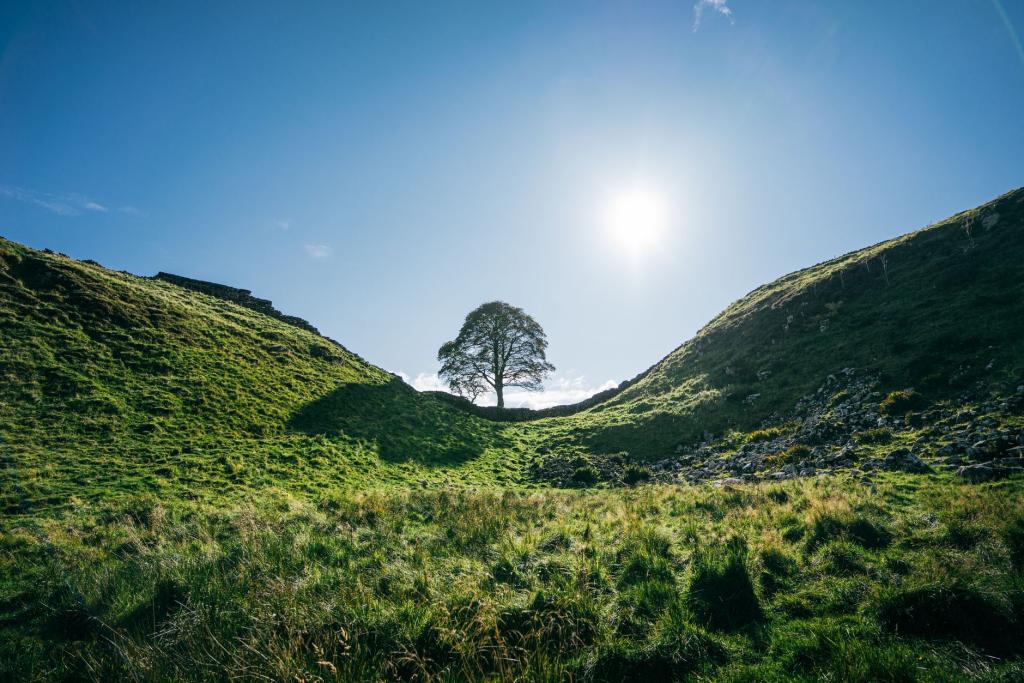
Three years after the Sycamore Gap tree was cut down in the middle of the night, the famous stump is pushing out new growth. Leafy shoots are now sprouting around the base of the stump near Hadrian's Wall, forming a thick ring that stands a couple of feet tall. The site is fenced off to keep visitors at a distance while the regrowth settles in. It is the first real sign that the Sycamore Gap tree, one of England's most photographed landmarks, might come back.
Andrew Poad, the National Trust's general manager at Hadrian's Wall, told the London Times he was "filled with hope by the way nature is taking its course," according to Smithsonian Magazine. The conservation charity has reduced soil compaction around the roots and kept human disturbance to a minimum, and Poad says those measures are paying off. Rangers will watch the stump closely and manage it based on how it develops.
The night the Sycamore Gap tree came down
For well over a century, the Sycamore Gap tree stood in a dip in the rolling landscape of northern England, a lone silhouette between the hills. It appeared in the early-nineties Robin Hood film and was named England's tree of the year nearly a decade ago. On the morning of September 28, 2023, a farmer found the tree felled by a chainsaw. Its crown had landed partly on Hadrian's Wall, and archaeologists later found that the fall damaged the ancient Roman fortification.
Police investigators built their case from cellphone location data, call records, traffic camera footage, and a nighttime video of the cutting. They zeroed in on Daniel Graham and Adam Carruthers, who were convicted of criminal damage last year at Newcastle Crown Court. Prosecutors called the felling "mindless thuggery" and argued the pair cut down the Sycamore Gap tree for "a bit of a laugh." Both men were sentenced to more than four years each in prison. Earlier this year, Carruthers was released early and will serve the rest of his sentence at home under strict conditions.
The felling drew grief from far beyond Northumberland. People left flowers at the fence, and thousands shared photos of their own visits to the dip. That reaction was why the recovery effort mattered beyond the stump itself. The National Trust says the site will stay protected while the stump works out what it can do. For now, the shoots get the sun they need, and the stump gets left alone.
A comeback measured in decades
Nobody is pretending the stump will look like the old Sycamore Gap tree any time soon. The Times noted it will be a long time before the site regains its previous majesty, according to Smithsonian Magazine. Still, the stump has an established root system, and a living root crown can do things a seedling cannot. Rangers at the site are in no rush; the plan is to let the shoots grow and thin or shape them only if needed.
The tree's legacy has already been preserved elsewhere. The largest section of the felled trunk is on display at the Sill: National Landscape Discovery Center in Northumberland National Park, as the centerpiece of an exhibition called "Sycamore Gap: Coming Home." The exhibit includes benches and curved wood pieces inscribed with phrases like "old friend" and "from this land." Seeds recovered from the tree were raised into saplings, and a sapling was handed out for every foot of the Sycamore Gap tree's final height, with communities across the United Kingdom each receiving a tree to plant.
Recovery stories like this are rare but not unheard of. Scientists keep finding that trees run more of their own repair machinery than older models assumed. Southern Hemisphere pines, for example, have a sense of their own shape that straightens bent stems, and researchers in the United Kingdom are priming young oaks to defend themselves against disease. Trees also need help when the climate turns against them, as heat-stressed coast redwoods show. For the Sycamore Gap tree, the best medicine right now is simply time, space, and people staying on the other side of the fence.
Comments 0
No comments yet. Be the first to share your thoughts!
Leave a comment
Share your thoughts. Your email will not be published.