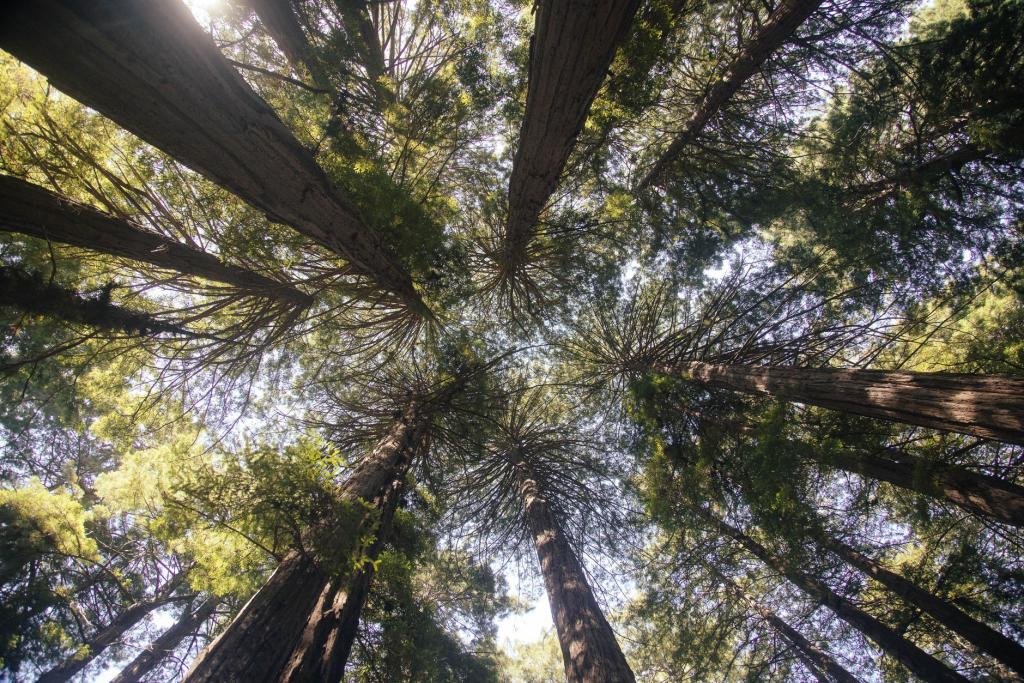
A team at UC Davis has found that coast redwood heat stress does something counterintuitive to the world's tallest trees: it slows the very process that feeds them. When temperatures spike, the giants throttle back photosynthesis, the chemical reaction that turns sunlight, water and carbon dioxide from the air into carbon the trees use to grow. It is as if coast redwood heat stress makes the trees slow their breathing and, as a result, their eating.
The findings come from the first study to measure heat's effect on coast redwood photosynthesis directly, according to the researchers. Led by Lily Klinek, a PhD candidate in the Plant Optics Lab in UC Davis's Department of Plant Sciences, the team took measurements over three summers in a redwood forest in Mendocino County. The paper was published in the Journal of Geophysical Research: Biogeosciences.
Leaves running hotter than the air
Coast redwoods are used to cool, foggy coastlines where the average temperature sits around 59 degrees Fahrenheit. But during the summers of 2022 and 2024, air temperatures in the study forest topped 86 degrees Fahrenheit, and heat waves pushed past 100 degrees Fahrenheit. Some leaves measured nearly 20 degrees Fahrenheit warmer than the surrounding air. The UC Davis team tracked coast redwood heat across field seasons with canopy sensors and lab measurements.
That gap is a sign of stress. Under coast redwood heat, the trees close their stomata, the tiny mouthlike pores that take in carbon dioxide. Shutting those pores saves water but also chokes off the carbon dioxide photosynthesis needs, so the growth engine slows. Leaves that cannot cool down keep getting hotter, which deepens the shutdown.
Sweating, until the water runs out
Trees can cool themselves through evapotranspiration, essentially sweating out stored moisture through their stomata. According to the study, Klinek compared it to how people sweat to stay cool. Coast redwood heat stress complicates that trick twice over: rising air temperatures burn off the coastal fog these trees depend on for much of their water, so there is less moisture to spend.
The large gap between air and leaf temperatures suggests leaves closed their stomata to avoid losing precious water and overheated as a result, the researchers explained. To test whether water was the whole story, the team brought redwood branches into the lab and stood them in jars of water so the leaves could sweat freely. They then measured photosynthesis at temperatures up to 110 degrees Fahrenheit.
Even with water available and stomata open, photosynthesis still fell. That result shows coast redwood heat impairs the process itself, not just through water shortage. It separates the direct effect of heat from the indirect effect of drought. Heat alone degrades the machinery, which means watering or wetter years may not fully fix the problem.
Some parts of the range face more risk
The researchers say the findings are most worrying for redwood stands in the central, southern and eastern parts of the tree's range, which are already considered vulnerable. The study does not yet say where the breaking point is. "We don't know what the upper temperature thresholds are for redwood photosynthesis and mortality," Klinek said. She described the work as an important start toward figuring out which parts of the redwood range are at risk, what to expect, and how to intervene for the health of redwood ecosystems. Mapping where coast redwood heat stress hits hardest will take more field seasons, since the fog belt that buffers the trees varies ridge by ridge.
The result complicates a simple story about trees and climate. Planting and preserving forests is often framed as a straightforward way to pull carbon from the atmosphere, but recent conifer research has found trees behaving unexpectedly under new conditions, as pines in the Southern Hemisphere grow far faster than those back home, and heat extremes keep climbing alongside events like the record-tying super El Nino. Whether forests hold up as carbon sinks depends on how individual species handle heat, and how coast redwood heat affects other forest processes, one at a time.
For the world's tallest trees, the first direct heat test is not reassuring. When coast redwood heat stress arrives, the giants slow their breathing and wait it out. The full study is available at the journal's page for the paper, and Phys.org covered the findings in full.
Comments 0
No comments yet. Be the first to share your thoughts!
Leave a comment
Share your thoughts. Your email will not be published.