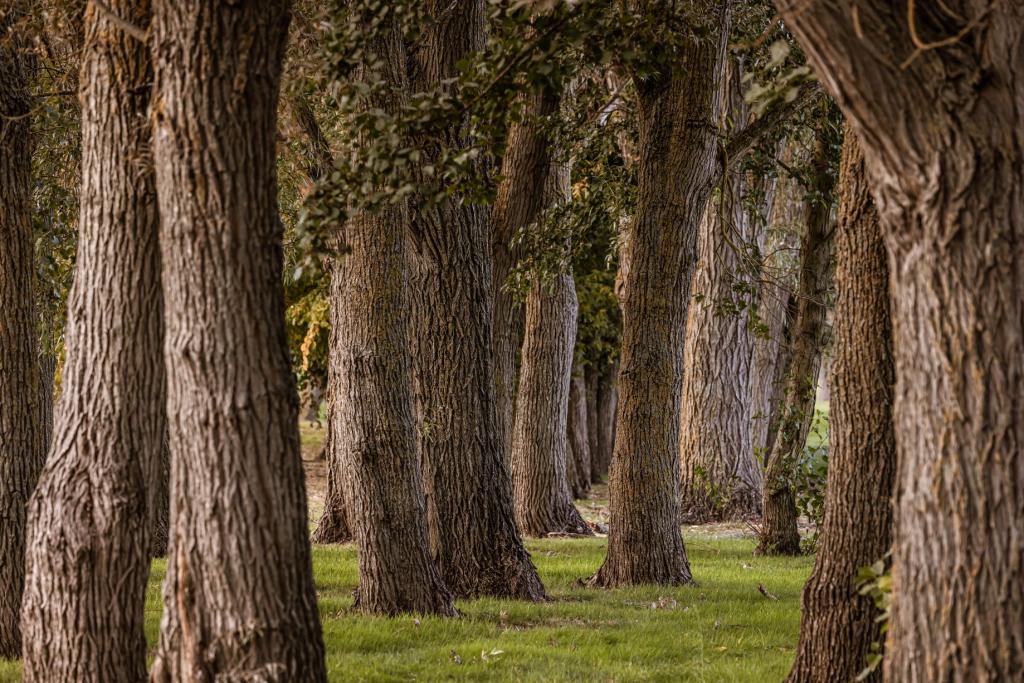
Your houseplant knows more about its own body than you thought. A team of French scientists has shown that trees can sense the curve of their own stems and fix it, producing a special kind of wood that works like opposing muscles to pull the trunk back upright. The findings, published September 2 in the journal New Phytologist, settle a question biologists have been circling for over a decade.
Trees can feel their own shape
Proprioception is the sense that tells your brain where your limbs are without looking at them. For a long time, scientists assumed it belonged only to animals. In 2012, researchers at INRAE, the French national institute for agriculture, demonstrated that plants have their own version of it: they can perceive the shape of their stems and use that information to grow straight.
But nobody knew the biological machinery behind that ability. The new study, led by INRAE and the University Clermont Auvergne, finally names the mechanism. According to the researchers, tension wood, a specialized tissue that generates powerful forces inside a growing stem, is the tree's proprioception muscle, the tissue that turns the plant's body awareness into physical movement.
To isolate this sense, the team designed an experiment that was elegant in its cruelty. They took young trees with deliberately bent stems and placed them in a setup that blocked their ability to sense light and gravity. In other words, they stripped the trees of every orientation cue except one: the perception of their own curvature. Cut off from the signals plants normally rely on, the trees still corrected themselves.
The trees responded by forming tension wood on one side of the stem, then switching to the other side, in a pattern the researchers describe as strikingly similar to the opposing muscle pairs in animals. Within a few weeks, the bent stems had realigned. "What we have uncovered is a genuine sensorimotor loop operating in the woody parts of trees!" said Bruno Moulia, research director at INRAE, in a statement. Poor coordination in this system, he added, creates excessive internal tension that can affect the quality of the wood.
Why a tree's posture matters
Under natural conditions, trees blend information about their own shape with signals from light and gravity to decide how to grow. That combination is what keeps a forest full of vertical trunks rather than a tangle of fallen stems. It also matters when things go wrong. Storms, landslides, and heavy snow can knock a tree sideways, and its ability to recover depends on how well it can sense and correct its posture. The researchers note that this kind of resilience is only becoming more valuable as extreme weather becomes more common.
The discovery has practical implications too. Moulia said the findings could redirect applied research toward improving wood quality and producing trees that stay straight and relaxed regardless of what life throws at them, since the same tension that straightens a trunk can make timber harder to work with when it goes wrong.
Beyond the forest, the work opens up a new trait for plant breeders: the proprioception muscle itself. Selecting cultivated plants for a better sense of their own posture could help fight lodging, the problem where cereal crops like wheat topple over in wind or rain and ruin harvests. "Revealing the remarkable capabilities of trees requires a great deal of ingenuity," said Félix Hartmann, an INRAE research engineer. "In this project, we achieved it by bringing together researchers from different disciplines, with complementary skills and perspectives. This requires time and perseverance, but these interdisciplinary discoveries show that the effort is worthwhile."
It is the latest in a run of recent plant breakthroughs, from the first European ash pangenome that could save trees to the new baobab species found hiding in Madagascar and fossil flowers preserved in amber from 15 million years ago.
The study, titled "Proprioception drives tension wood formation for autotropic straightening and postural control in trees" by Alexandre Caulus and colleagues, was supported by the French space agency CNES and the IRC-SAE, part of the I-SITE CAP20-25 programme. Read the full paper at New Phytologist, and coverage of the announcement at Phys.org.
Comments 0
No comments yet. Be the first to share your thoughts!
Leave a comment
Share your thoughts. Your email will not be published.