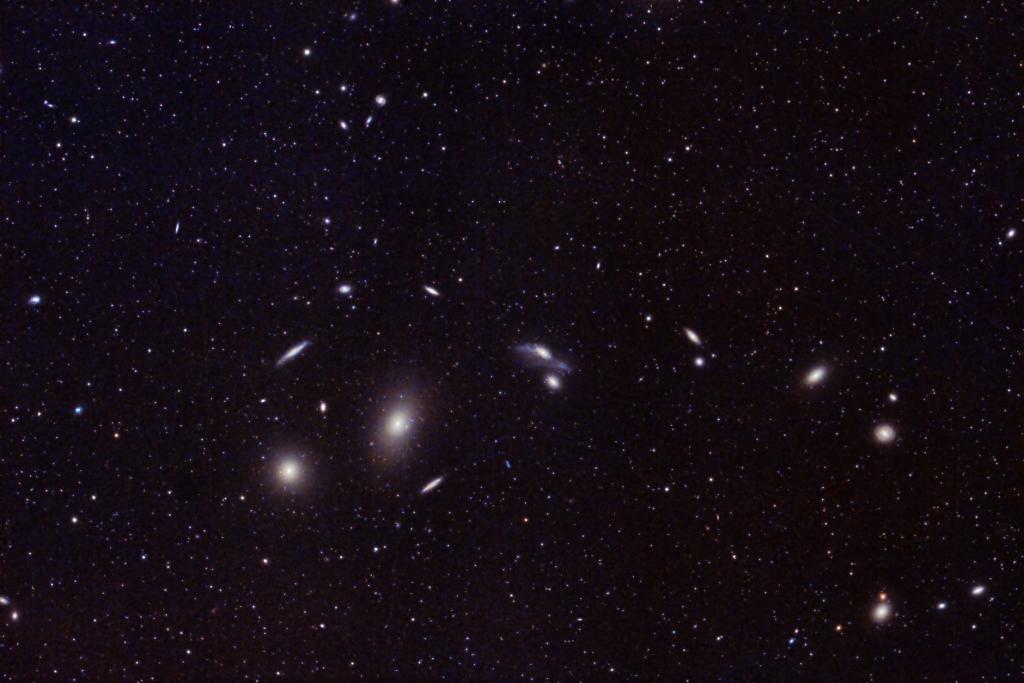
The NASA Deep Field Mission RXDF just became the most ambitious baby-picture project in astronomy. A team of more than a hundred researchers from sixty-two institutions has won nearly four hundred hours of observing time on the agency's newest flagship telescope to map the universe's earliest chapters — the stretch when the first galaxies, stars and black holes switched on. The survey, called the Roman eXtreme Deep Field, will go wider and deeper than any comparable campaign, chasing light that has been traveling for most of cosmic history.
The international collaboration is led by Haojing Yan, a professor of physics and astronomy at the University of Missouri, and it brings together NASA, Caltech, Princeton and Harvard, according to Phys.org. The team earned one of the largest time awards on the new observatory, a sign of how much weight the space agency puts on deep-field science. Their target is the period astronomers still understand least: the first few hundred million years after the Big Bang, when the cosmos went from hot fog to structured galaxies.
One wide shot does the work of hundreds
The trick is the camera. Roman's 300-megapixel infrared instrument covers a patch of sky in a single exposure that would take the James Webb or Hubble observatories hundreds of separate shots to assemble. That turns a classic trade-off — deep or wide, pick one — into something new: depth and breadth at once. Instead of studying a tiny postage stamp of the early universe, astronomers can look for patterns across a much larger landscape.
With that real estate, the team plans to census thousands of early galaxies and trace how quickly they formed stars and assembled into larger structures. They will hunt supernovae from the universe's first generations of stars and take on one of astronomy's biggest puzzles: how giant black holes grew so fast in the infant cosmos. The sheer volume of objects is the point — with thousands of examples, researchers can finally tell whether the strange things Webb has been spotting are freaks or the norm.
The little red dots get their census
Then there are the little red dots. Webb's most baffling finds — compact, distant objects that nobody can fully explain yet — could finally get a statistical treatment if Roman's wide net scoops up enough of them. The survey could also turn up things nobody planned for. "Historically, the most revolutionary outcomes from these deep-field observational campaigns over the last 30 years have been discoveries that were not part of the original plans," Yan said. "That's what makes a data set of this scale so exciting and valuable."
The catch: the plan is still a preprint
One note of caution before anyone treats the target list as settled science. The mission design is published as a preprint on arXiv, which means it has not yet passed peer review. Schedules can also shift: Roman only launched in late August and is still settling into its observing post about a million miles from Earth. Even so, the team argues that no other planned survey combines this depth with this much sky, and the award of hundreds of hours suggests NASA agrees.
The NASA Deep Field Mission also arrives at a telling moment for cosmology. Webb keeps finding galaxies that look too big, too early — objects that formed far sooner than textbook models allowed. If those turn out to be typical rather than exceptional, the story of how structure formed in the young universe gets a rewrite. "By stretching today's instruments to their limits, we can help pave the way for future generations to build even more capable observatories," the mission's lead scientist said, describing the work as part of understanding humanity's place in the cosmos.
For skywatchers, the payoff will take patience: deep-field data usually yields its biggest surprises years after the pixels arrive. But the bet behind the NASA Deep Field Mission is simple — when you photograph enough of the young universe at once, the patterns reveal themselves. Roman already saw starlight for the first time this fall, as GenZ NewZ reported when the telescope captured its first starlight, and the observatory's targets keep stacking up, from the failed stars being read by SPHEREx to the batteries being built for the Moon's deep freeze.
Comments 0
No comments yet. Be the first to share your thoughts!
Leave a comment
Share your thoughts. Your email will not be published.