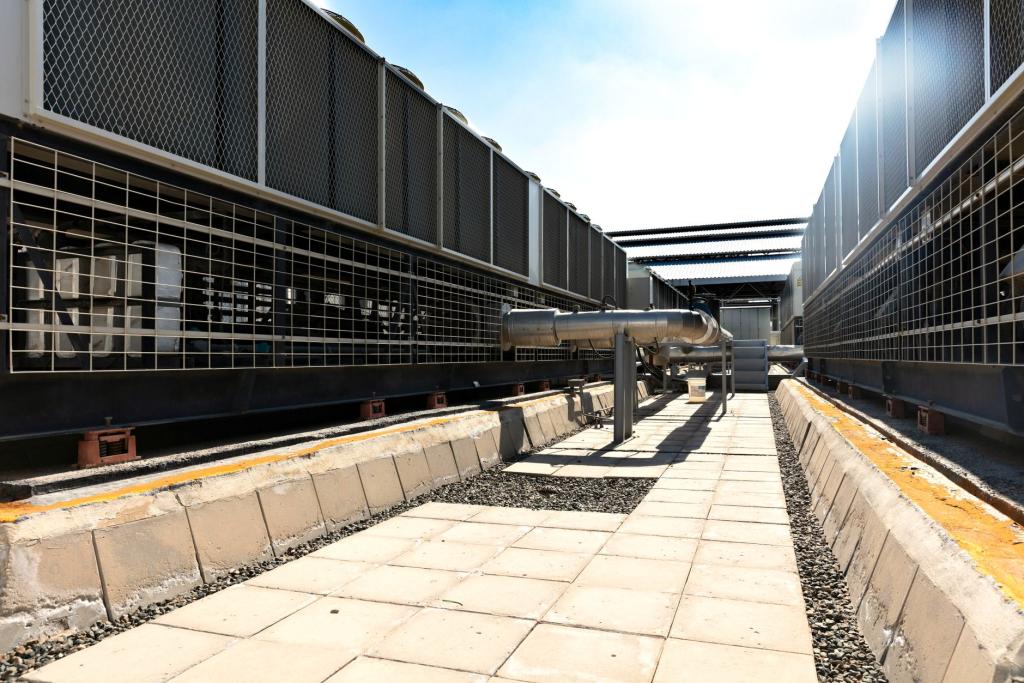
On a flat stretch of former ranch land outside Odessa, Texas, an oil company is building one of the strangest sights in American energy: a 65-acre plant designed to vacuum pollution straight out of the sky. It is called Stratos, and if its operator's timeline holds, Direct Air Capture is about to get its first real-world stress test at an industrial scale. The plant was supposed to start running two years ago, then again this summer, and now the target is the end of this year, with full operations in the new year.
The stakes go well beyond one facility in West Texas. Scientists widely say that pulling carbon dioxide back out of the atmosphere will be necessary to slow climate change, even alongside deep cuts to emissions. Right now the entire industry removes only a trickle. Stratos was built to change that in a single leap, and whether it delivers or stumbles will shape what the technology's skeptics and its believers claim next.
A Machine the Size of a Small Neighborhood
Stratos is the flagship of a joint venture between the energy firm Occidental and the asset manager BlackRock, constructed on a site in Ector County in the Permian Basin. According to E&E News, which covered the company's August earnings call, the project has been under construction since the spring of 2023 and was originally slated to begin operations at the end of 2024. After a string of commissioning setbacks, Occidental now expects full commissioning around the close of 2026, with the transition to operations in 2027.
The design numbers are ambitious. Phase 1 alone has 30 air contactors the size of small buildings, scrubbing air with potassium hydroxide chemistry, feeding kiln-temperature calciners, and sending the captured gas through a four-kilometer pipeline to three permitted injection wells sunk a mile underground. At full capacity the facility is designed to strip up to 500,000 metric tons of carbon dioxide from the air each year. That would make it the largest carbon removal plant on Earth by a wide margin, roughly fourteen times the size of the next-biggest facility.
That next-biggest facility is Mammoth, a Climeworks plant in Iceland that can nominally remove 36,000 tons per year. But nominal capacity and delivered carbon removal are very different things, and the gap between them is the heart of this story.
The Math Nobody Can Agree On
According to a forensic industry analysis published this year, Mammoth captured an annualized gross rate of about 750 tonnes across its first ten months, which works out to roughly two percent of nameplate capacity. After subtracting the emissions embedded in its own supply chain, verified net removal fell to around 105 tonnes. Those figures, if representative, suggest that the flagship of Direct Air Capture has so far performed like a demo plant wearing a commercial uniform.
There is also the cost question. Construction of Stratos ballooned from an initial estimate below a billion dollars to a reported one point three billion, a figure that analysts say pins theoretical removal costs around six hundred dollars per ton. That number only pencils out with the help of a federal tax credit for captured carbon, according to energy economists who track the sector.
Climeworks, for its part, says the performance picture is improving. The company announced in September that sorbent and mechanical upgrades have more than doubled real-world capture in upgraded collector containers at Mammoth, while cutting the operating cost per ton by more than half over the past year. Two upgraded containers ran the new design for over six months and hit the plant's original design rate at peak output, something the facility had never managed in real-world operation.
Why a Buyer Already Paid Up
The demand side of the market arrived before the supply did. In 2024, Microsoft signed what was then the largest direct air capture purchase ever, agreeing to buy removal from Stratos spread over six years, explicitly conditioned on the carbon going into permanent saline storage rather than into oil wells. It was a vote of confidence from a company with a net-zero promise and few other ways to erase its residual emissions.
Occidental's chief executive, Richard Jackson, told investors on the August earnings call that the company is positioning itself to offer carbon capture services to data centers and power plant operators. "We're excited and have positioned ourselves, I think, to do that," he said, as detailed in a close account of the plant's commissioning history, adding that the company cannot keep investing in low-carbon projects without regulatory support or corporate buyers.
That tension between ambition and economics is the thread to watch. The company's stated ambition stretches to a hundred similar plants by the mid-2030s, but each one is a billion-dollar bet on a market that barely exists yet. The critic's case is blunt: an oil major building machines to bury its own industry's exhaust looks less like a climate plan than a very expensive permission slip. The supporter's case is equally blunt: every technology that got cheap started expensive, and something has to be the first plant through the wall.
For Gen Z readers, the stakes are concrete rather than abstract. If Direct Air Capture works at scale and costs fall, it becomes one more lever for holding warming in check during your working lifetime. If it keeps missing its timelines and budgets, the money and attention it absorbs could have gone to cheaper tools like wind, solar, and batteries, which already deliver. The next twelve months in Texas will say a lot about which story turns out to be true.
For another angle on large-scale fixes that actually reached people, see how a hands-on method brought bleached reefs back to life in weeks, and for more moonshot-scale engineering, our story on batteries built to survive the Moon's deep freeze.
Comments 0
No comments yet. Be the first to share your thoughts!
Leave a comment
Share your thoughts. Your email will not be published.