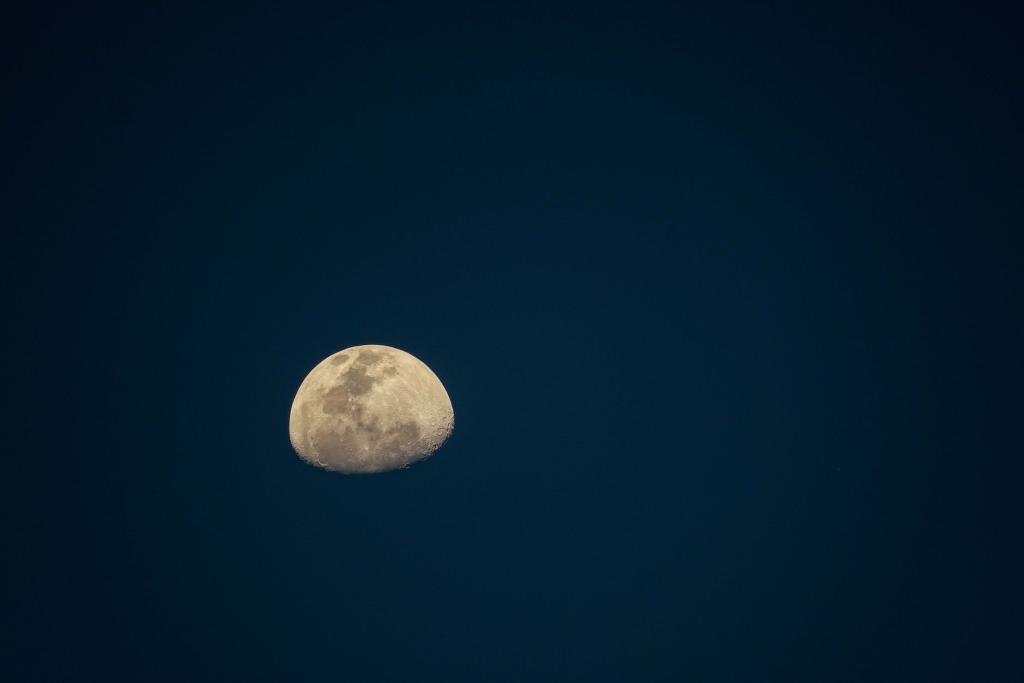
The Moon's far side is often called the “dark side,” but that nickname confuses what people on Earth cannot see with what the Sun can illuminate. The hemisphere turned away from Earth is not sealed in night: as the Moon travels through its orbit, sunlight reaches its far side as well as its near side. The lunar geography turned toward Earth stays broadly fixed, even as sunlight shifts across both hemispheres. According to NASA’s answers to common Moon questions, the far side gets as much sunlight as the near side. The apparent puzzle unravels once three different ideas are separated: rotation, phases and the far side itself.
Why Earth sees nearly the same hemisphere
The Moon rotates on its axis and takes almost exactly as long to complete one spin as it takes to circle Earth, a relationship known as synchronous rotation or tidal locking. According to NASA’s explanation of tidal locking, the motion is like a dancer circling a partner while keeping a face turned toward them. As the Moon advances along its orbit, it also turns by the matching amount; without that spin, the Moon would present different longitudes to Earth as it orbited. With the spin synchronized, one hemisphere remains the familiar near side and the opposite hemisphere is the far side.
That alignment is not a cosmic trick in which one side never moves. Rather, the Moon completes one rotation during one orbit, so its orientation relative to distant stars changes even though the same broad face points toward Earth. According to NASA’s Moon facts page, the orbital and rotation periods are each about 27 Earth days. The interval between successive new Moons is longer, about 29.5 days, because Earth and Moon are also moving together around the Sun; after one orbit, the Sun-Earth-Moon geometry has not quite returned to its starting arrangement. The difference between those periods is a useful clue: “how long to orbit Earth?” and “how long until the same phase repeats?” are related but not identical questions.
“Far side” is a geographic description: it means the hemisphere generally turned away from Earth. It does not mean a place that receives no sunlight. The Moon has day and night as it rotates, just as Earth does, and sunlight sweeps across lunar terrain over time. When the near side is largely night, the far side may be in daylight; at another point in the cycle, the balance changes. The day-night boundary, called the terminator, moves across the globe rather than respecting the line between the visible and hidden hemispheres.
Phases describe light, not geography
A Moon phase describes how much of the Moon’s sunlit half appears from Earth. The Sun illuminates roughly one half of the lunar globe at a time; as the Moon orbits, the angle between the Sun, Moon and Earth changes, making the visible disk look new, crescent, quarter, gibbous or full. According to NASA’s Moon phases guide, about half the lunar globe is illuminated at a time except during a lunar eclipse; changing viewing geometry determines how much of that lit half appears from Earth. Phases are therefore not caused by Earth’s shadow in ordinary weeks. Earth’s shadow crosses the Moon only during a lunar eclipse.
The far side also has phases. From a viewpoint on that hemisphere, the Sun’s angle changes through a complete cycle just as it does for observers on the near side. From Earth, a new Moon occurs when the near side faces away from sunlight and appears dark, while much of the far side faces the Sun. At full Moon, the near side faces the Sun and shines toward Earth. Neither phase changes which lunar terrain is called the far side; a phase is the lighting pattern visible on the Earth-facing disk, not a name for a different half of the Moon.
This distinction explains a common visual illusion. At a crescent Moon, the bright sliver can look like the only part of the Moon receiving sunlight, but the rest of the globe has not disappeared into permanent darkness. The near side outside the crescent is in lunar night, while the Moon’s far side is generally exposed to the Sun. At full Moon, the view is nearly the reverse: the near side is bright, and the far side is largely turned away from the Sun. The boundaries between daylight and night move; the near-side/far-side boundary, defined by the view from Earthpoint, remains broadly tied to Earth.
Libration offers a changing peek around the edge
Earth observers do not see precisely the same outline of the lunar hemisphere at every moment. The Moon’s orbit is slightly elliptical, so its orbital speed changes over the month, while its rotation rate remains steady. Its tilted orbit also shifts the viewing angle from Earth. Those small apparent nods and sways are called libration. According to NASA’s description of the Moon’s “wobble”, that libration lets observers glimpse a little more of the eastern or western limb at different times, and slightly more of the northern or southern regions as the viewing angle changes.
Across time, these shifts add up: observers on Earth can see about 59 percent of the lunar surface, rather than just the exact 50 percent that would be visible from a perfectly fixed viewing geometry. NASA Goddard’s libration explainer reports that up to 59 percent can be observed, while cautioning that details near the edge are difficult to make out because the line of sight is very slanted. This is cumulative coverage, not a single view in which more than half the Moon is visible at once. Libration reveals narrow strips just over the apparent limb; it does not expose the whole far side to Earth-based observers.
Spacecraft changed the story from one of glimpses to global mapping. According to NASA, the Soviet Luna 3 probe returned the first handful of grainy far-side images in 1959; later, NASA’s Lunar Reconnaissance Orbiter produced detailed maps. In its visualization of the Moon from the other side, NASA notes a striking surface contrast: the far side has fewer of the broad, dark volcanic plains called maria that shape the familiar “Man in the Moon,” while impact craters crowd much of its terrain. Those features offer one reason the far side is scientifically compelling: it is not just a hidden copy of the face the well-known, but a distinct landscape whose ancient record can be mapped and compared.
Some crater floors receive little direct sunlight
Some lunar terrain receives little or no direct sunlight for long periods. Deep polar crater floors can be blocked from the Sun by their rims because its path stays low over the horizon. According to NASA’s account of lunar water and ice, some crater bottoms receive no direct sunlight and explains why they can preserve water ice. These cold traps are not another name for the far side: “far side” identifies a hemisphere by its direction from Earth, while a crater-floor shadow identifies a site by its sunlight conditions and terrain. The two ideas answer different questions—where a location lies relative to Earth, and whether sunlight reaches it directly.
That distinction matters because it prevents one memorable phrase from distorting the science. Much of the far side experiences lunar daylight, and some shadowed polar terrain exists because crater rims block the low Sun, not because Earth cannot see the area. NASA’s overview of Earth’s Moon brings phases and lunar exploration together; its imagery and mission maps make it possible to look beyond the old “dark side” label. The Moon's far side is hidden from a steady Earthbound view, but it receives daylight at different points in the lunar month.
Comments 0
No comments yet. Be the first to share your thoughts!
Leave a comment
Share your thoughts. Your email will not be published.