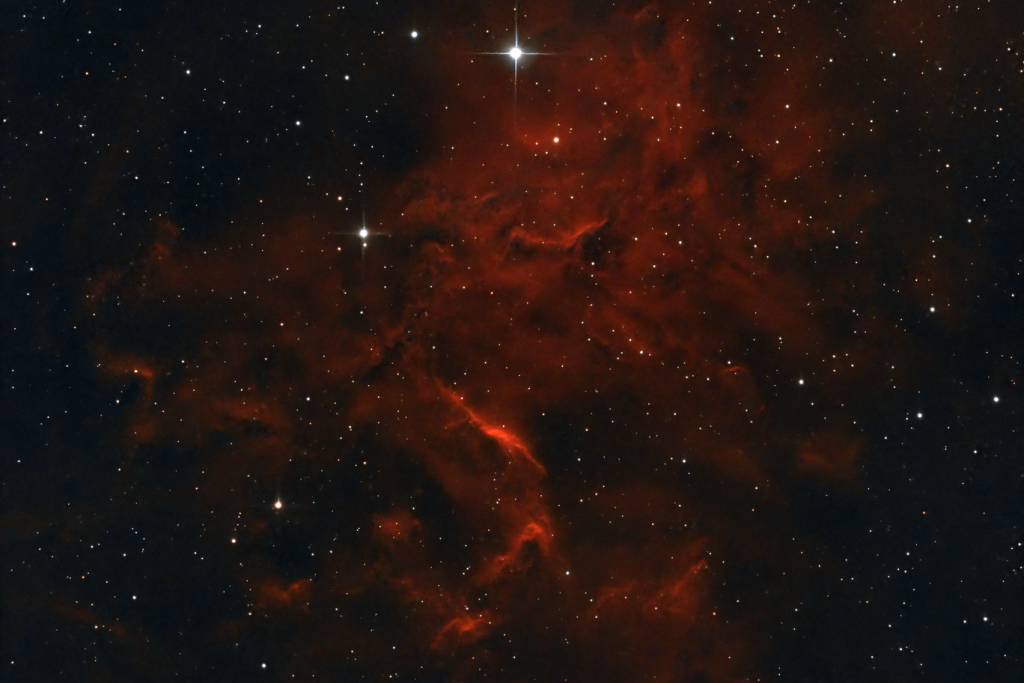
Astronomers are reading the Fingerprints of Failed Stars spread across the night sky, and the new readings look stranger than the textbooks predicted. A NASA space telescope called SPHEREx has taken the most detailed infrared measurements yet of brown dwarfs, the in-between worlds that never quite became stars, and found atmospheres richer in chemistry than many computer models expected.
Brown dwarfs have been spotted from Earth since the 1990s, but they remain some of the least understood objects in the sky. They form from collapsing clouds of gas, much like ordinary stars do, yet they never gather enough mass to ignite hydrogen fusion in their cores. The result is a dimly glowing ball of warm gas that shares characteristics with giant planets, but drifts through darkness unbound to any host star and heated entirely from within.
The new findings, published in a major astrophysics journal on October 8, 2026, come from the telescope's observations of thirty-seven nearby examples spanning the full temperature range of these objects, from roughly twenty-two hundred degrees Celsius down to about minus twenty. SPHEREx measured each object's brightness in one hundred two different colors, stretching from the deepest red the human eye can see into the invisible heat of infrared light. Those measurements revealed chemically rich atmospheres harboring water, carbon dioxide, carbon monoxide, and methane, according to NASA's announcement.
When the models miss
The most interesting part of the result is not what the telescope saw, but what the theories could not explain. The research team compared the new spectra against five leading atmosphere models, and none of them matched the data cleanly. As these objects cool, their exotic silicate clouds sink and methane takes over, and the models struggled to reproduce those cloudy transitions.
"The state-of-the-art models are capturing the general chemical trend, but when it comes to these cloudy transitions, the models are struggling to match the data," the study's lead author, Zafar Rustamkulov of Caltech's IPAC science and data center, told NASA. "No two brown dwarfs are alike. Even at the same temperature, their spectra look quite distinct."
The mismatch has practical consequences. Astronomers lean on the same modeling tools to estimate the size, mass, and age of distant worlds, including exoplanets. One independent analysis of the data found some models compensating for bad chemistry by predicting sizes that were physically unrealistic. Fixing the models on brown dwarfs, which can be studied without the glare of a host star, should sharpen what scientists infer about planets they can barely see.
A sky survey pulling double duty
Reading brown dwarf atmospheres was never the telescope's main job. SPHEREx, which launched in March 2025 and is managed by the agency's Jet Propulsion Laboratory in Southern California, was built to map the entire sky and chart how hundreds of millions of galaxies are distributed across the cosmos, a measurement that probes the first fractions of a second after the Big Bang. It takes thousands of unique images every day to stitch those maps together, and while scanning it also hunts for the chemical ingredients of life and interstellar ice that could seed oceans on faraway worlds.
Brown dwarfs simply turned out to be excellent hitchhikers. Only a few dozen of these dark wanderers had ever been studied in detail with space telescopes, because they are faint and best seen in infrared wavelengths that Earth's atmosphere mostly blocks. From orbit, the observatory catches light that ground telescopes cannot, and its wide survey is now imaging thousands of the objects for the first time in this rich part of the spectrum.
"Our paper concentrated on just three dozen, but we have thousands more that we are in the process of analyzing," coauthor J. Davy Kirkpatrick, also of the Caltech data center, told NASA. "I really want to see what bounds the universe places on the variety of brown dwarfs."
The team describes its next phase as accidental meteorology: learning to forecast weather on worlds where clouds are made of rock minerals and the skies rain methane. The full dataset is freely available to scientists and the public, so the Fingerprints of Failed Stars will keep getting read long after the first paper. For readers who follow cosmic imaging, GenZ NewZ has also covered a supernova remnant's pearls of gas and Japan's mission to grab a piece of a Martian moon.
Comments 0
No comments yet. Be the first to share your thoughts!
Leave a comment
Share your thoughts. Your email will not be published.