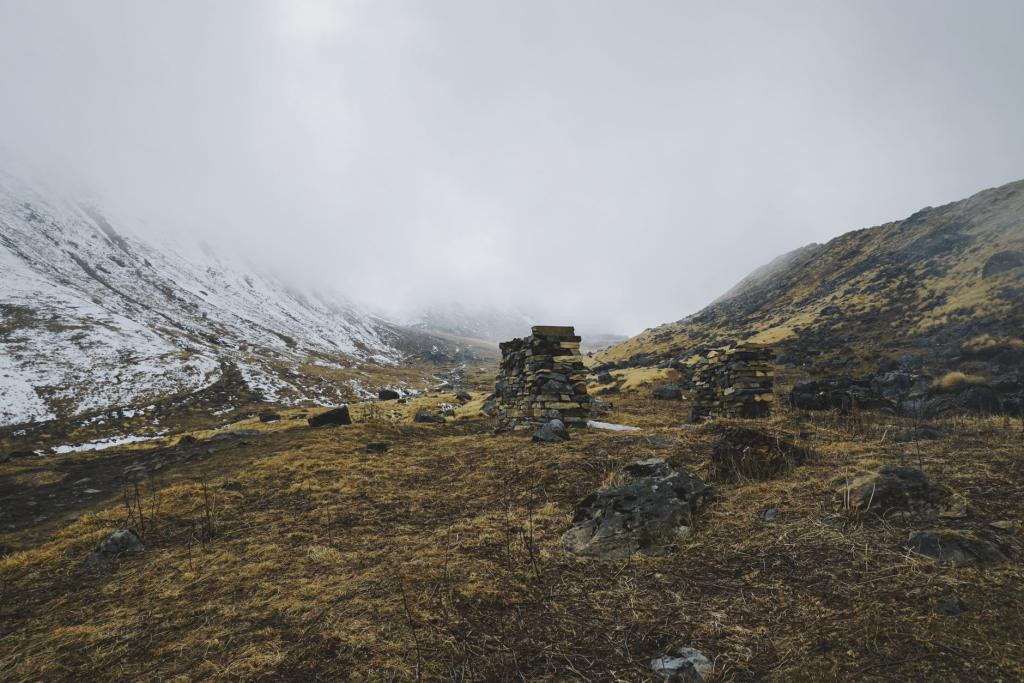
A Base Camp older than the pyramids just rewrote the story of the first Americans. On a windswept bluff overlooking the Tanana River Valley in interior Alaska, archaeologists have uncovered a 13,800-year-old settlement containing the oldest known dwelling in the Western Hemisphere — and possibly the bones of the earliest domesticated dogs in the Americas. The site, called Shég' Xdaltth'i' — pronounced roughly "shehg xuh-tuhl-TTH'EE" and meaning "they were there" in the Alaska Native Athabascan language — was used by some of the first people to settle North America, on and off, for a thousand years.
The findings, published in the journal Science Advances by a team led by the University of Kansas, are staggering in scale. Researchers recovered more than eighty thousand artifacts and fossils from the camp, and radiocarbon dating revealed three distinct occupation layers: one from about thirteen thousand eight hundred years ago, another from thirteen thousand years ago, and a third from twelve thousand seven hundred years ago. The camp sits on a small ridge some thirty-four miles southeast of Fairbanks, in a region that was once part of the Bering Land Bridge connecting Asia to North America.
Kelly Graf, the study's first author and a professor of anthropology at the University of Kansas, said she had not expected to stumble into a base camp with tens of thousands of artifacts.
What the First Americans Left Behind
The heart of the discovery is an oval dwelling with a hearth and an earthen oven — the oldest formal home ever found anywhere in the Americas. Discarded bones around the hearth show the inhabitants dined on mammoths, birds, hares and other animals. Some bones had been worked into fine sewing needles and awls, tools for stitching animal hides into clothing warm enough for Ice Age winters. Those needles are the oldest of their kind documented anywhere on the continent.
The camp also held an antler pendant, pigment that may be decorative red ochre, and a canid jawbone. That last find could be the most consequential: if confirmed as a domesticated dog, it would push back the arrival of dogs in the Americas past the current record, a ten-thousand-one-hundred-fifty-year-old bone from a cave in southeastern Alaska whose DNA proved it belonged to a dog. Because dogs travel with people, their bones serve as proxies for human migration itself.
Why One Camp Changes the Map
The Bering Land Bridge formed about thirty-five thousand years ago and vanished under rising seas around twelve thousand years ago, giving people a window of roughly twenty-three thousand years to cross from Siberia into Alaska. For much of the twentieth century, archaeologists believed the Clovis culture, which appeared about thirteen thousand years ago, represented the first Americans. Since the 1990s, older sites stretching as far south as Chile have dismantled that theory, leaving a messier question: who came first, and by which route.
This camp supplies a rare solid anchor in that debate, and that is why this Base Camp matters more than its artifact count. Most Beringian sites from the era are small seasonal hunting camps; a true base camp with homes, ovens and craft tools shows people were settling in, not just passing through. As Nautilus reported, the stone tools also show cultural connections across the Bering Strait, linking the Alaskan camp to traditions in Siberia. The researchers said the results help clarify how and when people traveled the land bridge from Asia into the Americas, according to The Debrief.
The Team Behind the Dig
The paper was co-written by Graf with fellow Kansas anthropologist Ted Goebel, doctoral student Mia Harbort and undergraduate Mason Sewing, alongside collaborators from the United States and Europe. The collaboration matters because the questions are bigger than one site: whether early Americans waited out the Ice Age in a Beringian standstill before moving south, and how much cultural exchange flowed back across the strait. Graf called it fascinating how people had evolved, and how humble beginnings as hunter-gatherers had led to the present day.
Years of analysis remain. Tens of thousands of artifacts still need cataloguing, the canid jawbone needs confirmation, and the site's connection to other early settlements on both sides of the strait is still being mapped. But one thing is already clear: the people of this camp were not wanderers passing through an empty continent. They built homes, sewed clothes, cooked over hearths, and kept animals close — a full domestic life, nearly fourteen thousand years before the present, at the edge of the inhabitable world.
The discovery continues a run of Ice Age archaeology rewriting American prehistory. Readers can explore a companion story about drowned stone tools off Australia, and the laser scans revealing hidden ship carvings in Cyprus, for more on how new technology keeps finding what the naked eye missed.
Comments 0
No comments yet. Be the first to share your thoughts!
Leave a comment
Share your thoughts. Your email will not be published.