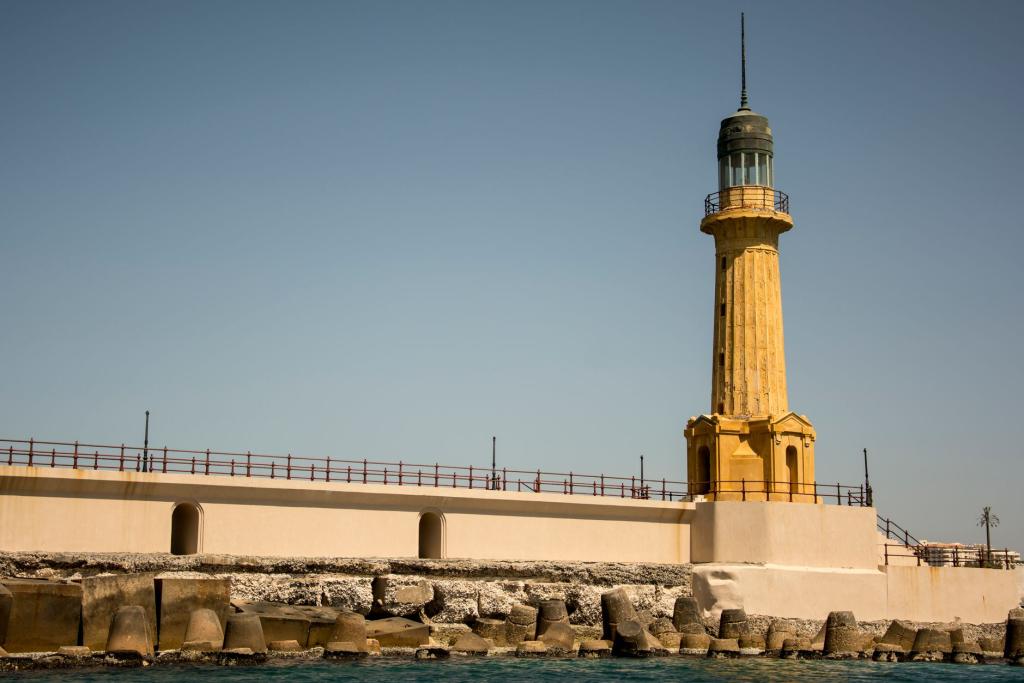
The sea just handed back a tiny piece of metal carrying one of the most famous buildings ever lost. Divers working in Alexandria's eastern harbor have pulled up a bronze signet ring engraved with the Lighthouse of Alexandria, and archaeologists say this Alexandria lighthouse ring is the first of its kind ever found.
The Alexandria lighthouse ring was announced on the seventh of October by the European Institute for Underwater Archaeology, the team led by Franck Goddio that has spent decades mapping Egypt's sunken cities. The find came from the palace site on Antirhodos, a submerged royal island that once belonged to the grandest quarter of Alexandria's great harbor, the Portus Magnus. In the institute's words, the ring is the first of its kind known to exist.
A signet is basically a stamp you can wear. The engraved image pressed into a surface to mark documents or goods, so whoever owned this ring chose the lighthouse as the symbol worth carrying on their hand. According to The Egypt Files' account of the announcement, the relief shows iconography matching depictions of the lighthouse on some second century coins, which points to a Roman era date. One writeup of the find describes it as roughly nineteen hundred years old, and the choice of image on the Alexandria lighthouse ring was personal as well as symbolic: the lighthouse was the emblem of the city itself.
Egypt's antiquities leadership took the discovery seriously enough to come see it in person. Sherif Fathy, the minister of tourism and antiquities, and his assistant Dr Ahmed Rehema boarded the team's research vessel to watch the season's underwater fieldwork and view the ring firsthand. The mission runs with the Egyptian Ministry of Tourism and Antiquities and the support of the Hilti Foundation.
What the ring actually is
To understand why one small ring matters, it helps to remember what it depicts. The Lighthouse of Alexandria, also called Pharos after the island it stood on, was one of the Seven Wonders of the Ancient World. Built in the third century before the common era, it ranked among the tallest human made structures of its time, second only to the Pyramids of Giza. Some estimates put its height between three hundred thirty and four hundred thirty feet. It guided ships for more than a thousand years until earthquakes in the fourteenth century finally brought it down into the sea.
Almost everything modern researchers know about how the tower looked comes from three kinds of evidence: monumental fragments recovered from the water, written accounts, and coin images. The Alexandria lighthouse ring adds a fourth kind of object to the mix, a personal or administrative item small enough to fit on a finger, and it is the only known Alexandria lighthouse ring in existence.
Why a tiny ring says so much about a vanished wonder
Goddio stressed the setting of the find when he announced it. He said the ring signet was "even more important" because it was excavated in "the legendary palace of the Island of Antirhodos, that once was a centre of power." His point about the Alexandria lighthouse ring was that the location gives the object its meaning. The palace was already standing when the Greek geographer Strabo visited Egypt between twenty nine and twenty five before the common era, and the institute argues that the ring shows the palace housed administrative offices at some point, including the administration of the famous lighthouse itself.
Egyptian officials are reading the find the same way. The Wild Hunt reported that Hisham El Leithy, secretary general of the Supreme Council of Antiquities, called it the first known discovery of a seal ring bearing the lighthouse image. He said the artifact may show that the palace complex on Antirhodos kept serving administrative purposes well into the Roman period, long after the Ptolemaic dynasty that built it had fallen. Researchers are also weighing whether the seal had a direct link to the running of the Pharos, though that reading is still a hypothesis rather than a confirmed interpretation.
The ring is not the only piece of the lighthouse coming back into view. Divers have recovered large architectural fragments of the tower from the Mediterranean, and researchers are using them to reconstruct the lost wonder digitally, as this overview of the evidence explains. The Alexandria lighthouse ring now gives those reconstructions something new to work with: an ancient image of the tower made not for a coin or a monument, but for someone's hand.
The digs at Antirhodos are already revealing architectural remains across an area of several thousand square meters, and further excavation could test the administrative theory and pin down more of the ring's story. For now the Alexandria lighthouse ring stands as a small time capsule from a drowned royal quarter, an office stamp carrying the skyline of a wonder that no longer exists. If you want more from the deep end of archaeology, read about the world's oldest shipwreck that just surfaced off Turkey, and for another unearthed burial mystery, see Norway's Neolithic gallery grave.
Comments 0
No comments yet. Be the first to share your thoughts!
Leave a comment
Share your thoughts. Your email will not be published.