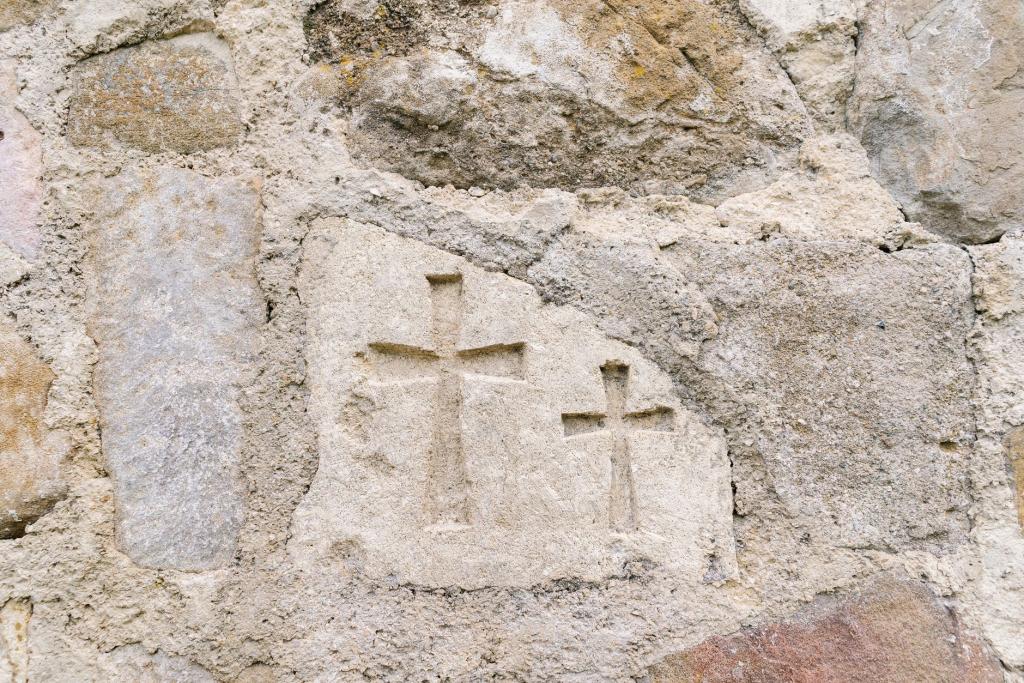
A laser scan of a weathered temple wall in Cyprus has revealed a hidden fleet. Researchers recorded twenty-three previously unknown ship carvings etched into stone at Kition, an ancient city-kingdom on the island's southern coast, more than doubling the number of vessels anyone knew was there. The Cyprus ship graffiti, published this year in the International Journal of Nautical Archaeology, shows that sailors and worshippers kept scratching boats into the same wall for centuries — a habit that survived one of history's most famous civilizational collapses.
The discovery was almost an accident. University of Cincinnati doctoral student Graham Braun and his research partners — Caroline Barnes of the University of British Columbia and Tzveta Manolova of Ludwig Maximilian University — were pointing a terrestrial laser scanner at the temple to document the dressed-stone masonry, not hunting for ships. But once the point-cloud data was processed, hulls, masts and figureheads emerged from stone that weathering had made unreadable to the naked eye, according to the University of Cincinnati. "We certainly didn't expect that there would be so many," Braun said. The result was the first full catalog of the Cyprus ship graffiti, hidden no longer.
A fleet hiding in plain sight
The new survey found the Cyprus ship graffiti depicts six types of vessels, including galleys and merchant ships, some that would have carried imposing animal figureheads, crow's nests and other nautical fittings. Some images are simple curved lines or semicircles; others are far more elaborate, showing masts that could be lowered horizontally and yards, the horizontal arms that hold a sail. A computer analysis of the scans sorted each suspected figure by a confidence level that it was really the handiwork of a carver rather than a random mark or flaw in the stone.
With the new finds, the site now holds forty-three ship images in total. Nineteen were first recorded in the early nineteen eighties, and two more were known from a temple altar. The latest study shows the Cyprus ship graffiti mixes shipbuilding traditions mostly from Cyprus and the Levantine coast, with possible Aegean influence — the first time all of the ships have been fully illustrated, measured, mapped and categorized, the researchers say.
A three-century timeline redrawn
Earlier scholars had treated the carvings as a single Late Bronze Age moment, a snapshot of one era's seafaring. The laser data overturned that. The researchers found evidence the drawings were added at different times, perhaps spanning centuries — one ship sits on a small repair block added to the temple about one hundred and fifty years after the main wall was built, as reported by Archaeology News Online Magazine. The Cyprus ship graffiti now runs from the Late Bronze Age into the Early Iron Age, crossing the Bronze Age collapse that toppled kingdoms across the Eastern Mediterranean.
That continuity is the story's quiet surprise, and it makes the Cyprus ship graffiti one of the longest-running public art projects of the ancient world. Elsewhere around the Mediterranean, cities were being abandoned as trade networks failed and palaces burned. On Cyprus, people kept carving ships. The researchers say the practice of carving ships persisted on the island through later periods too — a parallel experience through time that suggests resilience where textbooks once described only ruin.
It changes how historians should talk about collapse, according to Braun. Rather than treating the period as a total loss of civilization, he argues it was a time of change, when some practices ceased, new ones began, and some — like scratching a boat into a temple wall — simply carried on.
Why a laser beat the naked eye
The wall has been exposed to the elements since excavations decades ago, and the carvings have visibly deteriorated in that time. Lasers caught what eyes could not, and the detailed three-dimensional records now preserve the Cyprus ship graffiti before time erases more of it. The team plans a virtual-reality reconstruction of the temple walls so the public can experience the ships in context rather than as fading scratches.
There is a lesson here beyond archaeology: the same scanning technology behind modern mapping and game design is now rescuing history itself. And the wall may still hold more. The researchers say missing and damaged sections of the temple likely held additional ships, meaning the hidden fleet of Kition — the same Cyprus ship graffiti the team just cataloged — could grow again — a reminder that ancient history is not a finished book, just one we keep learning to read. For more stories from the ancient world, visit The Old World or read about Roman wall paintings resurfacing beside Sicily's ancient assembly hall.
Comments 0
No comments yet. Be the first to share your thoughts!
Leave a comment
Share your thoughts. Your email will not be published.