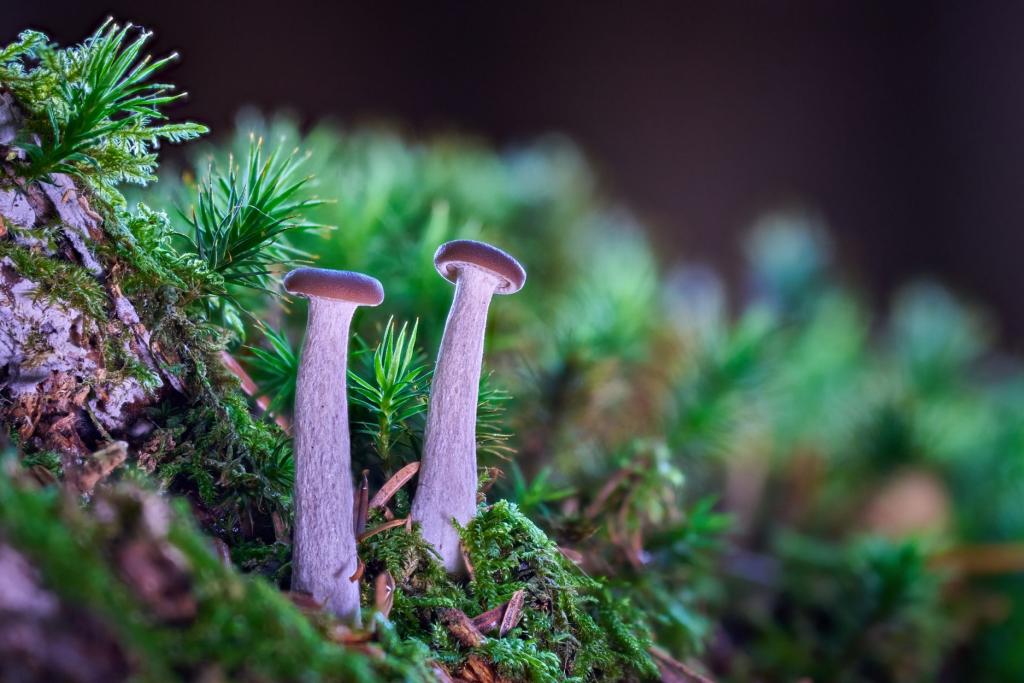
Two New Fungi Found on Thailand's Neem Trees might read like a footnote from a mycology journal. It is not: if you have ever bought a "natural" moisturizer, a plant-based insecticide, or anything marketed as Ayurvedic, you have probably handled neem. The tree, known to science as Azadirachta indica, has spent centuries as one of Asia's most useful plants: its leaves, seeds, and bark yield extracts used in natural pesticides, cosmetics, and traditional medicine. Now, dead branches of neem collected in Chiang Rai Province have given scientists something entirely different — five saprobic microfungi found growing on decaying stems, including a pair of species never before described.
The discovery, published in the journal MycoKeys and reported by Bioengineer, comes from a team that set out to examine a blind spot in neem research. Neem's chemistry has been studied in hundreds of papers, but almost all of the work on its fungal partners has focused on endophytes — microbes living quietly inside healthy leaves and stems, hunted for decades because of their potential as sources of medicinal compounds. Far less attention has gone to the saprobes: the decomposers that colonize dead woody tissue, break it down, and return its nutrients to the soil.
The fieldwork behind the find was deliberate. Between June and October 2024, the researchers gathered dead neem stems from sites around the northern Thai province and carried them to the lab, where they examined the fruiting bodies under stereomicroscopes and compound microscopes. Single spores were isolated and grown into pure cultures on potato dextrose agar, incubated at a warm 25 to 30 degrees Celsius, and deposited in the Mae Fah Luang University culture collection. For the DNA evidence, the team sequenced a panel of genetic markers — the ITS region, the LSU and SSU ribosomal subunits, and the tef1-alpha and rpb2 genes — then built phylogenetic trees with maximum likelihood and Bayesian inference as independent checks, treating a species as new only when it formed a distinct, well-supported branch on both.
Species new to science
The first novelty, Neomassaria azadirachtae, announces itself on dead bark as semi-immersed, dark brown to black fruiting bodies, each 220 to 250 micrometres across, containing eight-spored, bitunicate asci with single-septate ascospores. Its strains formed a distinct sister branch to several previously known members of the genus, supported by 83 percent bootstrap value and a posterior probability of 99 percent. Crucially, the newcomer differs from its relatives not just genetically but anatomically, with larger asci and ascospores and a different peridium structure.
The second new species tells a different life-history story. Nigrograna azadirachtae was found only in its asexual, coelomycetous form, producing immersed pycnidia that release minute, single-celled, guttulate conidia just under four micrometres in length. Its genetic analysis placed it in a distinct clade sister to Nigrograna guttulata and N. peruviensis, with striking molecular divergence — differences of 7.7 to 7.8 percent in the ITS marker and roughly 16 percent in the rpb2 gene against its closest match. Its genus is a genuinely eclectic group, spanning wood-decaying saprobes, plant endophytes, and even human pathogens responsible for eumycetomas, which makes the placement ecologically significant.
Alongside the new pair, the study extended the known ranges of a few existing species. Aquadictyospora yunnanensis, previously recorded only on decaying coffee branches in southwestern China, was confirmed on neem in Thailand with maximum statistical support — both a new host and a new geographical record. Neoaquastroma bauhiniae, originally described from dead twigs of Bauhinia variegata elsewhere in Thailand, appeared on neem with larger ascomata and longer asci, yet its DNA placed it firmly within the species. Pararoussoella lincangensis, known from China and Thailand on unrelated hosts and even from forest soil, completed the set, clustering with its reference strain with maximum support.
The first worldwide census of neem's microfungi
Perhaps the most consequential part of the work is not the new names but the checklist. Sifting through published literature, books, and databases such as Index Fungorum and the USDA fungal database, the authors assembled a list of 212 microfungal taxa reported from the neem genus worldwide. Of those, 210 come from neem itself, while its only congener, A. excelsa, has yielded a single recorded fungus. Taxonomically, the order Pleosporales dominates with 43 species, followed by Hypocreales with 24, and the most species-rich family is Pleosporaceae with 18. Geographically, India leads with 105 recorded species, followed by China with 45 and then Pakistan — while Thailand previously had no documented neem microfungi at all, until the species described here raised its count from zero.
The census also reveals how research incentives have warped what we know. Among species with documented lifestyles, endophytes dominate with 124 records, followed by 31 pathogens — and only nine saprobes, plus a small number of arbuscular mycorrhizal fungi, while more than 50 species have no recorded lifestyle at all. The authors attribute the skew to decades of bioprospecting: neem's endophytes are screened for bioactive compounds with medicinal potential, so they receive disproportionate attention. Saprobes, despite doing the essential ecological work of litter decomposition and nutrient cycling, have been nearly ignored. Intriguingly, the neem tree's rich antimicrobial chemistry may itself shape which saprobes can colonize its woody litter — a question the authors flag for future work.
Why a well-known tree still hides new species
The finding fits a bigger pattern: the global fungal census is nowhere near finished. According to the Royal Botanic Gardens, Kew, scientists name roughly 2,500 new fungi each year, yet only slightly more than 200,000 have been described out of an estimated two to three million — meaning the vast majority of fungal species on Earth remain unknown. Thailand has been on a discovery streak: its flowers recently produced sixteen new fungus species in a single survey. Northern Thailand sits within the Greater Mekong Subregion, a recognized biodiversity hotspot where fungal surveys routinely report novelty rates of 55 to 96 percent. That even a host as intensively studied as neem can yield new species from a single province shows how incomplete the catalog remains, and Kew's researchers have warned that many undescribed species may vanish before they are ever recognized.
For readers, the stakes are closer to home than they look. Neem is not a curiosity — it is a working tree whose extracts appear in pest-control products, skincare, and medicine cabinets around the world. Knowing the full community of organisms that live on it, including the quiet recyclers on its dead wood, is part of understanding how to cultivate it sustainably and what else its biology might offer. A lesson taxonomists keep relearning from the new study: you do not need an expedition to an untouched rainforest to find new species. Sometimes you just need to look closely at the fallen branches of a tree you thought you knew — a pattern seen in other finds, like a new flower revealed by a tourist's snapshot.
Two New Fungi Found on Thailand's Neem Trees is the kind of headline that gets filed under science trivia — until you remember what neem does for a living. The authors argue that targeted sampling of neem across more regions and substrates, combined with careful microscopy and DNA analysis, is the way to fill these gaps — and to get a realistic sense of the fungal diversity sheltered by this remarkable tree. Until then, every dead neem branch is a reminder that the catalog of life is still being written.
Comments 0
No comments yet. Be the first to share your thoughts!
Leave a comment
Share your thoughts. Your email will not be published.