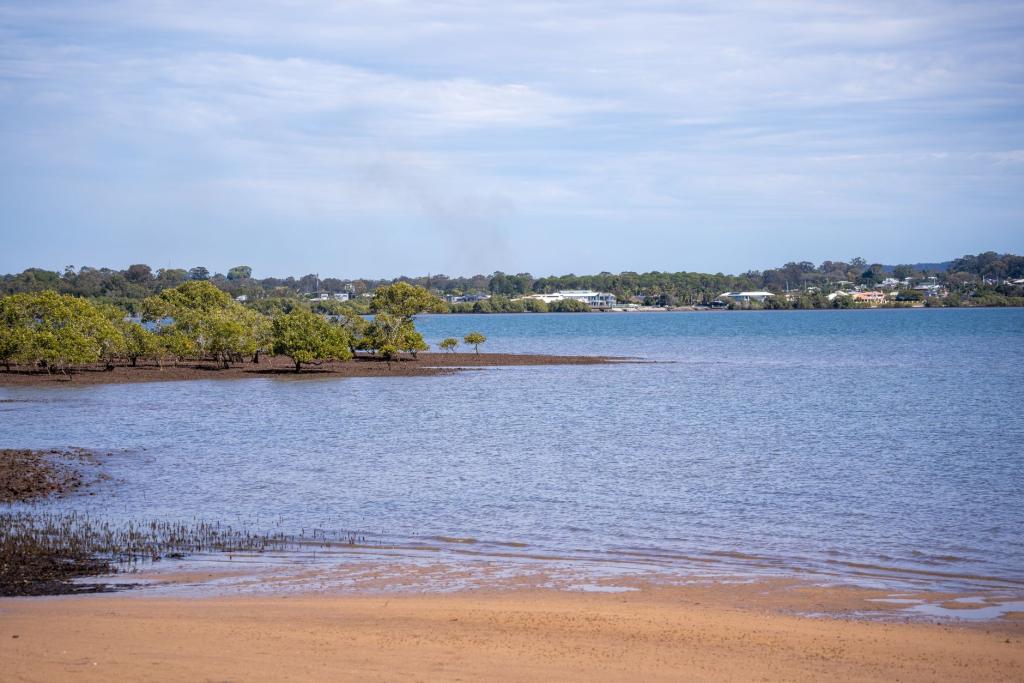
On a wind-scoured shoreline, a mangrove seedling is a small wager against the sea. Its roots have days, not years, to grip the mud before the next rough spell arrives. New global research suggests that whether that wager pays off depends less on average conditions than on timing, on the Calm-Water Windows when the sea goes quiet long enough for young plants to anchor before stronger waves return.
The work, reported in October 2026 in the journal Nature, drew on two decades of wave records from 400 coastal sites around the world, evenly split between shorelines where the forests stand and shorelines where they do not. A team spanning UNSW Sydney, Tulane University in the United States and the University of Oldenburg in Germany built a model from those records that correctly predicted where the forests stood at more than three quarters of the locations studied. Sarah Wells, a doctoral candidate at UNSW and the paper's corresponding author, put the contrast plainly: "But in the first three months or so, during the seedling stage of life, they are highly vulnerable to waves." The full findings were published in the announcement, according to the research team.
Why the youngest plants face the hardest test
Tolerance grows with age, and the steepest gains come earliest. A seedling a single day old can barely tolerate any waves at all, while one a week old can handle some, and the capacity keeps climbing from there. The team describes these calm spells as "windows of opportunity," and combined that establishment idea, developed by Thorsten Balke, with a wave exposure framework drawn from the global data. Without such a spell, a young plant can simply be washed away or undermined by erosion before its roots take hold. Will Glamore, a professor in the university's water research laboratory, framed the gap with a comparison: "You can think of it in terms of a baby compared to an adult." Restoration planning, he argued, has to account for that early fragility rather than assuming young plants behave like the grown trees around them.
That creates a paradox for coastal defence. The shorelines where a forest would blunt surf most are often the hardest places for seedlings to establish, because the same pounding water that a forest would tame is what uproots the young plants. The study's measure of wave exposure accounts for both wave height and the angle at which waves meet the shore, and the researchers found that relatively small shifts in conditions could decide whether a site offered a usable calm spell. Direction, in other words, matters as much as size.
What this changes for restoration
The stakes are practical. Restoration programs spend large sums replanting coastlines, yet results often disappoint: best-practice guidelines from the Global Mangrove Alliance note that some regions still see failure rates of up to 80 percent, often because planting goes ahead in unsuitable spots without fixing the underlying conditions. Glamore noted that local studies typically focus on average conditions rather than the thresholds that actually limit growth. The new work points the other way: short stretches of ideal conditions, not long-run averages, can decide whether a planting survives. The same pick-the-right-place logic is reshaping tree programs on land, where new heat maps show cities where to plant trees for cooling.
For planners, the payoff is a screening tool. A site can be checked for its Calm-Water Windows before money and labour are committed, planting can be timed to the calmer season, and where no quiet spell exists, low structures can be used to dampen wave energy until roots hold. Field trials under Project Halo are already testing such approaches on degraded coasts in Australia and Fiji, according to the university's release. Wells said that understanding the local forces shaping growth should let teams optimise both restoration and conservation, rather than planting on hope.
Climate change adds urgency to the same logic. Warming seas are expected to shift wave direction across many tropical and subtropical coasts, which could leave some existing forest sites unable to recruit new seedlings while opening up stretches that look unsuitable today. Coastal forests elsewhere are already under strain, as North Carolina's ghost forests are vanishing faster than ever, and the United Nations has warned of a narrowing window for forest restoration more broadly. Yet a calm spell is necessary, not sufficient: a site can offer quiet water and still fail on salinity, sediment, tides or temperature. The researchers stressed that waves are one factor among several, including sea-level rise, tides, salinity, temperature and sedimentation.
For anyone backing a planting project, whether by volunteering, donating or voting on coastal spending, the question to ask is now a sharper one: did the team check the local wave record before it planted? A seedling put in during the wrong season is a donation to the tide. The same seedling, given a quiet spell to root, can grow into a forest that shelters a shoreline for decades.
Comments 0
No comments yet. Be the first to share your thoughts!
Leave a comment
Share your thoughts. Your email will not be published.