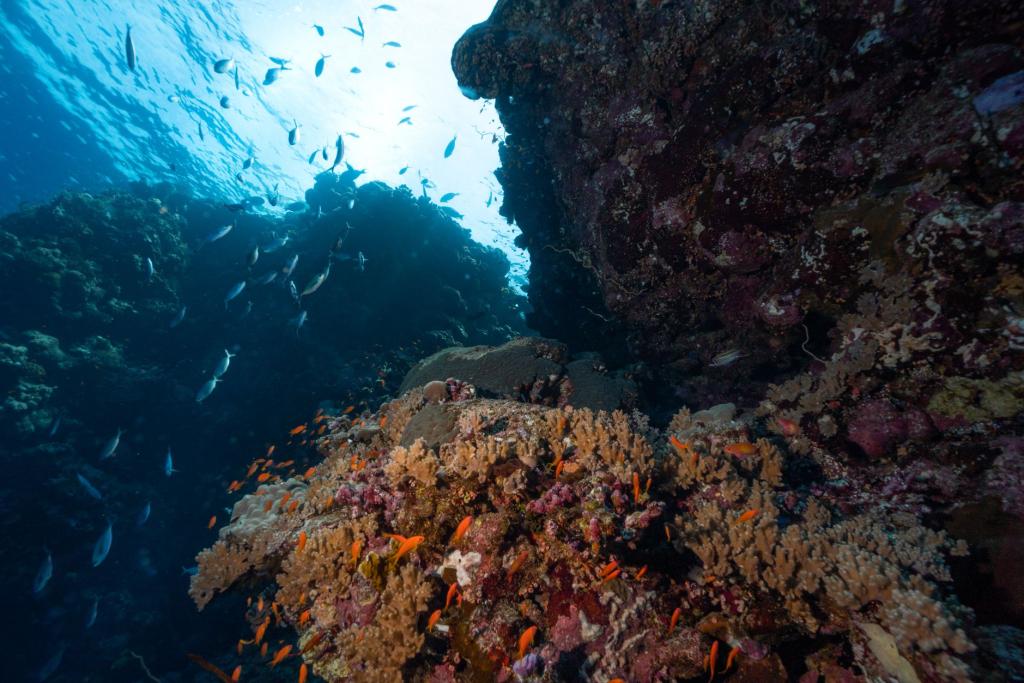
Bleached Reefs may not be a lost cause after all. In a laboratory experiment, ghostly white corals on the brink of death fully recovered within seven weeks through brief physical contact with healthy corals, the fastest documented recovery to date, according to a study published in the journal Science Advances.
The result is a genuine shock for marine biology. When ocean waters warm, corals expel the colorful, beneficial algae living in their tissues, the partners that provide the energy corals need to grow. Stripped of their algae, the animals turn pale and starving, left vulnerable to invasion by harmful algae. Even when bleached corals survive a heat wave, full recovery can take months or years, if it happens at all. This time, recovery came from something almost absurdly simple: touch.
The discovery began with an accident. Last year, marine scientist Steve Palumbi noticed two coral fragments in a research tank, one bleached and one healthy, that had tipped over and were now touching. Both fragments had been sampled from the same colony. Where they made contact, color had returned to the bleached fragment, signaling the return of beneficial algae.
That observation reached oceans doctoral student Danny Collins, who had been studying how harmful bacteria reach corals through physical contact, often riding in on plastic debris. If contact could deliver something harmful, he reasoned, it might also deliver something good. Collins assembled ten pairs of coral fragments, each pair one bleached and one healthy, taken from the same animal. He arranged five pairs close enough to touch and left gaps of just a few millimeters between the remaining pairs.
The outcome was decisive. The bleached fragments in the touching pairs fully recovered, while those kept apart died. For Bleached Reefs, the message is that brief contact with healthy kin can restart the symbiosis that heat takes away. Under a powerful microscope, the team found that microscopic channels in coral tissues align shortly after contact, creating a pathway for transport between the two animals. Beneficial algae and the nutrients they produce began flowing through those channels, moving from healthy to bleached fragments within three days of contact.
Five days of contact was enough
The team then tested how much contact the recovery actually required. They separated coral pairs at varying intervals and found that after a single week of contact, and in some cases after just five days, bleached fragments had received enough beneficial algae to complete recovery on their own. That short window proved enough to put the Bleached Reefs on a path to complete recovery. Separated early, the corals still bounced back in the same span as pairs left touching continuously.
What drove the comeback, the researchers realized, was not a steady drip of algae from the donor but explosive growth inside the rescued coral. Once beneficial algae entered the bleached fragments, they began dividing at the fastest rates ever seen in corals. During the second week of contact, the algae inside bleached fragments doubled every four days, roughly ten times faster than the rate observed in wild corals.
As Palumbi explained it, genetically identical corals recognize one another on contact, and their tissues fuse the way they do in a successful organ transplant between identical twins. The algae, he said, do not simply spread through the recovering coral. They flood in and multiply at extraordinary speed.
What has to happen before this can save reefs
The study team is quick to flag the gap between a tank and an ocean. The approach requires a genetically identical, healthy copy of every bleached coral, which the researchers say is not feasible at the scale needed to restore reefs in the wild. Real reef restoration would need a way to deliver beneficial algae in bulk without one-to-one contact.
That is the next frontier. In the coming months, the researchers plan to explore collecting algae from healthy corals well before heat waves strike, then delivering those batches to bleached corals afterward. One faculty adviser on the study, marine scientist Fiorenza Micheli, said she hopes the work will inspire solutions that keep corals healthy long enough to enable full recovery through slower natural processes like growth, reproduction and the recruitment of new colonies.
The context makes the urgency clear. Corals could vanish within a few decades by some estimates, as climate change drives more frequent and intense marine heat waves. For years, researchers have raced to protect reefs with tools like selectively breeding heat-tolerant corals, cultivating underwater nurseries and even transplanting coral microbiomes. Bleached corals have often been written off as lost, because recovery after a heat wave is so slow. This experiment suggests they are not dead yet, and that a rescue mechanism may already exist inside coral biology itself, waiting to be scaled. The full peer-reviewed paper is available through the journal.
More from the GenZ NewZ newsroom: a survey of thousands of scientists found that techno-optimism is linked to less climate action, and our live coverage tracked mass arrests during protests in France.
Comments 0
No comments yet. Be the first to share your thoughts!
Leave a comment
Share your thoughts. Your email will not be published.