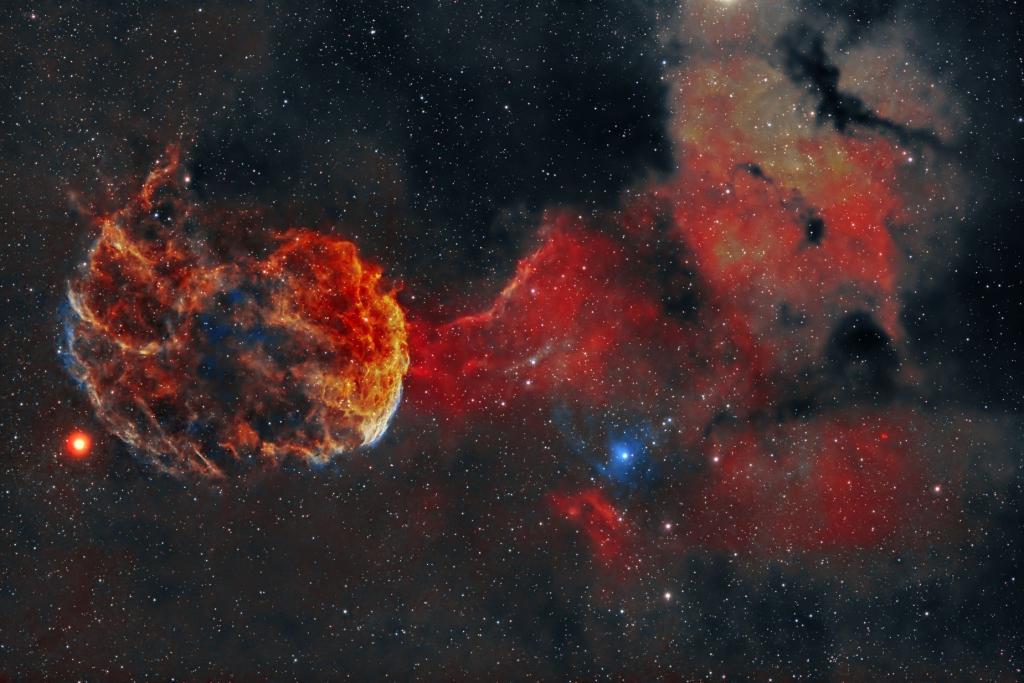
Astronomers have captured the sharpest image yet of Pa 30, the likely remnant of a supernova recorded by observers in 1181, and found its filaments resolve into chains of remarkably uniform pearl-like knots. The image, released on October 6, 2026, reveals about ten times more filamentary structure than any previous observation of the nebula, according to the Center for Astrophysics | Harvard & Smithsonian.
The analysis was led by Timothy Cunningham, a Harvard College Observatory astronomer at the Center for Astrophysics, and Ilaria Caiazzo, an assistant professor at the Institute of Science and Technology Austria, with co-authors J. C. Raymond and S. J. Kenyon. Their findings appear in The Astrophysical Journal. The image came from the Gemini North telescope on Maunakea in Hawai'i, one half of the International Gemini Observatory, using its Gemini Multi-Object Spectrograph.
A supernova recorded before telescopes existed
That explosion is one of only five supernovae in the Milky Way observed from Earth before the invention of the telescope. Eight surviving texts show that Chinese, Japanese, and Arabic astronomers first recorded it between 4 and 6 August of that year, and it stayed visible in the constellation Cassiopeia for 185 days.
The nebula now linked to that event was only found in 2013, during a citizen-science hunt for planetary nebulae in data from NASA's Wide-field Infrared Survey Explorer. It was the 30th nebula found by American amateur astronomer Dana Patchick. Follow-up imaging at Kitt Peak National Observatory showed faint, diffuse emission threaded by radial filaments arranged in a nearly perfect sphere, and the estimated age and brightness pointed to the medieval explosion.
Pearls on a cosmic string
The new analysis shows the radial filaments are not smooth streaks at all. Each is a consistent chain of tiny gas knots, and the average knot measures roughly 0.7% of the nebula's radius, about 100 billion kilometers across. Caiazzo said in a statement that the planetary region of the solar system would fit inside a single knot with room to spare, and she described the knots as "quite strikingly uniform".
The researchers suggest the knotty pattern records conditions in the gas that surrounded the star before it exploded. Thermal or density variations in that circumstellar medium would have sculpted the debris into clumps as the ejecta expanded outward. Cunningham said the filaments have "a surprisingly intricate structure", appearing as "chains of bright knots extending outward from the center" rather than simple streaks.
The Milky Way's only Type Iax remnant
What makes the object unusual is the star left behind. A blue central star sits at the middle of the shell. It burns at about two hundred thousand degrees Celsius and drives stellar winds of roughly sixteen thousand kilometers per second, according to the Center for Astrophysics. Phys.org's report on the discovery notes the surviving star marks the site of an incomplete explosion.
Surviving stars are usually kicked off-center by the blast. This one sits almost exactly in the middle, which implies a symmetrical explosion without a large kick. From that, the team concludes the explosion was an extremely rare Type Iax supernova, a lower-energy and incomplete blast that leaves its star behind, rather than a standard Type Ia, which destroys the star entirely. It is the only known Type Iax remnant in the Milky Way. Cunningham said the knots offer clues about the explosion and how its material moved through its surroundings, and that they are helping the team "reconstruct the history of this unusual supernova".
Why astronomers want to model the knots
At roughly 7,500 light-years from Earth, the remnant is close enough for astronomers to inspect the aftermath in detail. Caiazzo said the team plans to model the knots, a step that could tighten the link between Type Iax theory and what telescopes actually see.
The result also closes a loop stretching back to the twelfth century. Cunningham noted the power of studying the aftermath of an event that medieval skywatchers recorded: their descriptions "began the story", he said, and the new observations continue it "across nearly nine centuries". The portrait joins a run of recent deep-space images, including Webb's first three-dimensional map of an exoplanet's atmosphere. Read more in genznewz.com's science section.
Comments 0
No comments yet. Be the first to share your thoughts!
Leave a comment
Share your thoughts. Your email will not be published.