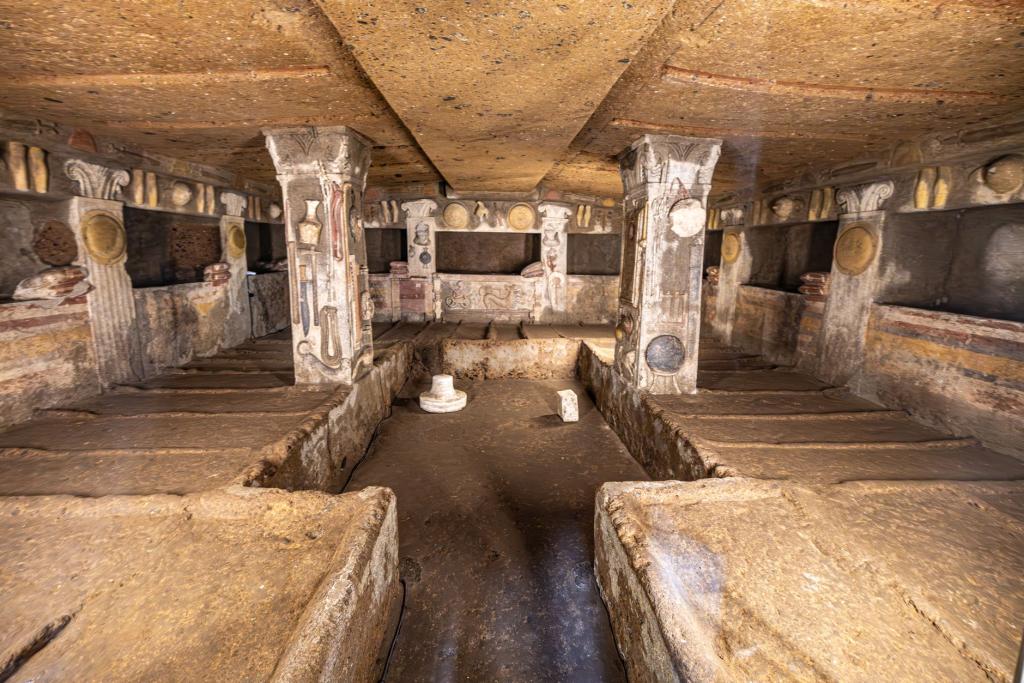
Italy announced a new find this month that diggers had been waiting on since the eighteen hundreds. At the Polledrara necropolis of ancient Vulci, archaeologists uncovered the Etruscan tomb at Vulci they are calling the Tomb of the Stone Chamber, a burial complex from the late seventh century BCE that survived repeated looting with much of its treasure still in place. According to Archaeology News Online Magazine, which reported the announcement on September 22, the tomb held gold ornaments, weapons, chariot parts, painted pottery and a woman's shoe so rare it made the headlines.
Vulci was one of the great Etruscan cities, part of a civilization that ruled central Italy as a major Mediterranean trading power long before Rome absorbed it. Most of what survives of Vulci's elite comes from tombs like this one, and this burial looks like it belonged to someone near the top of the order. Archaeologist Christian Mazet described the find to Etruscan Times as "of the very highest rank," judging by the quality of the grave goods that survived, according to a report on the announcement. That ranking is why researchers are already comparing the Etruscan tomb at Vulci with the famous Tomb of Isis, the best-known burial from the same necropolis.
What was still inside the Etruscan tomb at Vulci
The complex holds three funerary chambers, and the main chamber is the one that astonished the team. It was cut into ground once shaped by the ancient course of the Fiora River, and its walls were built from big blocks of nenfro, a local volcanic stone. Illegal diggers hit the tomb again and again through the twentieth century, but the collapse of its roofs and internal walls accidentally sealed much of the burial goods away from later disturbance. Objects were found in their original positions, where mourners had left them. With goods this intact after so much looting, it is no wonder the team reburied the Etruscan tomb at Vulci to protect it when the season ended. A full account of the find was published by Archaeology News Online Magazine and Arkeonews.
The inventory reads like a portrait of elite Etruscan life. Greek pottery imported from Attica and Corinth sat beside finely decorated local vessels and bucchero, the dark polished ware the Etruscans are known for. The team also recovered weapons, parts of a chariot, iron spits, sheets of gold and bronze, carved bone and ivory, and fittings from clothing and personal dress. A standout is the woman's shoe, a find rare enough to headline Arkeonews's coverage. The side chambers added a bronze tripod, an alabaster plaster lamp that probably came from the area of Naucratis or Rhodes, and an unusual banquet set in the local Polledrara Ware style, painted drinking and pouring vessels that were still sitting where they were placed. A grater used in preparing wine and a large polychrome bowl in the Ionian Wild Goat Style filled out the picture of how this household drank and feasted.
A mound found in eighteen eighty-nine, never finished
The 2026 excavation season is part of Ritorno a Vulci, an international project launched in two thousand twenty-three that joins the École française de Rome, Sapienza University of Rome and the British Museum with Italian heritage institutions. The team was tracing the circular enclosure of the Gsell Tumulus, a monumental funerary mound first found by the École française de Rome in eighteen eighty-nine but never fully excavated. This season they mapped the enclosure and uncovered the burial inside it, which the Etruscan Times account, as relayed by 7Globe, identifies as likely the princely burial Gsell searched for but never found.
The find has a neat historical echo. The famous Tomb of Isis, discovered by the Bonaparte couple in eighteen thirty-nine near the same tumulus, is now at the British Museum, and the two tombs share dates and cultural features. Researchers plan to use the Etruscan tomb at Vulci alongside the Tomb of Isis to study burial rites, artistic production and trade networks among Vulci's elite. With the season's work complete, the team reburied the tomb and the tumulus enclosure to protect the remains, and a new campaign is planned for the following year, with further study, publication and public presentation to follow.
Why the Etruscan tomb at Vulci matters beyond the gold
The objects are only half the story. Because the collapsed roof left so many of them in place, archaeologists can see how a wealthy Etruscan household arranged its dead: which vessels shared the funerary banquet, which imports were prized enough to travel across the Mediterranean, what a person of standing wore into the afterlife. That kind of undisturbed context is what looted tombs usually lose forever, and it is what makes the Etruscan tomb at Vulci a genuine window onto the wealth and ritual of Vulci's ruling class.
It is also a reminder that the ground keeps giving. GenZ NewZ recently covered a new fragment of the Kadesh peace treaty found in Turkey, the solving of the Devil's Arrows' four-thousand-year-old mystery, and a Roman military camp in the Nile Delta found over far older tombs. The Etruscan tomb at Vulci belongs on that shelf of digs rewriting history, and when the team returns to the Polledrara necropolis, the mound may have more to say.
Comments 0
No comments yet. Be the first to share your thoughts!
Leave a comment
Share your thoughts. Your email will not be published.