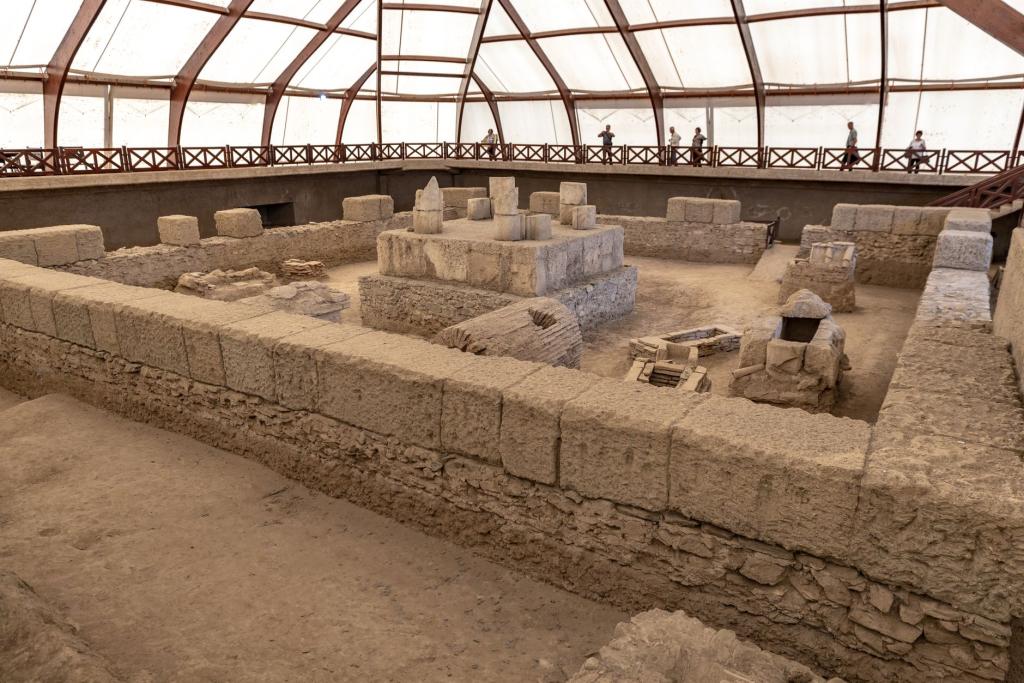
Paris may have finally found its origin story in stone and charred timber. France's Culture Ministry announced last week, in the ministry's announcement, that archaeologists digging under the Hôtel-Dieu hospital on the Île de la Cité, steps from Notre-Dame, have uncovered a burned wall that could be part of the ramparts of Lutetia, the Gallic settlement that grew into the French capital. The ministry called the find a major archaeological breakthrough, and according to early carbon dating the structure predates Rome's conquest of Gaul.
A burned wall under a hospital courtyard
Digging teams have been working the Hôtel-Dieu's courtyards since February 2026. The excavation, led by David Couturier of the city's archaeology and architecture department with France's national preventive-archaeology institute Inrap, was ordered ahead of the hospital's restructuring. The teams went in expecting traces of ancient housing, old streets, and medieval occupation. Instead they found a stone-and-wood wall, twenty meters long, built in the style of Gallic fortifications, the kind of rampart that would have guarded Lutetia.
The wall's architecture told the story fast. According to Dorothée Chaoui-Derieux, the culture ministry's archaeology coordinator for Paris, the large stone blocks and interlocking timber beams immediately recalled Gaulish building tradition. Then the details piled up: a carbonized facing, burned seeds, and the remains of a wooden building destroyed by fire directly in front of the structure. Behind it lay a two-meter-thick artificial platform of sand and gravel, the kind of groundwork that signals a serious fortification. A Gallic spearhead was recovered at the wall's foot, alongside pottery from Caesar's era.
Initial radiocarbon dating of the wood places the wall somewhere between 200 and 10 BCE. That window matters because it covers the final decades of Gallic Lutetia's independence. According to the ministry, the fire traces make the reading stronger still: this looks like a rampart that burned the way Caesar said Lutetia burned.
The tribe that set its own city on fire
Lutetia's history until now came from exactly one source: Julius Caesar. The settlement belonged to the Parisii, a Gallic tribe that occupied the area from the third century BCE, and, as Smithsonian Magazine notes, its name is Latin for "midwater-dwelling." In 53 BCE Caesar came to Lutetia to convene an assembly of Gauls. A year later his lieutenant Labienus marched on the town, and the Parisii made a decision that still reads as shocking: they burned their own oppidum, a walled center of power and trade, rather than let it fall to the Romans. Caesar then described the town as sitting on an island in the Seine linked by bridges, a description vague enough to start an argument that lasted two thousand years. Rome absorbed Lutetia after the conquest, and the town kept its Gallic name into the Roman era.
The argument was real. The Île de la Cité was always the traditional candidate for the oppidum's site, but archaeology in the 1990s gave weight to a rival theory placing Lutetia at Nanterre, miles west in the suburbs. No physical proof of a pre-Roman settlement on the island existed. According to Stéphane Deschamps, the regional archaeology curator, that is what makes the new find land so hard: after centuries of debate, with some scholars even backing Nanterre, the wall and its context may be the key to the mystery.
Paris mayor Emmanuel Grégoire, who visited the dig, put it more simply. According to his remarks to Agence France-Presse, via AFP reporting, it is dizzying to stand there and look at what is probably the origin of the city. Culture Minister Catherine Pégard, who announced the discovery on September 23, said the remains may be among the most important ever found for understanding Gallic Lutetia, while cautioning that the wall's function and chronology still need verification. Excavations are expected to continue for several more months, and according to dig operations director David Couturier, new surprises cannot be ruled out. One of the city's archaeologists, Julien Avinain, went further and said doubt about the wall's Gaulish origin is now barely allowed.
What happens to the wall now
Do not expect the rampart to stay where it is. The remains are too fragile, stones altered by fire and wood reduced to charcoal, and too deep to be preserved inside the hospital's rebuilding plans. According to Edward de Lumley, the regional director of cultural affairs, archaeologists will make a mold of the wall, then build a replica that incorporates original facing stones. The replica is meant for display in a Paris museum, and a 3D photogrammetry model will give the public a faithful virtual version. It is the rare archaeological find whose afterlife is already planned: another sign of the season's museum energy, along with first exhibition devoted to information design now running at MoMA.
There is also more science to come. In mid-September the find was formally declared of exceptional importance, and the regional archaeology authority ordered the dig to continue with reinforced resources. The next phase is meant to date the structure precisely, pin down how it was used and when it was abandoned, and probe the sand-and-gravel platform and any older occupation layers beneath it. The fire that the Parisii set to deny Rome their city may turn out to be the detail that proves, two millennia later, exactly where Lutetia stood.
Other recent discoveries show how busy the field has been: ancient Jerusalem ritual baths unearthed by the Temple Mount made their own headlines this month. For now, though, the Lutetia wall stands alone as the discovery that could move a capital's founding story from Caesar's pages into the ground beneath its most famous island.
Comments 0
No comments yet. Be the first to share your thoughts!
Leave a comment
Share your thoughts. Your email will not be published.