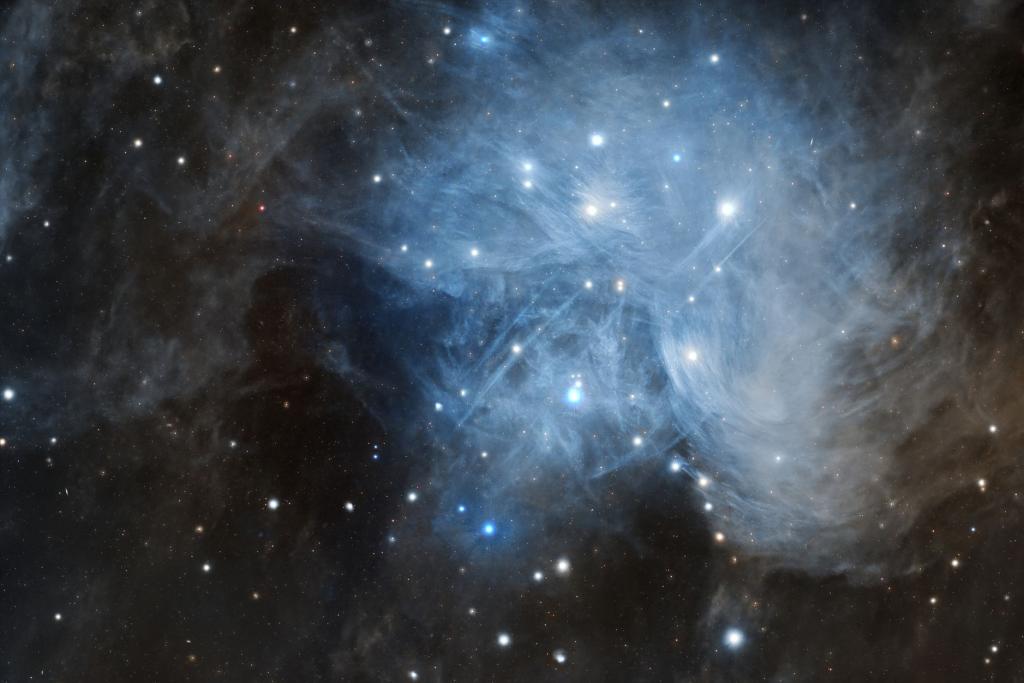
Somewhere behind the star-strewn plane of the Milky Way, a shape drawn in radio light looks uncannily like the musical symbol that opens every piece of sheet music. Astronomers have puzzled over this glowing formation — nicknamed the Treble Clef — for years, and now NASA's Chandra X-ray Observatory has cracked the case. In short, NASA traced a giant treble clef in space to a black hole: the verdict is that a supermassive black hole fired off a violent outburst, and the fading embers were later relit when two galaxy clusters, each packed with hundreds of galaxies, crashed into each other, according to NASA.
The result is a striking composite image built from three telescopes. X-ray data from Chandra and the German eROSITA telescope, shown in blue, reveal multimillion-degree gas filling the clusters. Radio observations from the LOw Frequency ARray — a European network of roughly 20,000 antennas — appear in red and trace the musical shape. Infrared light from the United Kingdom Infrared Telescope, rendered in white, marks the stars and galaxies scattered across the foreground and background.
A black hole fired first, then a collision relit the glow
The team, led by Andrea Botteon of Italy's National Institute for Astrophysics, argues the structure formed in two acts. First came the outburst: the supermassive black hole at the cluster's heart blasted clouds of charged particles and magnetic fields outward at near light speed. That blast generated brilliant radio waves — a kind of cosmic crescendo — that faded over time as the particles lost energy.
The encore arrived much later. Two clusters collided, and the impact squeezed the fading particle cloud and reenergized it, making it glow brightly in radio waves again. Shock waves from the smashup — described as similar to the sonic booms from supersonic jets — may have helped recharge the particles. The researchers estimate the direct collision happened a few hundred million years ago, and the clusters are now drifting apart.
This is not the first time astronomers have caught dead radio plasma being brought back to life. Revived clouds like this help explain why some corners of the universe shine far more brightly in radio waves than their age suggests. What makes this one special is the unusually clear picture of cause and effect: a black hole's outburst, a long quiet fade, and then a second flash triggered by the most violent kind of cosmic pileup.
The mystery hiding behind our own galaxy
For years, the Treble Clef resisted explanation for a straightforward reason: it sits almost directly behind the plane of the Milky Way. Our own galaxy's stars, gas, and dust block the view, smothering the details astronomers needed. To peer through that curtain, the team turned to wavelengths that can punch through it. Chandra and eROSITA found the diffuse hot gas that marks a cluster's presence — and revealed the supposed single cluster is actually two clusters in the middle of merging.
Botteon's group then applied a clever image-processing trick to the Chandra data, subtracting a smooth symmetrical oval to expose whatever was left behind. The leftover glow shone brightest to the left and right of the cluster's center and faintest in the middle — a fingerprint suggesting the smashup ran along a left-right line across the sky. The findings were published this week in the journal Astronomy & Astrophysics, according to the announcement on the Chandra blog.
Why a treble clef — and why it matters
The musical resemblance is pure coincidence. It is a textbook case of pareidolia, the brain's habit of spotting familiar shapes in random data, and it carries no scientific link to music. The Chandra team notes the same radio glow could just as easily be read as a dragon seen in profile, and released an alternate version of the image playing up that reading, as covered by Starlust.
Space is full of such accidental portraits. There is the Horsehead Nebula, the "Face on Mars" spotted by early orbiters, and pulsar wind nebulae nicknamed things like the Hand of God. The Treble Clef now joins that gallery — but behind the whimsy sits serious physics. Collisions between galaxy clusters rank among the most energetic events since the Big Bang, and they govern how the universe's largest structures grow. Each one mapped in detail, especially a case hidden behind the Milky Way's glare, sharpens models of how clusters assemble, how black holes pump energy back into their surroundings, and how magnetic fields spread across millions of light-years.
For now, the treble clef hangs in the dark like a signature nobody wrote — a black hole's old outburst, redrawn in neon by a cosmic crash.
Read more science from this newsroom: NASA's Parker Probe found a hidden magnetic flip in the solar wind, and researchers named a new dinosaur species the unconquered female warrior.
Comments 0
No comments yet. Be the first to share your thoughts!
Leave a comment
Share your thoughts. Your email will not be published.