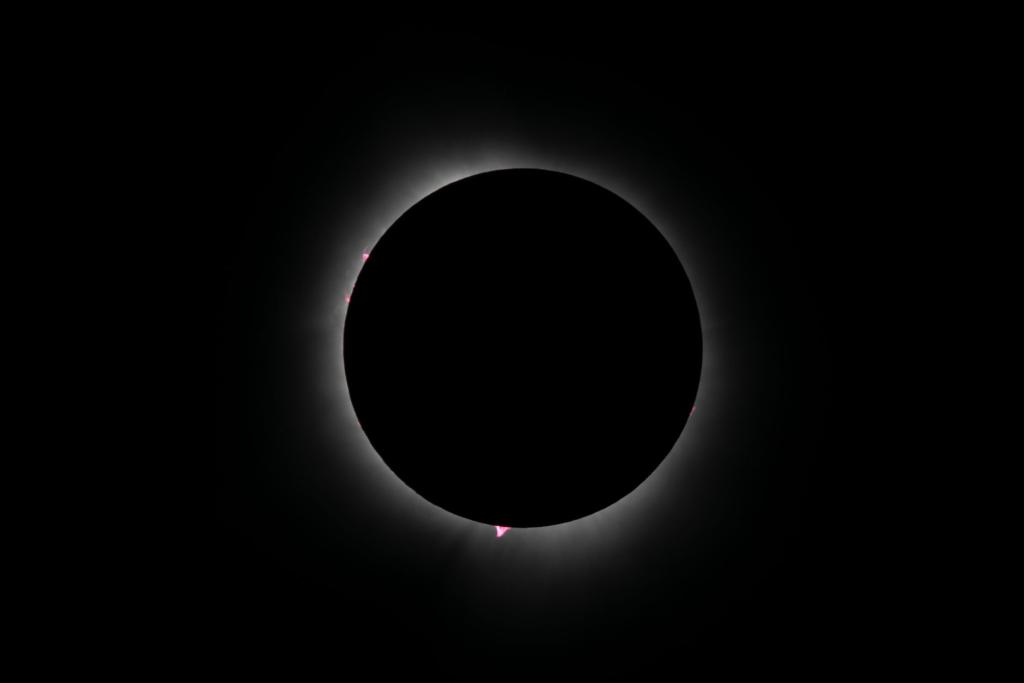
The solar wind looks like a steady stream of charged particles blowing off the Sun, but deep inside that flow sits turbulence that has frustrated physicists for decades. Now an international team reports a strange hidden order, a magnetic flip hiding in the wind itself: its magnetic fluctuations change their preferred direction of spin depending on their wavelength. At larger scales they lean toward counterclockwise rotation; at smaller scales clockwise takes over. The finding, reported by the Daily Galaxy from a study published in The Astrophysical Journal Letters in October 2026, is the first direct observation of its kind in space turbulence.
The measurements came from NASA's Parker Solar Probe, the fastest human-made object yet flown, which flies closer to our star than any spacecraft before it. The team was led by first author Dr. Masatomi Iizawa of TU Braunschweig and brought together researchers from the University of Tokyo, Tohoku, Kyushu, and Osaka universities with partners across ten countries. Combing through the probe's magnetic-field and particle data, they mapped how the turbulent fields rotate across a range of wavelengths. The pattern was unmistakable: "We see a clear structure in the spectrum, even though the turbulence represents unstructured motions," Iizawa said.
A Mission Built to Skim the Sun
Launched in 2018, the spacecraft was designed to do what no mission had attempted: fly through the Sun's outer atmosphere, the corona, and sample the solar wind near its source, the region where the magnetic flip was eventually found. In December 2024 it made its closest approach yet, passing within roughly 3.8 million miles of the solar surface while its heat shield endured blistering temperatures. The new analysis builds on data from those daring inner-heliosphere dives, where the wind is still fresh off the star and its turbulence carries the clearest fingerprints of its origin.
This is not the first time the probe has surprised scientists about solar magnetism. In 2019 it discovered "switchbacks," sudden reversals where the magnetic field snaps around by half a turn before settling back. But this magnetic flip is subtler and more fundamental: it is not the field itself reversing, it is a systematic change in which way the fluctuations prefer to rotate at different sizes. And it is not frozen in place. The team found the magnetic flip grows more pronounced and shifts toward longer wavelengths as the wind travels outward, proof that this feature of the plasma evolves during the journey away from the Sun.
Where Fluid-Like Motion Gives Way to Particles
The reversal sits exactly where physicists would hope to find a clue. At larger scales, the wind behaves like an electrically conducting fluid, and its motion can be described with a framework called magnetohydrodynamics. At smaller scales, that description breaks down: the behavior of individual ions and electrons and their dance with electromagnetic fields start to dominate. Locating the spin flip near that transition gives researchers a measurable signature of how turbulence changes character as ever-smaller structures get involved, a long-sought bridge between the two regimes.
Why Your GPS Cares About Solar Turbulence
Here is where the physics meets daily life. The solar wind is a collisionless plasma, meaning its particles almost never collide; electromagnetic fields, not friction, shuffle energy around. That is the opposite of how turbulence works in water or air, and it is a big reason space weather is so hard to forecast. The wind constantly slams into Earth's magnetic field, and during strong outbursts it can knock satellites off course, scramble GPS signals, black out radio communications, and overload power grids. A new, concrete fingerprint of the magnetic flip gives modelers something real to test their simulations against, as ScienMag noted in its coverage of the discovery.
What the Result Does Not Prove Yet
The researchers are careful not to overclaim. This reversal concerns the preferred spin of magnetic fluctuations, not a flip of the entire interplanetary magnetic field, a distinction that matters. The team established that the spin change, the wavelength range, and the distance from the Sun are linked, but they have not pinned down which physical mechanisms produce this magnetic flip or control how it sharpens outward. Whether the same scale-dependent signature shows up in other turbulent plasmas, from Earth's magnetosphere to the hot gas around black holes, is an open question, and co-author Yokoi said the results carry real weight for plasma physics and astrophysics.
The solar connection runs wider than one discovery, too: astronomers keep finding that stars shape their surroundings in unexpected ways, from how a star determines the kind of planetary system it gets to how its wind structures turbulence across that system. More dives by the spacecraft and sharper theoretical models will decide whether this hidden pattern is a solar quirk or a universal rule.
Comments 0
No comments yet. Be the first to share your thoughts!
Leave a comment
Share your thoughts. Your email will not be published.