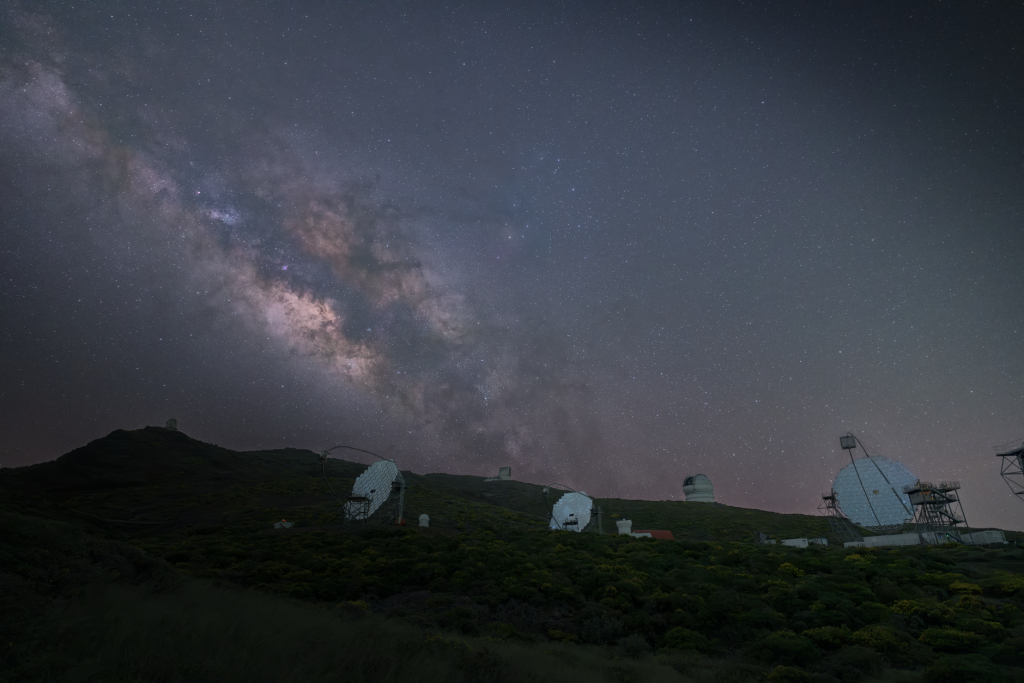
Scientists inaugurated the completed Large-Sized Telescope sub-array at the CTAO-North site on La Palma on 15 October 2026, completing a four-telescope gamma-ray array that forms the low-energy core of what will be the world's most powerful gamma-ray observatory. About 250 scientists and representatives of research institutions gathered at the Roque de los Muchachos Observatory for the ceremony, according to the CTAO announcement.
Each of the telescopes carries a 23-metre reflector dish and ultrafast cameras built to catch the faint blue flashes, known as Cherenkov light, that very high-energy gamma rays produce when they strike Earth's atmosphere. The collaboration behind the instruments developed new optics, photodetectors and high-speed electronics to reach the lowest energy threshold of any ground-based gamma-ray observatory. The new gamma-ray array holds the most sensitive instruments ever built for gamma rays in the lowest band, starting near 20 gigaelectronvolts and reaching up to several teraelectronvolts. That low-energy reach matters because the highest-energy gamma rays get absorbed as they cross the universe. By catching the lower-energy survivors, the telescopes can study sources at cosmological distances, look further back in cosmic history, and track rapid flickers in violent objects with better precision.
A prototype that already proved itself
The first of the instruments, LST-1, has been observing since 2020 while its companions were still being built. Even in that testing phase, it recorded pulsars, studied active galactic nuclei at cosmological distances, and chased fast-changing events including novae and gamma-ray bursts. With LST-2, LST-3 and LST-4 now complete, the gamma-ray array will watch the same atmospheric showers from several positions at once, which sharpens sensitivity, angular resolution and the reconstruction of each gamma ray's energy.
Prof. Masahiro Teshima, principal investigator of the LST Collaboration and spokesperson of the CTAO Consortium, said in a statement that finishing the sub-array was the culmination of "more than fifteen years of international collaboration and technological innovation". The new gamma-ray array, he said, would let researchers explore "some of the most extreme environments in the Universe", from supermassive black holes and neutron stars to the possible origins of cosmic rays and the nature of dark matter.
Looking back at the young universe
The new gamma-ray array forms the low-energy core of CTAO-North, and its reach into the lowest energies opens a window on the universe as it was about 12 billion years ago, when it was less than two billion years old. The observatory said the telescopes could detect bright gamma-ray bursts at high redshift, potentially reaching sources at a redshift of around 4, offering new clues about the early universe.
Related reading on the site: NASA Traced a Giant Treble Clef in Space to a Black Hole and Perseverance Driving Record: Mars Rover Outruns Oppy.
Beyond this gamma-ray array, the full Cherenkov Telescope Array Observatory is designed to become the largest and most powerful gamma-ray observatory ever built, covering energies up to 300 teraelectronvolts. Its science programme is organised around three themes: the origin and role of relativistic cosmic particles, extreme environments such as black holes and neutron stars, and frontiers in physics including the search for dark matter and tests of Einstein's theory of relativity.
The observatory will eventually field more than sixty telescopes in large, medium and small sizes, each covering a different slice of the energy range, split between CTAO-North on La Palma and CTAO-South at the Paranal Observatory in Chile's Atacama Desert. The project brings together institutions from eleven countries: Brazil, Bulgaria, the Czech Republic, Croatia, France, Germany, Italy, Japan, Poland, Spain and Switzerland.
CTAO will also be the first gamma-ray observatory of its kind to run as an open, proposal-driven facility, with high-level science data made publicly available. The central organisation, the CTAO ERIC, counts Austria, Croatia, the Czech Republic, the European Southern Observatory, France, Germany, Italy, Poland, Slovenia, Spain and Switzerland as members, with the Netherlands as an observer and Australia, Brazil, Japan, South Africa and the United States working toward joining as strategic partners.
Over the coming years the new gamma-ray array will be commissioned and folded into CTAO operations, joining the other instruments planned for both arrays in tackling questions about dark matter, the origin of cosmic rays and the physics of the universe's most extreme accelerators.
Comments 0
No comments yet. Be the first to share your thoughts!
Leave a comment
Share your thoughts. Your email will not be published.