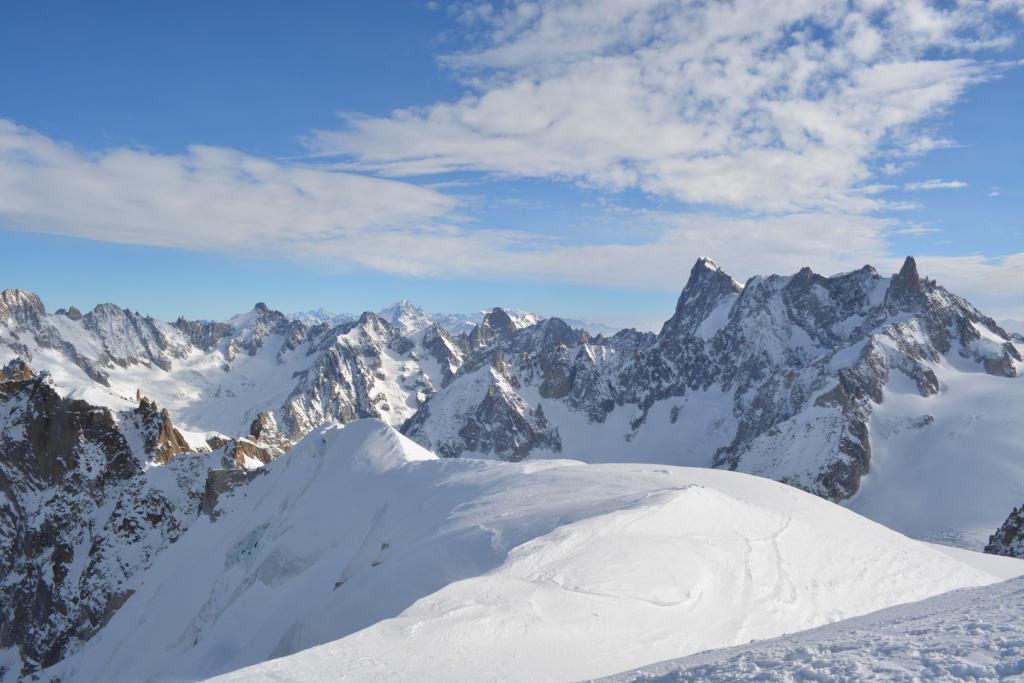
The Mont Blanc height just got a fresh number, and it is a plot twist: French surveyors say the summit of Western Europe's tallest mountain now sits at four thousand eight hundred and seven point four seven metres above sea level. That is nearly two metres taller than the last official reading, which sounds like the Alps are growing. The real story is messier and a lot more interesting.
What the surveyors actually found
According to The Guardian, the team announced the result on Wednesday. The reading is one point eight eight metres higher than in two thousand twenty-three, when the summit hit its lowest level in recent memory. But it is also one point two nine metres lower than the measurement taken in two thousand twenty-five.
So both headlines are true at once. Compared with three years ago the peak is up, and compared with last year it is down. The Mont Blanc height is not a fixed fact carved in granite. It is a snapshot of a moving target.
The expedition itself was no casual hike. According to the Associated Press, as republished by New Delhi Times, surveyors, guides and scientists reached the top at daybreak on the seventeenth of September and spent more than two hours taking readings. They hauled nearly thirty kilograms of gear on top of their mountaineering equipment.
Rock versus snow: why the number moves
The rocky core of the mountain is about four thousand seven hundred and ninety-two metres tall. Everything above that is a cap of snow and ice, and that cap changes with snowfall, wind and temperature. Think of it like a scoop of ice cream on a cone that gets reshaped every season.
That is why the Mont Blanc height bounces around from one survey to the next. Records show a peak of four thousand eight hundred and ten point nine metres in two thousand seven, which means the summit has since shrunk by three point four three metres, according to The Guardian. Still, the latest figure lands close to the altitude that cousins Joseph and Henri Vallot calculated in the eighteen nineties using triangulation.
The high-tech toolkit
Modern surveying has come a long way from the Vallot cousins. The team used satellite positioning instruments to pinpoint the exact top of the snow. A drone captured more than one thousand three hundred images to build a three-dimensional model of the snowy cap, and ground-penetrating radar probed the ice and the rock beneath it.
The Haute-Savoie surveyors' association has organised these measurements since two thousand one, building a long record that scientists can use to study how the summit changes. It is basically a two-decade glow-up diary for a mountain.
Does this mean climate change is not a problem up there?
Not so fast. The surveyors were careful to warn people against reading too much into a single year. A spokesperson for the national surveyors' union said it is essential to distinguish between changes in surface altitude and changes in the total volume or mass of ice, and that a higher summit does not contradict the documented retreat of Alpine glaciers.
The wider context is rough. The Guardian reports that Western Europe just had its hottest summer on record, and Swiss glaciologists recently warned of an explosion of melt rates after confirming that one-fifth of the country's ice was lost in the past five years. Expedition leader Jean des Garets said the warming trend is visible to the naked eye across the rest of the Alpine massif, noting that in places climbers now cross a stream where a glacier used to be.
Above four thousand metres, though, things look different for now. Research by glaciologists in Grenoble, cited by the Associated Press, found the summit is so high and cold that its ice rarely melts, with its thickness changing by only a few metres over the whole twentieth century. In other words, the top is holding steady while the lower slopes are visibly suffering.
Why you should care
Mountain stats are fun trivia, but this one is also a lesson in reading science headlines. A big number going up does not automatically mean good news, and a number going down does not automatically mean disaster. The context decides everything, and one measurement is never the whole story.
Expect the Mont Blanc height to keep wobbling in future surveys as winters and summers shift the snow. The trend to watch is not the summit but the glaciers below it. For more on this beat, check our climate coverage.
Comments 0
No comments yet. Be the first to share your thoughts!
Leave a comment
Share your thoughts. Your email will not be published.