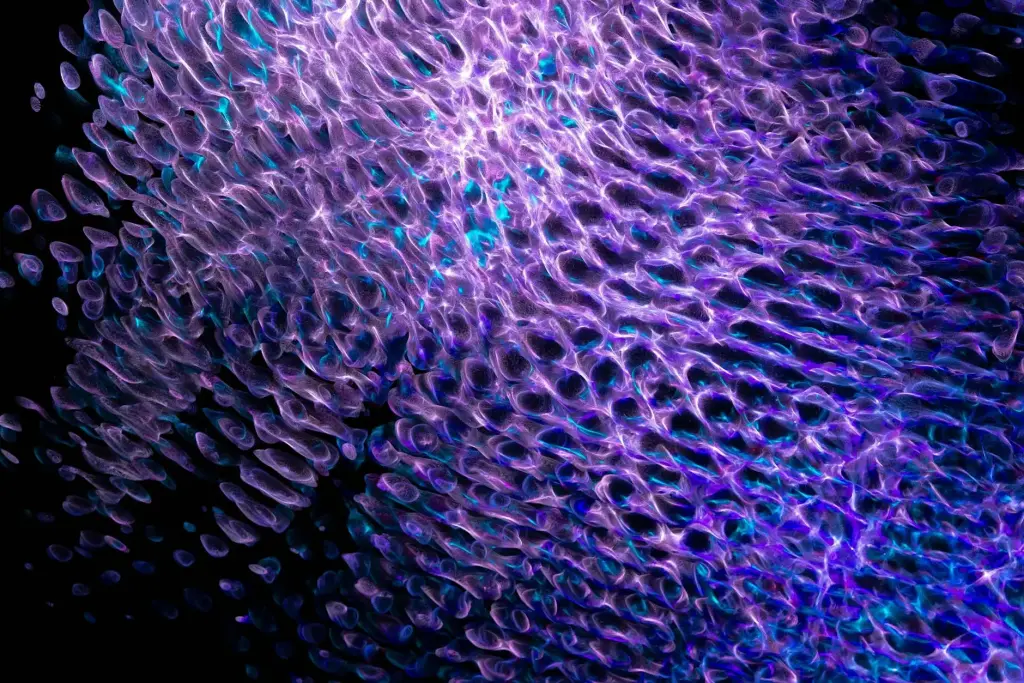
Scientists just discovered something wild happening inside your cells that could change how we fight cancer forever. According to research published in Nature Communications, hidden cellular winds are rushing through the body right now, carrying proteins faster than anyone thought possible.
How Researchers Accidentally Found Cellular Winds
This breakthrough started as a total accident during a classroom demo at the Marine Biological Laboratory in Massachusetts. Dr. Catherine Galbraith and Dr. James Galbraith were running what they thought was a routine experiment with students when they noticed something unusual happening at the front edge of a living cell.
"We kind of did it for fun and then realized this gave us a way of measuring something that wasn't able to be measured before," Cathy told reporters. The team used a laser to temporarily make proteins invisible at the back of a cell, expecting them to slowly drift forward through random diffusion like textbooks have claimed for decades.
Instead, they saw a dark band appear at the front of the cell way faster than it should have. That dark band was actually a wave of actin proteins being actively pushed forward by something textbooks never mentioned: directed fluid flows inside the cell acting like internal trade winds.
According to the Oregon Health & Science University research team, cells are not passive blobs waiting for proteins to randomly bump into the right spots. They actively squeeze and create currents that turbocharge protein delivery to where it's needed most. Think of it like squeezing a sponge at the back to push water out the front.
Why This Matters for Cancer Treatment
Here's where things get really interesting for anyone worried about cancer. The researchers discovered that highly invasive cancer cells have figured out how to supercharge these cellular winds. They push proteins to the front edge of the cell at speeds normal cells cannot match, which helps them spread through the body faster.
"We know these highly invasive cells have this really cool mechanism to push proteins really fast, really rapidly where they need them at the front of the cell," Jim Galbraith explained. All cells have the same basic parts, but cancer cells assemble them into a machine that behaves totally differently.
The discovery opens up brand new possibilities for targeted therapies. If scientists can figure out how cancer cells hijack these internal flows differently than healthy cells, they could potentially develop treatments that specifically slow or stop cancer spread without damaging normal tissue.
To actually see these flows, the team had to develop completely new imaging techniques at the Howard Hughes Medical Institute's Janelia Research Campus. They used iPALM technology that can resolve structures at the nanometer scale, literally 10,000 times finer than a human hair. This let them watch the actin-myosin barriers that direct protein traffic inside living cells.
The researchers describe this system as a "pseudo-organelle" - a functional compartment inside the cell that is not enclosed by a membrane but still plays a huge role in organizing cell behavior. It is like discovering a hidden highway system inside the body that nobody knew existed.
"Just as small shifts in the jet stream can change the weather, small changes in these cellular winds could change how diseases begin or progress," Cathy Galbraith noted. The implications stretch beyond cancer to wound healing, immune responses, and potentially even tissue engineering applications.
This study completely flips the script on decades of cell biology. Instead of proteins drifting randomly like leaves on a breeze, cells have built-in conveyor belts that actively transport materials exactly where they are needed. The discovery shows there is still so much about our own bodies that science is just beginning to understand.
The research was funded by the National Institute of General Medical Sciences and the National Science Foundation, bringing together experts in engineering, physics, microscopy, and cell biology from Oregon Health & Science University and the Janelia Research Campus. Their collaboration demonstrates how breakthrough discoveries often happen when different scientific fields collide.
"All you had to do was look," Cathy Galbraith said. "The flows were there all along. Now we know how cells use them." This discovery could influence everything from cancer research and drug delivery to tissue repair and synthetic biology applications.
Related coverage: Continue with the latest GenZ NewZ headlines, more science coverage, California Snowpack Just Hit Zero Months Early: Climate Crisis Deepens, Coral Sea Species Discovered: 110 New Creatures Found Off Australia, and Northern Lights Just Lit Up 16 States Tonight: Where to See the Aurora.
Comments 0
No comments yet. Be the first to share your thoughts!
Leave a comment
Share your thoughts. Your email will not be published.