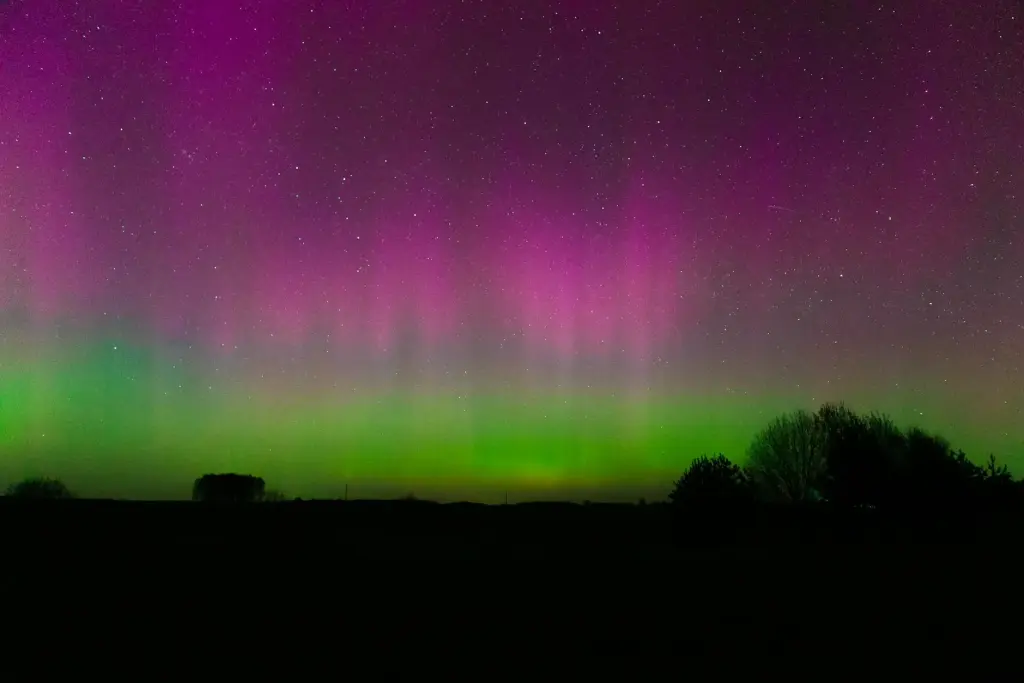
The sky is putting on a show tonight that no filter can match. A powerful burst of solar activity has triggered a rare northern lights display visible across sixteen US states, giving millions of Americans a chance to witness one of nature's most spectacular phenomena without leaving their backyards.
According to The New York Post, the National Oceanic and Atmospheric Administration issued a geomagnetic storm watch after spotting a fast-moving coronal mass ejection over the weekend. When that solar surge collides with Earth, it pushes the aurora borealis much farther south than usual—creating a cosmic light show that stretches from the Midwest to the East Coast.
Where to See the Northern Lights Tonight
If you are wondering whether you are in the viewing zone, here is the full list of states where the northern lights could appear tonight. The display may be visible along the edges of Oregon, Washington, Idaho, Montana, Wyoming, North Dakota, and South Dakota. You can also catch them in Minnesota, Iowa, Wisconsin, Michigan, New York, Vermont, New Hampshire, Maine—and of course, Alaska.
For the absolute best experience, you will want to escape city lights and find a spot with clear northern exposure. According to NOAA, the ideal viewing conditions involve dark skies away from light pollution, looking toward the northern horizon between 10 PM and 2 AM local time. Cloud cover is your biggest enemy tonight, so check local forecasts before heading out.
The further north you are within these states, the better your chances of catching the display. Rural areas away from major cities like Seattle, Portland, Minneapolis, Chicago, Detroit, New York City, and Boston will offer significantly darker skies and clearer views of the aurora's colorful dance.
Why Are the Northern Lights So Active Right Now?
This is not just a random cosmic coincidence. The sun is currently at its peak activity in the eleven-year solar cycle—the solar maximum—which happens to be the most explosive phase in over two decades. Solar flares and coronal mass ejections are ramping up dramatically, creating perfect conditions for aurora displays.
March is actually prime time for northern lights, thanks to the spring equinox. According to BBC Sky at Night Magazine, this seasonal alignment creates what scientists call the Russell-McPherron effect—when solar winds more easily penetrate Earth's magnetic field, triggering stronger and more widespread auroras. September brings another peak during the fall equinox, giving skywatchers two prime windows each year.
The science behind the spectacle is genuinely fascinating. When solar particles slam into Earth's magnetic field, they get redirected toward the poles. These charged particles then collide with gases in our atmosphere—oxygen creates green and red light, while nitrogen produces blue and purple hues. The result is those dancing curtains of color that have captivated humans for millennia.
Earlier this year, the sun unleashed four powerful X-class solar flares in just two days—including an X8.1 flare that was one of the strongest in thirty years. That eruption knocked out radio signals across the South Pacific and triggered communication blackouts. Tonight's display comes from that same increasingly active sunspot region, reminding us that our nearest star still holds plenty of surprises.
How to Capture the Perfect Aurora Photo
If you are hoping to document tonight's display, you will need more than just your standard phone camera settings. The aurora moves quickly and appears in low light conditions that challenge most automatic camera modes. Put your phone in manual or night mode, stabilize it on a surface or tripod, and use a longer exposure time if your device allows it.
Professional aurora photographers recommend wide-angle lenses, high ISO settings between 800 and 3200, and exposure times of 5 to 15 seconds. But honestly, sometimes the best approach is to put the camera down and simply experience the moment. The northern lights have a way of making you feel wonderfully small in the grand scheme of things.
For Gen Z skywatchers, this is the perfect opportunity to disconnect from screens and witness something genuinely awe-inspiring. Unlike viral videos or curated content, the northern lights are unpredictable, unfiltered, and impossible to fully capture on a phone camera. They remind us that some of the most incredible experiences happen in the real world, not on a display.
So tonight, grab a blanket, find a dark spot with a clear northern view, and look up. You might just catch the sky doing something absolutely magical—and creating memories that no TikTok trend can replicate.
Comments 0
No comments yet. Be the first to share your thoughts!
Leave a comment
Share your thoughts. Your email will not be published.