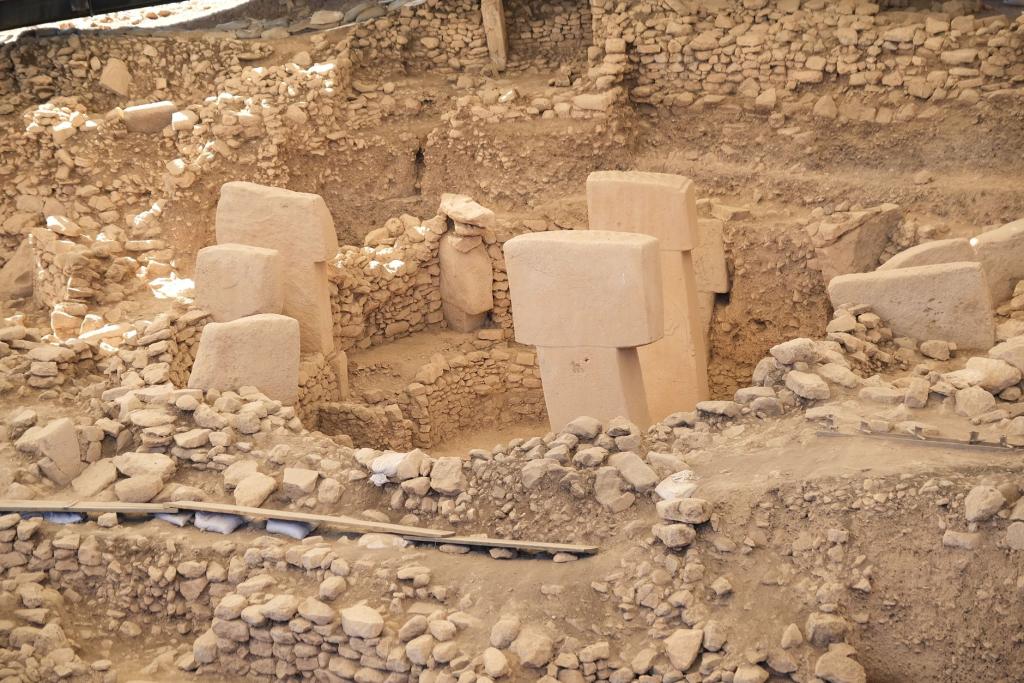
For three decades, archaeologists working at Göbeklitepe have tripped over a puzzle: hundreds of human bone fragments scattered through the fill of the site's monumental stone enclosures, with no clear story of how they got there. A study published in September 2026 in PLOS One now offers the strongest lead yet. Researchers describe the first two intact Göbeklitepe burials ever recovered, and they suggest that at least some of those famous scattered bones were never placed inside the enclosures on purpose at all.
The discovery changes how scientists read the oldest known monumental architecture in the world — and it quietly challenges the idea that this place was only ever a temple.
Göbeklitepe sits about fifteen kilometers northeast of Şanlıurfa in southeastern Türkiye, and its enormous carved T-shaped pillars are older than agriculture, pottery, and the wheel. The settlement mound grew over roughly sixteen hundred years, between about 9600 and 8000 BC, while Southwest Asia was shifting from mobile hunting to farming. For years the site was framed mostly as a ritual center. Newer digs have uncovered houses and workshops too, and the latest research adds burials to that picture of everyday life — ordinary people lived, worked, and were laid to rest here.
According to the researchers, the new evidence points to a surprisingly plain mechanism. Burials were tucked beneath the plaster floors of houses built on higher ground. Over thousands of years, erosion and slope movements dragged soil, stones, and bones downhill into the great stone enclosures below, which sit in a depression ringed by higher deposits. Earlier work had already hinted that the monumental buildings were filled partly by natural processes rather than deliberately sealed at abandonment, reported by Heritage Daily; the new skeletons make that case much harder to dismiss.
Two graves under house floors
The first burial turned up in 2017, when crews were digging a drainage channel for the protective shelter over the main excavation area. Beneath the plaster floor of a rectangular Neolithic building, archaeologists found a kidney-shaped pit holding the remains of at least three people whose bones had been deliberately rearranged: a woman at least thirty-five years old, a man in his twenties, and a girl roughly eleven to fourteen, with skeletal hints of a possible fourth person.
The skulls had been gathered in the pit's southeastern corner while long bones lined its western wall, and the presence of tiny hand and foot bones showed that whole bodies, not loose bones, went into the ground first. Because the pit was small, the team thinks it was reopened over time, with earlier occupants shifted aside to make room for new ones — a collective grave used again and again by people who knew exactly where their dead lay. It is one of the clearest signs yet that the Göbeklitepe burials belonged to ordinary household life, not special ritual events.
The second burial had waited even longer. It was first spotted in 2012 but sealed back up for lack of time, then fully excavated in 2022. Found just west of the site's monumental Building A, it held a young adult, most likely a woman between 20 and 30, lying on her left side in a flexed position and facing east, resting on a layer of stones. No clear pit survived, so the team believes the grave originally sat beneath a floor that has since eroded away. Though largely undisturbed, the skeleton was heavily broken: long bones with missing ends, fragments coated in chalky mineral deposits, and marks that look like rodent gnawing. That damage proved crucial, because it showed that a body can end up badly fragmented through entirely natural causes while still buried — no ritual required.
What the landslides explain
When the team compared the two intact graves with the bones scattered through the monumental buildings, the match was striking. Both sets showed heavy fragmentation, chalky mineral crusts, and signs of animal activity. That resemblance is the heart of the study's argument: ordinary floor burials, broken up and washed downhill over millennia, could plausibly account for much of the mystery that has puzzled the site since digging began in the mid-nineties. The enclosures' position at the bottom of the mound made them natural catch basins for everything the slopes shed.
The researchers are careful not to overclaim, and that caution is part of why the paper matters. They stress that not every scattered fragment can be traced to a displaced house burial, and that the site's burial traditions were probably more varied than any single mechanism can cover. Further skeletal analysis and absolute dating will be needed to sort out which practices belong to which centuries of the settlement's long occupation.
What the landslides can't explain: the skull cult
Here the story takes a stranger turn. Some skull fragments at the site carry deep, deliberate incisions — cuts made by human hands after death. The new study notes cranial fragments from five individuals with such modifications, and the site's imagery backs the pattern: carvings of headless figures and animals shown with human heads. Comparable practices appear elsewhere in the region's Neolithic world. At Sefertepe, excavators found a chamber holding at least twenty-one skulls, most of them facing southeast; at Karahantepe, skull fragments show cutting, scraping, and burning. Those marks almost certainly reflect ceremonial handling of selected people's skulls, though what the rituals meant is still unknown.
The honest picture, then, is layered. Ordinary families buried their dead under the floor and later rearranged the bones, while something altogether more ritualized happened to certain skulls. Both can be true at once, and that is the point the researchers land on: a plain burial practice and an elaborate skull tradition coexisted in the same community.
Why the Göbeklitepe burials matter
This finding keeps pushing Göbeklitepe's interpretation in the same direction it has been moving for years: away from the image of a lonely temple on a hill and toward the reality of a settlement where people cooked, built, raised children, and buried their grandparents under the living room floor. Burial beneath house floors was widespread across Neolithic Anatolia and the Levant, and these graves put the site squarely inside that broader tradition. There is also a practical moral for archaeology itself: a skeleton can look like a ritual victim when it is really just an ancestor who spent ten thousand years in a bad spot. Separating what people did on purpose from what time did on its own is one of the hardest jobs in the field — and this study shows the work is worth doing. For more on deep-time science, related reporting on how crawling archaea may reveal the origin of complex life, and browse the rest of The Old World for forgotten stories from the distant past.
The study itself is open access: read the full paper in PLOS One, with reporting on the find from Heritage Daily.
Comments 0
No comments yet. Be the first to share your thoughts!
Leave a comment
Share your thoughts. Your email will not be published.