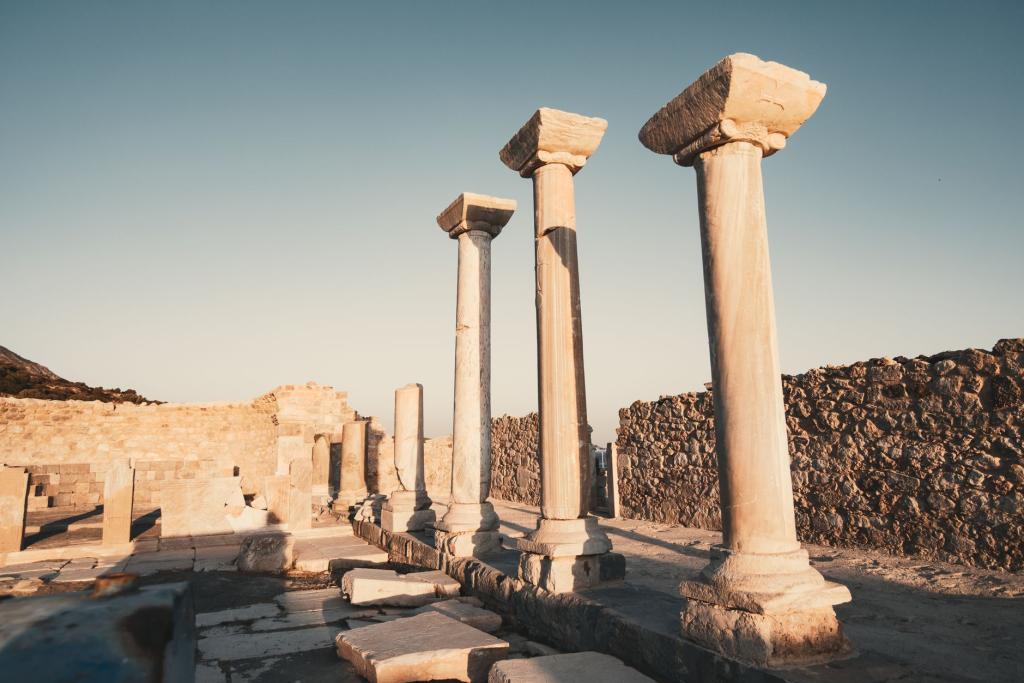
Greek officials have announced that archaeologists working at the royal gymnasium of Mieza in northern Greece have uncovered ornate, mosaic-decorated halls that may have formed part of the Alexander the Great school, where a teenage Alexander is believed to have been taught by Aristotle. According to Smithsonian Magazine, which covered the Hellenic Ministry of Culture's statement on September 28, the finds are the latest in a three-year project peeling back the layers of the 2,400-year-old complex, and they may be the most revealing yet.
The site is Mieza, an ancient Macedonian city, and the complex is the Royal Gymnasium, a roughly thirty-acre site where young Macedonian elites studied, trained, and dined. Based on ancient accounts, scholars have long held that Alexander the Great was tutored by Aristotle at Mieza during the reign of his father, Philip II, in the fourth century B.C. Excavation at the site began in 2024. This year's dig focused on the eastern side of the complex, including the palaestra, or wrestling ring, and the Didaskaleion, the teaching area, where lecture rooms with stone benches came to light.
The standout find inside the Didaskaleion is a three-part complex of more than seventeen hundred square feet: a central entry room flanked by two banquet rooms with surviving mosaic floors and raised platforms that once held dining couches. The buildings were destroyed by the Romans after the second Battle of Pydna in 148 B.C., but officials say significant architectural remains survived. Those remains are now giving researchers a clearer picture of what education looked like for young Macedonian elites, reported by the New York Post.
What the new halls reveal
Earlier seasons at the Alexander the Great school had already mapped a palaestra, a stadium, arcades, and a xystus, a covered track about two hundred meters long where athletes could train in any weather. The new mosaic halls add the missing piece: the teaching itself. Lecture rooms with stone benches point to formal instruction, while the banquet rooms suggest the symposium-style dining that sat at the center of Greek elite life. For a conqueror whose campaigns redrew the map of the ancient world, the setting of his schooling has always been more legend than location. Mieza is changing that, one excavated room at a time.
The attribution deserves as much care as the mosaics. The claim that Aristotle taught Alexander at Mieza rests on ancient accounts, not on an inscription uncovered this season. The ministry's announcement describes halls that may have formed part of the school, and researchers present the Aristotle connection as the long-standing scholarly reading of the site rather than something the stones themselves confirm. That caution is worth keeping. Archaeology advances by narrowing the gap between story and stone, and each season at the Alexander the Great school narrows it a little more.
Why this ancient classroom matters now
Alexander's tutoring by Aristotle is among the most storied pairings in the history of education, yet physical evidence of it has always been thin. Mieza offers something better than another anecdote: rooms, floors, and benches. The complex survived the Roman destruction that followed the second Battle of Pydna, and its remains now let researchers reconstruct what schooling looked like for the young Macedonians who would go on to rule an empire stretching from Greece to India. A royal gymnasium that trained the heirs of Macedon is a remarkable find on its own. That it may be the Alexander the Great school is what will keep this dig in the headlines.
The work is far from finished. The excavation at Mieza is an ongoing project, and archaeologists say future seasons will keep opening new areas of the complex. For now, the mosaic floors and stone benches of the Didaskaleion stand as the clearest physical trace yet of the place where history's most famous student may have learned from history's most famous teacher. The Alexander the Great school is not a metaphor anymore. It has mosaic floors.
Comments 0
No comments yet. Be the first to share your thoughts!
Leave a comment
Share your thoughts. Your email will not be published.