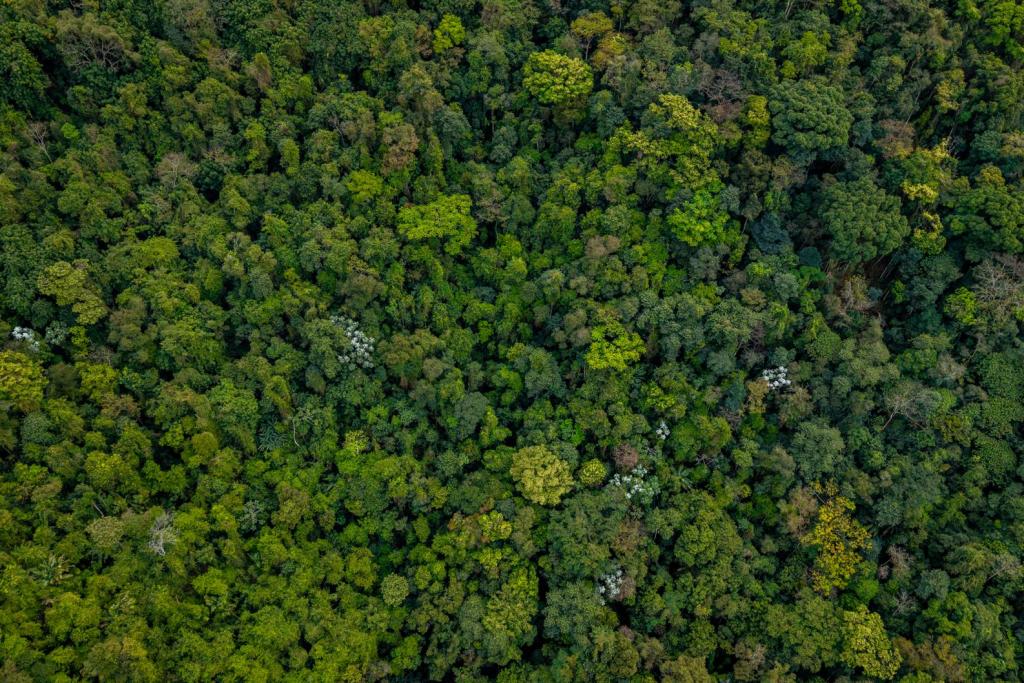
Amazon Wildfires are doing double damage to the rainforest, and the second blow is one nobody has been counting. New peer-reviewed research finds that ground-level ozone generated by wildfire pollution is quietly weakening the Amazon's ability to absorb carbon dioxide — cutting the forest's carbon uptake by an amount equivalent to around 24% of the carbon the fires themselves release. That hidden loss has never been factored into carbon accounting for the region.
The research, led by Dr Flossie Brown of ETH Zurich with colleagues from the University of Exeter and James Cook University, combined nearly three decades of observations with a global vegetation model to track how ozone damage changed from 1997 to 2024, according to the University of Exeter. The study appeared in the journal Communications Earth & Environment.
How Amazon Wildfires Poison the Air Trees Breathe
Ground-level ozone is not smoke itself. It forms when pollutants released by burning react in sunlight, and at low altitude it harms both human health and plant life. When ozone drifts over forest that survived a fire, it slips into leaves through the same tiny pores trees use to draw in carbon dioxide, injuring leaf cells and impairing photosynthesis, as reported by Phys.org.
That is the mechanism behind the double blow: Amazon wildfires release carbon dioxide directly as biomass burns, while the ozone they generate suppresses the surviving forest's ability to capture and store that gas. Trees left standing after a fire are less able to resume their role as carbon absorbers in the months and years that follow — so the forest pays for the same fire twice.
Why Amazon Wildfires Strike Hardest in Drought Years
The damage is not constant. It peaks during major droughts, and the three most extreme Amazon droughts of the past three decades — the El Niño droughts of 1998, 2016 and 2024 — all arrived in El Niño years. During the severe drought that stretched from 2023 into 2024, the ozone toll of Amazon wildfires nearly doubled compared with the average of the previous decade, according to EarthSky.
El Niño is the warm phase of a natural, recurring global climate cycle. It is not caused by human activity, but it now unfolds against rising baseline temperatures that make record heat and extreme weather more likely — which is why drought-linked fire damage keeps setting new records.
That pattern is the reason the researchers are worried about right now. Forecasters warn that a strong El Niño is already developing this year, with the potential to become one of the most intense on record, and the study's authors say another major spike in hidden carbon loss is likely. "We're concerned we could see history repeat itself," said Dr Brown.
"Forest fires don't just release CO2 when they burn," said Dr Brown, the study's lead author. "They also contribute to the rise in ground-level ozone, a pollutant that damages the leaves of surviving trees." The team found this hidden effect amounts to about a quarter of the carbon the fires themselves release — a significant loss to the Amazon's carbon budget that had not previously been considered.
Carbon Accounting Never Counted This Loss
Here is the part that matters for everyone tracking the climate: carbon accounting has not factored in this hidden loss. Official estimates of what Amazon wildfires cost the climate are undercounting — they miss an invisible surcharge equal to roughly a quarter of the fires' direct emissions.
The damage is also concentrated where people are clearing land. Almost all Amazon fires are started by people, through land clearance or agriculture that escapes into standing forest, and the worst ozone damage sits in the so-called Arc of Deforestation, where farmland keeps expanding into rainforest. "The extra ozone damage we're describing is largely preventable," said Professor Stephen Sitch of Exeter — which means cutting deforestation would protect the forest from both the fires and the invisible pollution that follows them.
The experimental side of this science runs at the TropOz facility on the Nguma-bada campus in Australia, where researchers expose vegetation to ozone to study the damage up close — the controlled counterpart to the continental-scale modelling behind the new findings.
The bottom line: fewer Amazon wildfires means less carbon released and less ozone quietly eroding what is left of the forest's ability to soak it back up. For more on forests bouncing back after fire, see Strangler Figs Are Rebuilding Burned Forests From Scratch, and browse the full plants and trees beat for related coverage.
Comments 0
No comments yet. Be the first to share your thoughts!
Leave a comment
Share your thoughts. Your email will not be published.