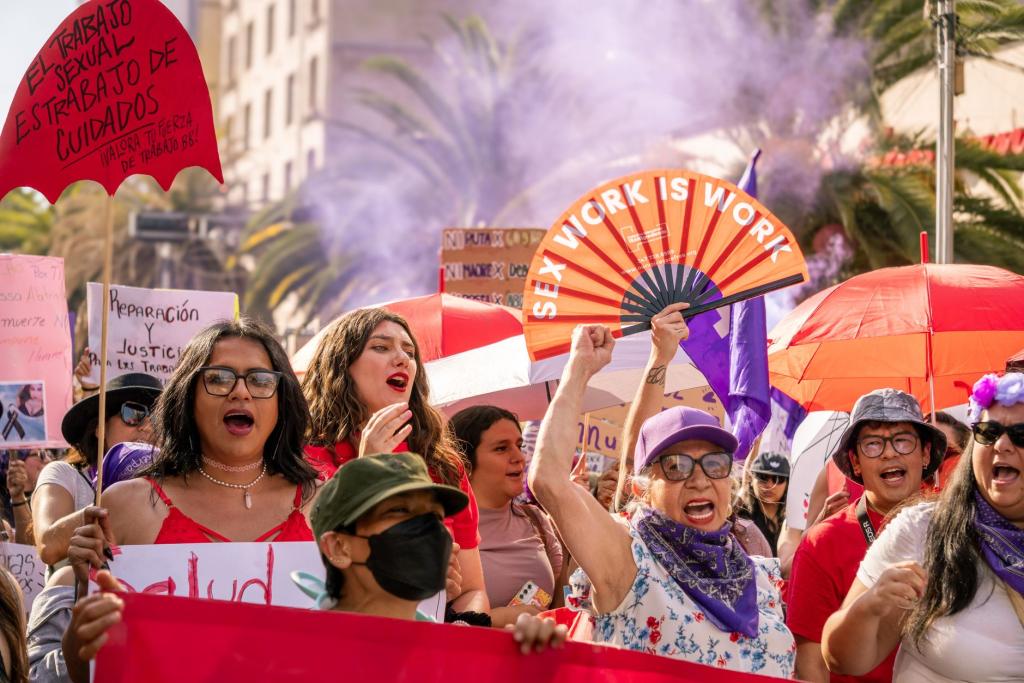
On September 28, the Mexico City abortion march brought hundreds of women and feminist groups into the capital's streets for the Global Day of Action for Access to Legal and Safe Abortion. One large contingent gathered at the Monument to the Revolution and walked toward the Zocalo, while a second group headed into the historic center. The demand, repeated on banners and over loudspeakers, was that abortion be legal, safe, free, and accessible in every part of the country, not only in the states where access has already expanded. Video coverage of the march showed demonstrators insisting that people seeking abortions face no stigma, no legal barriers, and no difficulty getting medical care.
The Mexico City abortion march was never only about the capital's streets. According to EFE's reporting, some participants raised concerns about doctors refusing to provide abortions that are already legal, and about access barriers affecting minors and other vulnerable groups. That complaint lands hard in a country where the right to an abortion can still depend on which state a person happens to live in.
A federal ruling, a state-by-state patchwork
In twenty twenty-three, Mexico's Supreme Court struck down federal criminal penalties for abortion, ruling that the provisions criminalizing it in the federal penal code were unconstitutional. Reproductive-rights advocates celebrated the decision as a victory for the movement across Latin America, according to the Beacon Journal's reporting at the time, and the ruling required federal health institutions to offer abortion care to anyone who asked for it.
But the court's decision did not rewrite every state law, and it shows. EFE reported that seven of Mexico's thirty-two states still criminalize abortion outright, and activists argue that gaps in state legislation and uneven healthcare access mean the right exists on paper without existing in practice. The ruling was supposed to settle the federal question, but the Mexico City abortion march treated it as unfinished business. Mexico City itself decriminalized abortion nearly two decades ago, becoming the first jurisdiction in the country to do so, which makes the capital both the movement's home turf and an outlier.
The green wave stretched across Latin America
The marches were not confined to Mexico. According to Reuters, women also took to the streets in the capitals of Peru and Colombia for the same global day of action. Peruvian activists pointed to denied care for minors, while Colombians turned out to defend the country's twenty-four-week abortion law. Green handkerchiefs, the symbol of Latin America's green wave movement, showed up at rally after rally, and the Mexico City abortion march was no exception.
In Chile, the 8M Feminist Coordinator called for a national mobilization under the slogan "Legal Abortion Represents Social Justice," with the main rally at Santiago's Plaza Dignidad and sister gatherings in cities from Arica to Valparaiso, El Ciudadano reported. The group said the Chilean state still pushes thousands of women and girls toward clandestine options, nearly a decade after a twenty-seventeen law legalized abortion in three narrow exceptions: risk to the mother's life, rape, and non-viable pregnancies. "On September 28, we go out together because justice is not requested: it is demanded!" the Coordinator said in its public declaration.
The Chilean organizers also warned of backsliding. They pointed to a bill before the Chamber of Deputies' Health Commission that would require people terminating pregnancies to listen to fetal heartbeats first, and called it a "dehumanizing punishment" for rape victims and people with non-viable pregnancies or life-threatening conditions. The group added that four out of ten doctors act as conscientious objectors in rape cases, and criticized a separate government-backed bill that would criminalize facilitating access to abortion medication.
Rights advocates in the region are facing pressure from more than one direction. In Turkiye, an LGBTI crackdown unfolded under a campaign called "My Family Is Safe," with police raids targeting community spaces we covered this week. The Mexico City abortion march named the same tension: laws on the books, and a state apparatus pulling in the other direction.
That frustration with closed clinic doors extends beyond Latin America. A recent survey found that a third of women felt dismissed by their doctors, a problem we examined earlier this month. It was a theme of the Mexico City abortion march too: legal rights mean little when the person on the other side of the desk says no.
The September 28 mobilizations belong to a longer regional trend. Across Latin America, countries have loosened abortion restrictions in recent years even as access has narrowed in parts of the United States. But as the Mexico City abortion march made clear, a court decision only starts the process. Until state laws, doctors, and hospitals catch up, the map will keep deciding who gets care. For the marchers, that is exactly what has to change.
Comments 0
No comments yet. Be the first to share your thoughts!
Leave a comment
Share your thoughts. Your email will not be published.