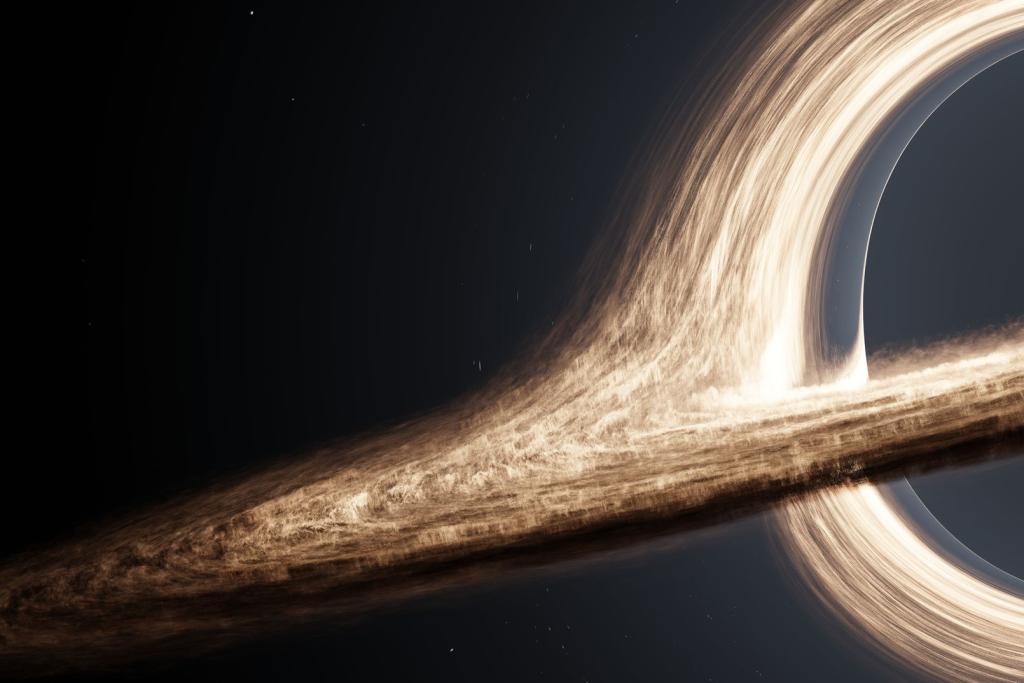
A shredded star has given away a wandering black hole. Astronomers have traced a tidal disruption event dubbed TDE 2023mfm to a massive black hole sitting 1.08 kiloparsecs, roughly 3,500 light-years, from the center of its host galaxy, according to a study reported by Science X Network's Phys.org this week. The find adds this Wandering Black Hole to a small but growing census of runaway giants living far from the galactic cores where such giants are supposed to reside.
Why black holes are supposed to stay home
Supermassive black holes are usually found at the centers of large galaxies, but astronomers have recently uncovered a population of wanderers far from those centers. They may end up off-center through gravitational-wave recoil, slingshot ejections, stalled orbital decay during galaxy mergers, or long-lived binaries and triples. Such drifters matter because finding them helps researchers understand the population and evolution of the lesser-studied intermediate-mass and massive black holes, as the study authors explain.
The problem is that dormant black holes are nearly invisible. They produce no steady glow when they are not feeding, so astronomers only spot them when something unfortunate happens nearby. That is what a tidal disruption event provides: a star that wanders too close gets ripped apart by gravity, and the debris stream lights up the sky across multiple wavelengths, betraying the location of its destroyer. TDE 2023mfm was first flagged by the Zwicky Transient Facility and then examined with an unusually wide fleet of telescopes, including Keck, Lick, Hubble, Swift, Chandra, XMM-Newton and the Very Large Array.
What the wreckage looks like
The optical light curve of the event peaked within thirty days and then faded slowly over about a hundred days. Fitting the light across wavelengths, the team inferred a temperature near twenty thousand Kelvin that stayed hot for more than a month after the peak. A clear broad hydrogen line in the spectrum places the event in the TDE-H class, whose spectra show only hydrogen emission, and together with the blue colors, the sustained heat and the off-center position, the team classified it as a genuine off-nuclear event.
Three independent methods put the black hole's mass at roughly one million to ten million times the mass of the sun, similar to many known tidal disruption events. Its brightness and timing closely match another off-center event, TDE 2024tvd, in peak brightness, duration and host galaxy size, which gives researchers a rare point of comparison between two runaways. One puzzle is the silence in X-rays: no X-ray emission came from the disruption itself, though a faint X-ray source was detected that most likely belongs to the galaxy's nucleus. About four in ten optically discovered tidal disruption events turn X-ray bright later, so a late-blooming X-ray phase is still possible, but events that stay faint for years are, in the team's words, not unprecedented.
The radio signal that arrived two years late
The strangest chapter is written in radio waves. The Very Large Array saw nothing from TDE 2023mfm until a faint signal finally switched on about 991 days after the flare, roughly two and three-quarter years later, and changed only slowly afterward. That sets it apart from its off-center cousin TDE 2024tvd: the two look much alike in visible and ultraviolet light, but the newcomer's radio behavior is faint, late and slowly evolving. Whether that difference comes from a missing early outflow, a different surrounding gas environment or simply the viewing angle remains an open question, and the researchers say further radio observations may settle it.
"If radio emission is also detected from the off-nuclear TDE, this can provide a confirmation for the off-nuclear massive black hole and a precise measurement between the two black holes," the researchers wrote in their paper, which was posted to the preprint server in late September 2026. A confirmed second radio source would nail down the distance between the wandering giant and the one sitting at the galactic center.
How did it get out there?
The team explored several origin stories for the displaced black hole. One possibility is that it is the stripped remnant of a small galaxy that collided with the host. A compact clump of stars, around ten million to a hundred million solar masses, sits at the black hole's location, but it is far too light for the black hole's mass, which means the original galaxy must have been heavily stripped of its stars. Another scenario is that the black hole was ejected from a triple black hole system by gravitational-wave recoil. The researchers estimate such ejections could account for about one percent of tidal disruption events, so with around 250 known optical events, one such case appearing is plausible by the numbers alone.
A third idea, that two black holes merged and the gravitational waves kicked the merged remnant out of the center, is effectively ruled out: the galaxy's center clearly hosts its own black hole, shown by a faint active galactic nucleus. That means this galaxy has two black holes, which makes the stripped minor-galaxy scenario the most plausible of the bunch.
For readers watching from the cheap seats, the takeaway is that the universe keeps more black holes in more places than the textbook picture suggests. Each Wandering Black Hole found through a shredded star fills in the population of runaway giants and the galaxy mergers that scattered them. The full study, led by Itai Sfaradi of the University of California, is available as a preprint at arXiv. For more cosmic detective work, see how astronomers found the first green star ever recorded, how the MMX mission will grab the first Mars moon dirt, and the mystery JWST signal in a supposedly empty patch of sky.
Comments 0
No comments yet. Be the first to share your thoughts!
Leave a comment
Share your thoughts. Your email will not be published.