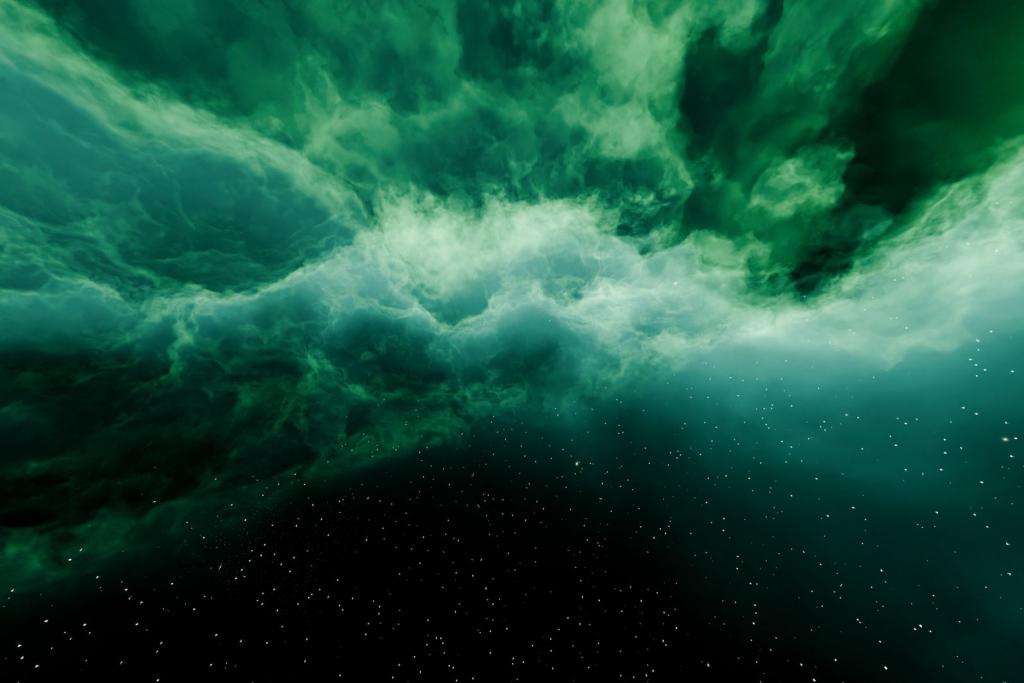
Astronomers say they have spotted the first green star ever credibly reported, and it turns out to be a dead one. The glowing oddball is a white dwarf, the burnt-out core left behind when a sun-like star runs out of fuel, and it looks chartreuse because of what it has been eating. Its cosmic snack of choice? Pieces of its own former planets.
A dead star with a ghostly green glow
The team, led by Mark Hollands at the University of Warwick in the United Kingdom, calls the object WD J1330+6435. According to The Independent, it is a cool white dwarf with a surface temperature of about four thousand degrees Celsius. Rocky debris from the planetary system it once anchored has rained into its atmosphere, loading it up with calcium, lithium and sodium.
That sodium is the star of the show. "The traces of sodium in the atmosphere of this white dwarf absorb the orange part of the spectrum, leaving behind a ghostly green glow," Hollands said, as quoted by Space.com. He added that standing on a planet and looking up at a green star "feels like something out of science fiction."
Here is the wild part: the researchers say no other star, living or dead, has ever been credibly reported as green. That makes this the first green star on record, and it arrived just in time for spooky season.
Why stars are not supposed to do this
Most stars follow a simple rule. Cooler ones look orange, medium ones like our sun look white, and the hottest burn pale blue. Astronomers call these objects perfect radiators because temperature alone sets their color, a bit like a blacksmith's iron glowing red, then orange, then white-hot.
White dwarfs were assumed to play by the same rules. But these stellar corpses are absurdly dense, with matter packed to roughly the density of water in a star-sized object, millions of times denser than the sun's visible surface, according to Space.com. In that crush, elements such as carbon, calcium and sodium interact with the surrounding plasma and soak up a much wider range of light than they would in a thinner atmosphere.
The result is that the color of a white dwarf reflects its chemistry, not just its heat. As the research paper puts it, white dwarfs are so far the only known way to make a green star.
Pink, yellow, cyan and the reddest star yet
Green is only one color in the palette. The team ran the light fingerprints of white dwarfs through models of human color vision to work out what each would look like to the naked eye, since no white dwarf is close enough for us to see its true shade. Carbon-rich ones glow pink or purple, those polluted by shredded asteroids and comets lean yellow, and cooler dwarfs with mixed hydrogen and helium atmospheres appear cyan or pale blue.
The study also flags what could be the reddest star ever found. That one, WD J1011+2845, sits only forty-eight light years away. Carbon is lifted from its interior up to its surface, where it warps the light into a deep salmon-pink glow unlike anything else in the sky, the Independent reported.
So the universe is a lot more colorful than the textbooks suggested. If you could fly past a graveyard of dead stars, you would see a whole mood board of neon shades instead of a bunch of identical white lights.
Do not expect a green sky tonight
Before anyone starts hunting for a green dot with a backyard telescope, the numbers are a reality check. Of the one hundred fifty-one white dwarfs the team studied within about sixty-five light years of Earth, only five had extraordinary colors, with two yellow and three pink. The other one hundred forty-six averaged out to a cool white, the Independent noted.
Extrapolating from that sample, the researchers estimate that roughly one in thirty white dwarfs has an unusual color. "One in thirty might not sound like a huge fraction, but across the entire population of white dwarfs in the universe, that is still a lot of oddly colored stars out there," Boris Gänsicke of Warwick said. The average white dwarf, he stressed, really is white.
There is one more caveat. The paper notes the spectrum of the green star is somewhat noisy, so its true chromaticity could differ slightly in reality, though an older model gave a similar hue. The finding was published on October fifteenth in the journal RAS Techniques and Instruments.
What it means for our own sun
The discovery is a fun headline, but it also gives astronomers a new tool. A white dwarf's color is a quick visual clue to what is in its atmosphere, which in turn hints at what its old planets were made of. Dead stars that gobble up their former worlds are basically leaving behind a color-coded autopsy report.
It also hints at the future of our own solar system. In several billion years the sun will swell, shed its outer layers and shrink into a white dwarf. If any rocky leftovers fall onto it the way they did on this distant star, our sun could one day glow with a faint green tint too, a point Space.com made with a cheeky nod to zombies.
For now, the lesson is that space still has plenty of surprises hiding in plain sight. Want more cosmic weirdness? Check out our science coverage for the latest discoveries.
Comments 0
No comments yet. Be the first to share your thoughts!
Leave a comment
Share your thoughts. Your email will not be published.