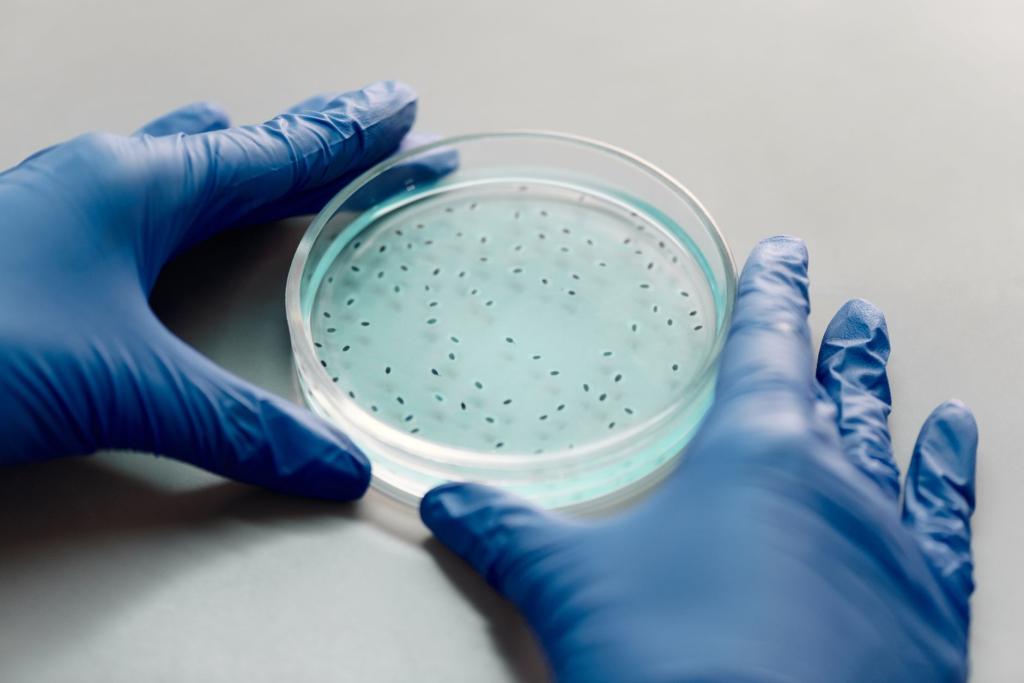
Researchers in England have shown that clusters of lab-grown human brain cells can tell the letters of the Braille alphabet apart, an experiment that edges living tissue a step closer to a role inside future computers. In the study, published this October in Frontiers in Artificial Intelligence, the Braille-reading brain organoids took signals from a real touch sensor and fired back neural patterns that a simple decoder could read as specific letters, a result the authors describe as a key step toward biohybrid computing.
The work was led by Tianyi Liu, a PhD candidate at Bristol University, with senior author Dr. Benjamin Ward-Cherrier. It tackles one of the hardest problems in the young field of organoid computing: getting living tissue to reliably receive information from the outside world and hand something useful back. According to the peer-reviewed paper, the team recorded tactile data from the 26 letters of the Braille alphabet with a touch sensor, converted that data into patterns of electrical stimulation, and played the patterns into human forebrain organoids resting on multielectrode arrays. A support vector machine, a simple classification algorithm, then sorted the organoids' neural activity to check whether the responses still carried the identity of the letter.
A lone organoid, a speck of tissue less than a millimeter wide holding about 10,000 neurons, produced patterns a decoder could read correctly about 61% of the time. Pooling the responses of three organoids working together lifted performance sharply to 83% accuracy, and the combined setup also held up better when the scientists deliberately blurred the signals with artificial noise. The decoder reading the obscured signals directly, with no organoid in the loop, was fooled more easily, which suggests the living tissue was doing real work rather than simply passing data through.
Why the trio of Braille-reading brain organoids beat the soloist is still unclear. Liu said individual organoids may have slightly different wiring, growth stages and background activity, so the same input can produce similar-but-not-identical responses, and combining them may supply complementary information that a lone organoid cannot offer. She added a caution: the same variation that helps today makes predictable, standardized living hardware harder to build.
From fingertip to living circuit
The pipeline has four stages. First, the touch sensor, an event-based device named the Evetac, scans embossed Braille characters and records how each dot pattern changes over time. Next, a transferable encoding strategy translates those tactile events into electrical stimulation patterns, built from systematic tests of pulse counts, phase amplitude, phase duration and trigger delay against the organoids' spike responses. The multielectrode arrays then deliver the patterns to the tissue and listen to the neural activity that comes back. Finally, the classifier reads those activity patterns and names the letter.
“We can take information from a real tactile sensor, turn it into a form that a living neural network can receive, and then recover meaningful information from the organoid response,” Liu said in a statement about the findings. She added that this gives researchers a practical way to connect artificial sensors with biological neural systems, a possible route toward far more energy-efficient computing, since living neurons process information on a fraction of the power that silicon chips demand.
From playing Pong to reading Braille
The result lands in a fast-moving field. A few years ago, the Melbourne company Cortical Labs showed that hundreds of thousands of lab-grown neurons wired to an electrode array could learn to play the video game Pong in a closed feedback loop. Another milestone, a hybrid system called Brainoware, paired a brain organoid with conventional electronics and learned to recognize different human voices. The new study pushes the field in a different direction: instead of training tissue by trial and error, it shows that a real-world sensor signal can be encoded, delivered to living tissue and decoded again, reliably enough to matter, and more reliably when several organoids vote together.
That encoding step is the quiet breakthrough. Earlier demonstrations proved organoids can respond to stimulation; this one builds the bridge between the physical world and the dish, translating touch into a language the tissue can receive. The Bristol team says the same framework could eventually be extended to other senses, a prerequisite for any computer that genuinely mixes biology and electronics.
The big questions: awareness, consent and hype
None of this means a dish of cells is thinking. Experts generally agree that today's organoids, which lack most of the structures of a real brain, are not conscious, nor close to it. But bioethicists warn that the field is moving faster than the rules: there are few specific legal limits on neural organoid use anywhere, and tissue donors are rarely told their cells might one day end up inside a computing experiment, a gap that could erode public trust in biomedical research. Some computational neuroscientists are also skeptical that living circuits can ever be engineered with the precision of silicon, arguing that neurons do what they were wired to do rather than what a designer instructs, as reporting on the study has noted.
For now, the honest takeaway sits between the two poles: Braille-reading brain organoids are research instruments, not processors, and nobody is about to slot one into a laptop. But the study answers a concrete question the field needed answered, can living tissue receive a real sensor signal and return decodable information, with a yes that gets stronger when organoids work as a team. The next steps are bigger ensembles, longer-lived tissue and, eventually, closed loops where the organoid's output steers the world it senses. For a generation that may one day touch robots, prosthetics or assistive devices that feel the way biology does, that bridge between fingertip and living circuit is worth watching.
Comments 0
No comments yet. Be the first to share your thoughts!
Leave a comment
Share your thoughts. Your email will not be published.