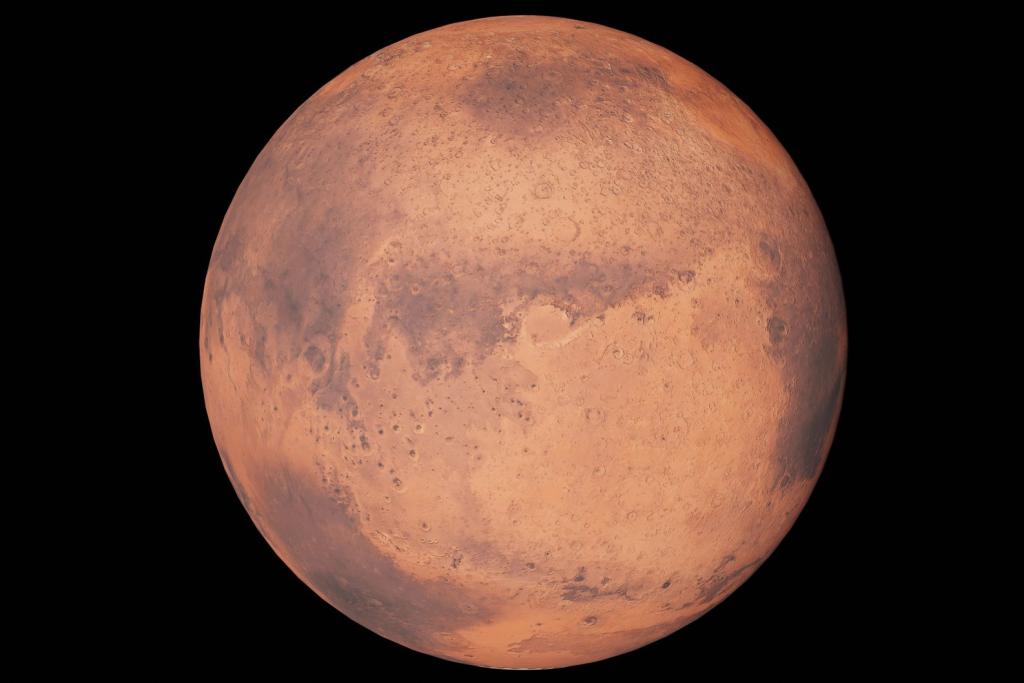
A moon the width of a city is about to get its first visitor with a shovel, and the MMX Phobos Mission is the one carrying it. Japan's Martian Moons eXploration spacecraft is scheduled to lift off on an H3 rocket from the Tanegashima Space Center on October 19, 2026 at three forty-one in the afternoon Eastern time, which is four forty-one in the morning on October 20 in Japan, according to Space Policy Online, which covered this week's NASA mission briefing. The target is Phobos, the larger of Mars' two moons, and the cargo coming home will be the first material ever deliberately collected from the Martian system and returned to Earth. If the schedule holds, a sealed capsule of Phobos soil will parachute into the Australian desert in 2031.
That makes this more than a cool launch to watch from your phone. The MMX Phobos Mission is designed to settle one of the longest-running arguments in planetary science: where did Mars' moons actually come from? Scientists have argued about it since the American astronomer Asaph Hall discovered Phobos and Deimos in 1877, and right now there are three competing theories instead of two. Telescopes and orbiters can only guess from a distance. A spoonful of real dirt, studied in a lab on Earth, could end the debate for good.
The five-year road trip, milestone by milestone
The spacecraft will not arrive tomorrow. According to the mission timeline reported by the Planetary Society, the MMX Phobos Mission will cruise through deep space for roughly ten months after launch and slide into orbit around Mars in August 2027. It will then spend more than a year mapping Phobos from a safe distance, picking a landing site on a surface that is barely holding itself together. Sample collection is planned for no earlier than December 2028, after NASA acting planetary science director Lindsay Hays briefed reporters this week.
That slow pace is partly about gravity, or the lack of it. Phobos pulls with roughly one two-thousandth of Earth's gravity, which puts the mission in an awkward middle ground for the MMX Phobos Mission. The gravity is too weak for normal orbiting or conventional landing tricks, yet strong enough that the spacecraft cannot just hover and grab like it did at an asteroid. Instead, the probe will fly in strange looping paths near the moon, then descend on its own, because radio signals take up to twenty minutes to travel between Earth and Mars. Real-time joystick control is impossible, so the spacecraft will compare the ground below it with crater maps it carries onboard and steer itself to a safe spot.
Once it lands, the work happens fast. The spacecraft carries two complementary sampling systems: JAXA's coring device, which drills below the surface, and a pneumatic collector built by Honeybee Robotics that fires a burst of gas to scoop surface material. The NASA-built sampler sits on one of the landing legs, and according to Space Policy Online, Honeybee Robotics vice president Kris Zacny described the whole collection as happening in a matter of seconds, adding that you blink and it is all done. The spacecraft is designed to touch down, collect and lift off again in a single pass, because Phobos circles Mars every seven point six five hours, and mission designers only get one window per orbit.
After the sampling, the main spacecraft leaves Mars orbit in 2030, carrying a return capsule on a year-long cruise home. The capsule is meant to survive the plunge through Earth's atmosphere and land in Australia in 2031. From there, the samples enter a global curation program, with NASA receiving at least fifteen percent of the returned material for study and long-term storage at its Johnson Space Center in Houston.
An international science team is riding along
This is a Japanese-led mission, but the passenger list is global. The spacecraft weighs four thousand four hundred eighty kilograms at launch and carries eleven science instruments across three interlocking modules, according to JAXA. France and Germany contributed a twenty-five kilogram rover called Idefix that will be dropped onto Phobos to scout the surface. NASA's contributions go beyond the sampler: the agency is providing the MEGANE gamma-ray and neutron spectrometer, built by the Johns Hopkins Applied Physics Laboratory, which will measure the moon's elemental composition as the spacecraft flies close to the surface. NASA is also supplying deep-space communications support through its Deep Space Network.
The American investment is not small. NASA puts the fourteen-year life cycle cost of its participation at eighty-seven million dollars. In return, the United States gets a guaranteed share of the samples, and Hays said the agency will preserve its portion for future research, so that scientists decades from now can run experiments nobody has invented yet. That long view is a JAXA specialty: the agency's Hayabusa missions previously returned samples from two asteroids, Ryugu and Itokawa, and the MMX Phobos Mission is the next step in that sample-return tradition, scaled up from a near-Earth asteroid to the Martian system.
JAXA project manager Yasuhiro Kawakatsu has called the finished spacecraft the team's starting line, framing launch as the beginning of the hard work rather than the finish. He is right to be cautious, because the rocket itself has a scarred history. The H3 vehicle suffered a catastrophic failure in 2023 and another in December 2025 before returning to flight this past June, as Tech Times reported. A backup launch window reportedly extends through November 7 if weather or technical issues scrub the first attempt.
Why a spoonful of moon dust is worth the wait
The scientific payoff hinges on chemistry that cannot be done from orbit. Spectral observations from spacecraft can estimate which minerals sit on Phobos' surface, but they cannot measure isotopic ratios precisely enough to pin down where the rock came from. Isotopes are the chemical fingerprints that tie a rock to its parent body, and they require a physical sample in a laboratory. That is why three theories are still alive: Phobos could be a captured primitive asteroid, debris from a giant ancient impact on Mars, or the remains of an asteroid torn apart by Mars' gravity. Each theory predicts a different fingerprint.
The comparison with Earth's own Moon shows what a sample can do. Scientists settled the giant-impact origin of our Moon only after Apollo astronauts brought rocks home for study. A Phobos sample could do the same for the Martian moons, and because the moons may preserve material from the early solar system, the results could shed light on how planets and their satellites assembled more than four billion years ago. The mission may also scout whether Phobos could serve as a natural staging post for future crewed trips to Mars, a concept JAXA has floated as essential groundwork.
For anyone watching, the launch itself is the moment. Liftoff is set for a Monday afternoon in the eastern United States, which means you can watch the MMX Phobos Mission begin a five-year journey in real time, just as NASA closed the book on its Artemis II heat shield verdict this week. The payoff lands in 2031, when the sample capsule comes home. By then, today's college students will be well into their careers, and the first grains of a Martian moon ever brought to Earth will be waiting in laboratories for them to study. If you like cosmic mysteries with real stakes, our look at a mystery JWST signal in an empty patch of sky is worth a read too.
Comments 0
No comments yet. Be the first to share your thoughts!
Leave a comment
Share your thoughts. Your email will not be published.