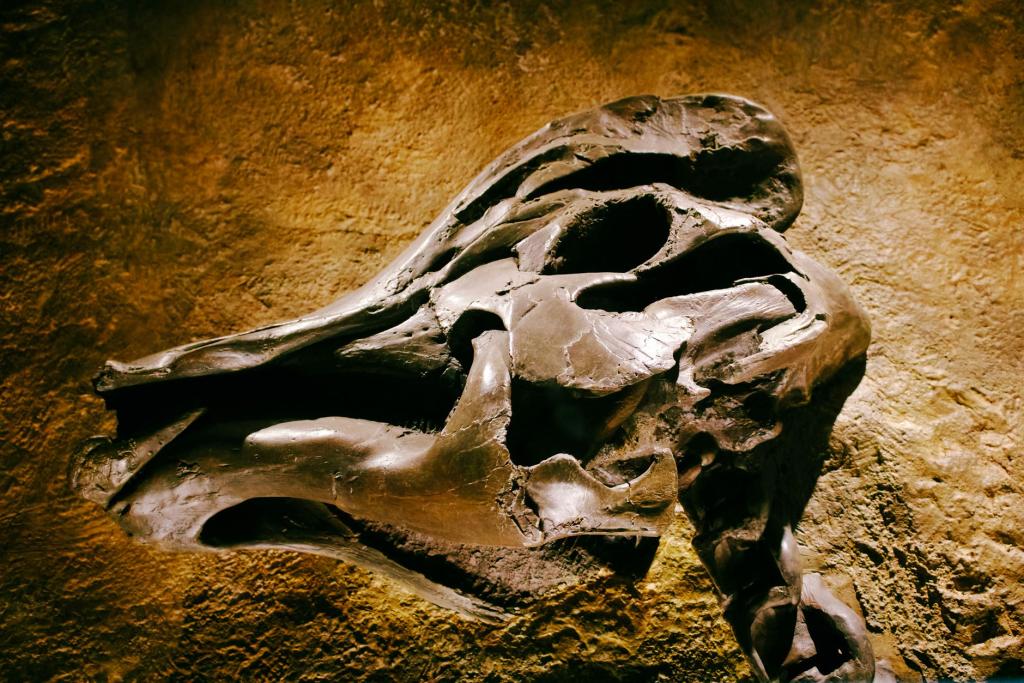
A fossil that sat in a London museum drawer for a century has finally been given a name, and it belongs to a New Dinosaur. According to the museum, scientists used CT scans to show that a weathered braincase found on the Isle of Wight comes from a previously unknown predator, the first of its long-clawed group ever found in Europe.
The story starts at the foot of a cliff on the island's southwest coast, near a village called Brook, where amateur fossil hunter Reginald Walter Hooley picked up the fragment. After Hooley's death, his widow sold more than a thousand of his specimens to the museum in May 1924, and the braincase entered the collection. It sat there, largely unstudied, for roughly a hundred years, even though the animal it came from had walked the Earth about one hundred and twenty million years ago.
A mystery solved with X-ray vision
The breakthrough came when a team led by Cassius Morrison, a researcher at University College London, gave the fossil a second look with modern scanning. Using computed tomography, the researchers built three-dimensional models of the braincase's internal and external structure and compared them with the skulls of other two-legged predators. The fossil showed a distinctive combination of features, including an oval-shaped opening for the spinal cord and an unusual bony crest. Their analysis placed it among the megaraptorans, a group of agile meat-eaters related to tyrannosaurs, and the full findings appeared in Royal Society Open Science.
Naming a New Dinosaur from a single piece of skull is unusual, but the case was strong enough that the team gave the animal a formal scientific name: Invictibellatrix amberina, which translates roughly as "unconquered female warrior." A short conference abstract had flagged the fossil as unusual in 2024, but the new paper makes the identification official.
Built to grab rather than to bite
The New Dinosaur was no giant. Based on its closest relatives, the researchers estimate it stretched three to four meters long and stood about as tall as a person, weighing roughly two to three hundred kilograms, comparable to a large tiger. It probably carried a coat of simple feathers, and its hand claws may have measured ten to twenty centimeters, according to the Brighter Side of News.
What sets megaraptorans apart is their hunting style. Tyrannosaurs relied on massive heads and crushing bites, but these predators had relatively slender skulls, powerful arms and curved claws built for grabbing and restraining prey. "It would have eaten small dinosaurs, lizards and mammals," Morrison said, filling a role in the food chain similar to a hyena's, according to Live Science. He added that for humans, the animal might have been deadlier than its famous cousin: "We would have been perfectly sized prey, about a third of their body weight. They definitely would have chased us."
A map of ancient hunters redrawn
Until now, megaraptorans had turned up in Asia, Australia and South America, but never conclusively in Europe. The new find plugs that continental gap. Mathematical modeling in the paper supports a dispersal route that began in Asia, passed through Europe and reached the southern continents, making the island predator an early waypoint in a global spread, as Knowridge reports.
The animal's small size carries its own message. Later members of the group stretched six to ten meters and topped two thousand kilograms, so this modest hunter suggests megaraptorans evolved their giant bodies relatively late. "Work like this shows the exceptional value of working with historical museum collections where there are still many discoveries to be made," said Paul Barrett, the study's senior author at the museum, according to Euronews. He noted that despite more than two hundred years of collecting, the island keeps producing new species. For a New Dinosaur known from a single braincase, it has already rewritten a chapter of predator history.
The bigger lesson is about the drawers, not the dinosaur. Museums around the world hold millions of specimens that have never been fully studied, and this week's paper shows that a world-first discovery can hide in plain sight for a century. It is the same quiet power behind other collection-based surprises, from ancient microbes foreshadowing modern medicine to new imaging tricks revealing hidden biology in living animals. Sometimes the next great find is not buried in rock. It is already on a shelf, waiting for someone to look again, much like the Alaskan camp rewriting the story of the first Americans without a single new excavation.
Comments 0
No comments yet. Be the first to share your thoughts!
Leave a comment
Share your thoughts. Your email will not be published.