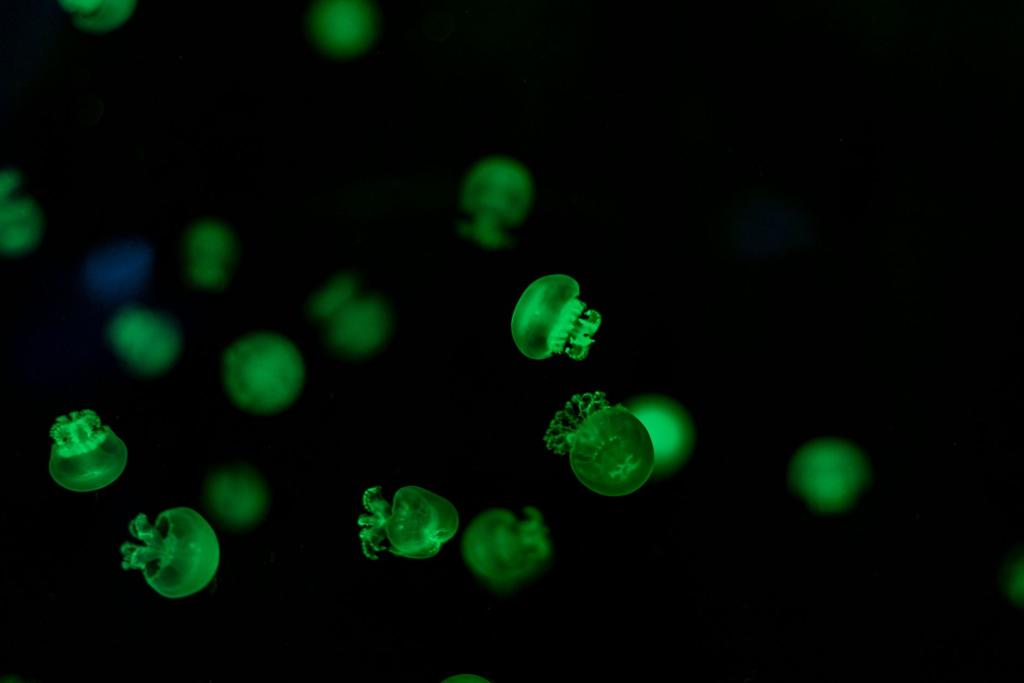
A Glowing Cuttlefish may sound like something from a late-night sci-fi binge, but this month it became a real animal. Researchers have created the first cuttlefish whose neurons light up green when they fire, giving science an unprecedented window into one of the ocean's most mysterious minds.
According to the team's preprint on the work, published this month, the transgenic pygmy cuttlefish carries an added gene that produces a fluorescent protein whenever its brain cells activate. The trait is heritable, meaning the glowing gene passes down to the next generation of offspring. For the first time, scientists can watch a living cephalopod brain at work in real time, neuron by neuron, while the animal hunts, hides and changes color.
Six Years and More Than Four Thousand Embryos
Getting there was a marathon. The project was led by neuroscientist Tessa Montague of the Zuckerman Institute at Columbia University, and reports on the work say it took more than four thousand embryo injections over six years to produce a stable glowing line. Cuttlefish embryos are notoriously difficult to manipulate, which is why no transgenic cephalopod had ever been made before.
The breakthrough could put cuttlefish in the same league as the laboratory's favorite model animals. Zebrafish and fruit flies became neuroscience staples precisely because scientists can engineer them to reveal their inner workings; until now, coleoid cephalopods had been locked out of that toolkit. A separate team at Cold Spring Harbor Laboratory reported its own method for generating transgenic cephalopods in a preprint in September, using microinjection and CRISPR-based approaches to introduce fluorescent reporters into embryos. That work has not yet been peer reviewed, and independent replication will be needed before the method spreads to other labs.
The animals' native camouflage system is what makes the new view so valuable. Cuttlefish control their skin through three layers of chromatophores holding yellow, orange, red, brown and black pigments, and they can shift their appearance in a fraction of a second. Matching exactly which neurons fire during those rapid changes has been guesswork until now.
Why Scientists Are Obsessed With These Animals
Cuttlefish are already celebrities in animal-cognition research. In one famous experiment adapted from the marshmallow test given to young children, six common cuttlefish could eat a piece of king prawn immediately or wait for a live grass shrimp they preferred; the most patient waited more than two minutes, a result in the same range as chimpanzees, crows and parrots. Other work has shown the animals remember what they ate, where and when they ate it, a kind of memory once thought limited to mammals and birds.
Fresh results from the University of Vienna add a deep-evolutionary twist. A team there mapped how DNA folds inside the cells of octopuses, squid and cuttlefish and found that an ancient burst of genome reorganization, hundreds of millions of years ago, reshuffled the genetic code and brought distant DNA regions into contact, rewiring how genes are regulated over long timescales. The findings were published in the peer-reviewed journal Nature Communications.
"The genome isn't just a sequence of genes," lead author Dr. Thea Rogers said. "It's folded into a complex three-dimensional structure. Understanding how that structure evolves is becoming increasingly important for understanding how new forms of biological complexity arise."
For readers who grew up on octopus documentaries and aquarium TikToks, the implications are tangible. If the technique holds up, the Glowing Cuttlefish line could let researchers record the neural patterns of a cuttlefish recognizing a familiar face at the glass, choosing which camouflage to deploy, or deciding to strike at prey. That is the kind of direct brain-to-behavior link neuroscientists have dreamed about for decades, in an animal whose brain architecture is completely alien to our own.
There is a counterpoint worth taking seriously. Genetically modifying a wild-behaving marine animal for laboratory study raises ethical questions that no amount of cool footage settles. A public poll attached to coverage of the announcement asked whether engineering marine animals this way is acceptable at all, and opinion was far from unanimous. The Columbia team's work also still needs to pass peer review, the same standard as any claim this big. Until independent labs reproduce the glowing line, a dose of healthy skepticism is fair.
Still, the Glowing Cuttlefish project marks a turning point for how science studies invertebrate minds. For years, cuttlefish intelligence has been a black box with spectacular outputs: instant camouflage, puzzle-solving, what looks suspiciously like self-control. Now, for the first time, scientists can see the machinery behind the magic, one lit-up neuron at a time.
Curious about other strange frontiers of science? Read about the ancient microbes that invented the RNA trick medicine uses now, or the high schooler who discovered three galaxies that break the rules. For another look at animal biology under the microscope, see how wind is quietly reshaping the world's forests.
Comments 0
No comments yet. Be the first to share your thoughts!
Leave a comment
Share your thoughts. Your email will not be published.