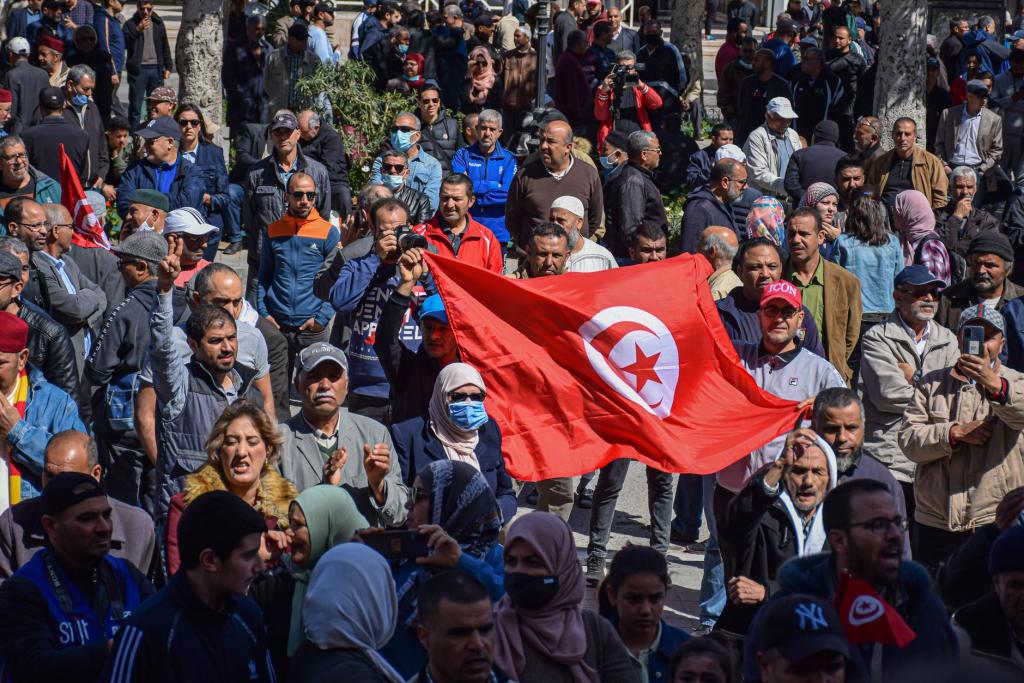
The Tunisia protest on Saturday became the biggest street challenge to President Kais Saied in years, as thousands marched through Tunis accusing him of undermining democracy and wrecking the economy, according to Reuters. If you grew up hearing about the Arab Spring, this is the country where it all started, and it is stirring again.
What happened in Tunis
The march was led by the powerful UGTT labour union and a wide set of civil society groups. Marchers walked along Habib Bourguiba Avenue, the same stretch that became a focal point of the uprising in 2011. Hundreds of police were deployed across the capital, Reuters reported.
What made the day stand out was who showed up. Opposition parties from across the political spectrum joined lawyers, doctors, journalists, unemployed people and activists in what Reuters called a rare show of unity. For years, a divided opposition struggled to pull big crowds, and that weakness has long helped Saied hold on.
The chants were blunt. Protesters shouted "No fear, power belongs to the people" and "The prisons are full, people are hungry." They also revived the famous slogan of 2011, "The people want the fall of the regime."
Why people are so angry
Reuters says the Tunisia protest comes as the country grapples with an economic crisis, worsening public services, recurring water and power cuts, and shortages of medicines and essential goods. Protesters also demanded the release of Saied's critics and an end to what they described as attacks on trade union rights. Some carried banners about unemployment and pollution.
One protester, Yassine Gharseli, travelled from Sfax, about one hundred and fifty-five miles south of Tunis. "Enough is enough! The country is collapsing," he told Reuters, describing power and water cuts and one crisis after another. UGTT head Slah Eddine Salmi told the rally that silence will no longer be acceptable and that a state cannot be built by concentrating all powers in one person's hands.
A summer of shortages
This did not come from nowhere. Writing for the Brookings Institution in August, analyst Sharan Grewal described a record-hot summer in which some regions neared one hundred and twenty degrees Fahrenheit. Water and electricity shortages, he wrote, were producing growing discontent with Saied's rule.
According to Brookings, the July anniversary of Saied's takeover brought some of the largest protests against him until then, and more demonstrations followed in August. Grewal argued that Saied's old playbook of blaming parties, businessmen, migrants and foreign powers is no longer working, because people can literally feel that things are not working when the taps run dry.
Brookings also pointed to unusual cracks inside the system. Some members of a parliament long seen as a rubber stamp have openly criticised the government, and one lawmaker has been preparing a censure motion. Those are claims from an outside analyst, and the outcome remains uncertain.
How Saied got here
Saied seized broad powers in 2021 and 2022, dissolving parliament, dismissing dozens of judges and ruling by decree, moves his opponents describe as a coup. Rights groups say he has intensified a crackdown on civil society, journalists and opposition figures. Saied rejects those allegations, says he is not a dictator, and accuses his opponents of engineering economic crises to fuel unrest.
That history is why Saturday's turnout matters. A government that has leaned on the line that critics are conspirators now faces a crowd that includes doctors, lawyers and unions, groups that are much harder to wave away.
What to watch next
A single march does not topple a government, and Tunisia's security forces remain deployed. The real test is whether the UGTT and the opposition can keep this unity going once the cameras leave, and whether Saied responds with concessions on services or with more arrests.
For Gen Z readers, the takeaway is simple: the generation that watched 2011 on screens is now watching a sequel play out over power cuts, empty pharmacy shelves and political prisoners. We will keep following how this Tunisia protest develops. For more coverage, see our world desk.
Comments 0
No comments yet. Be the first to share your thoughts!
Leave a comment
Share your thoughts. Your email will not be published.