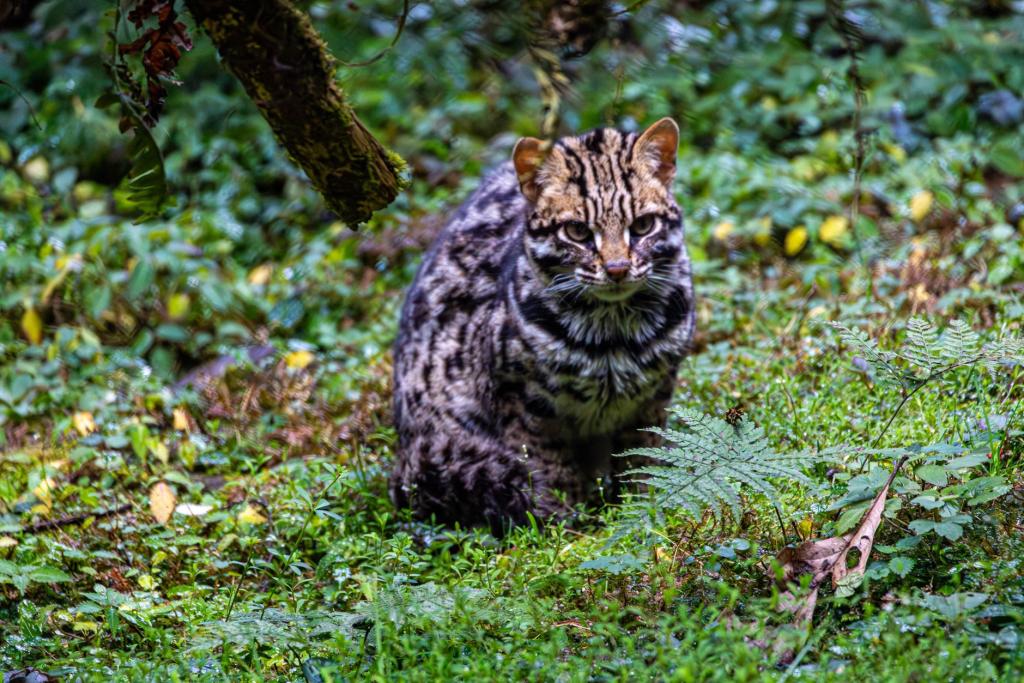
Scientists have formally described a new species of wild cat for the first time in more than a century. The tilcayo tiger cat, Leopardus tilcayo, is smaller than an average house cat, wears a leopard's spots, and lives in the cloud forests of Bolivia's Yungas region, where the eastern Andes meet the Amazon basin.
The description was published on September 17, 2026, in the journal Current Biology. It names the cat after the word local communities already used for it, tilcayo, a nod to the people who knew the animal existed long before science did. Genomic analysis and museum specimens confirmed what a decade of fieldwork suggested: this is not a strange-looking oncilla or margay. It is its own species. Around 1.4 million years ago it split from its closest tiger cat relative.
The story started in 2016 with a phone call. Paola Nogales-Ascarrunz, a Bolivian biologist and National Geographic explorer, was contacted by a wildlife sanctuary about what staff called a "weird cat." A man from a forest community near La Paz had found the animal as a kitten by a road, assumed it was an unusual domestic breed, and raised it for about a year before bringing it to the Senda Verde sanctuary. When Nogales-Ascarrunz saw it, she thought it was still a kitten. It measured around 46 centimeters and weighed roughly 1.4 kilograms, smaller than most house cats, with rounded ears, a long tail, and a light-brown coat marked with irregular dark rosettes.
Why it took a century to notice
How does a whole cat species stay unnamed until 2026? Tiger cats look a lot alike. The genus Leopardus holds several small spotted South American cats that are genuinely hard to tell apart by eye, so a new one can hide in plain sight for decades. Then there is the geography. The Yungas cloud forests are steep and misty, and biologists have never surveyed them thoroughly. And then there is the technology. Whole-genome sequencing has become cheap enough that researchers can settle arguments about spot patterns with DNA. A pair of tilcayos, the only two found so far, went through whole-genome sequencing, and the results showed the tilcayo is distinct enough to be its own species. The same study recognized five distinct tiger cat species in South America, including the tilcayo.
This matters for more than trivia. So far, the tilcayo has only been detected in Bolivia, nowhere else on the planet. Nogales-Ascarrunz has classified the species as vulnerable to extinction, and she warned it could soon be considered at much greater risk. The danger is not abstract: a female tilcayo was rescued and released into the wild after being attacked by locals, and a male is currently living at an animal shelter in the Yungas after a family handed it over. A formal name is the first step toward legal protection, because conservation law generally protects named species, not unnamed ones.
What happens next
Researchers will now try to figure out how many tilcayo tiger cats are actually out there, where exactly they roam, and what they eat. That work is harder than it sounds for an animal this small and this good at avoiding people. Camera traps and DNA from scat or hair are the usual tools, but the cloud forest is not kind to equipment or field schedules. Nobody knows the population size yet, and the first surveys will be as much about learning where to look as about counting.
The tilcayo is a reminder that the age of discovery is not over. New species get described every year, mostly insects and plants, but a mammal this recognizable going unnamed for a century is unusual. The last new wild cat described was the Uruguayan pampas cat in 1923. One hundred and three years later, a cat that fits in a backpack turned up in a forest people have walked through for generations. If a spotted cat can hide that long, the question is what else is still out there.
The discovery was reported by Scientific American, which noted the cat is smaller than a house cat but spotted like a leopard, and by AFP via News9, with photographs by Fernando Faciole for National Geographic showing the cat at the Senda Verde refuge on September 1. If you want more stories about the natural world turning up surprises, GenZNewZ recently covered how houseplants improved air quality more than anyone expected, NASA's discovery of a moon crater bigger than the Colosseum, and the solution to the Devil's Arrows' 4,000-year-old mystery.
Comments 0
No comments yet. Be the first to share your thoughts!
Leave a comment
Share your thoughts. Your email will not be published.