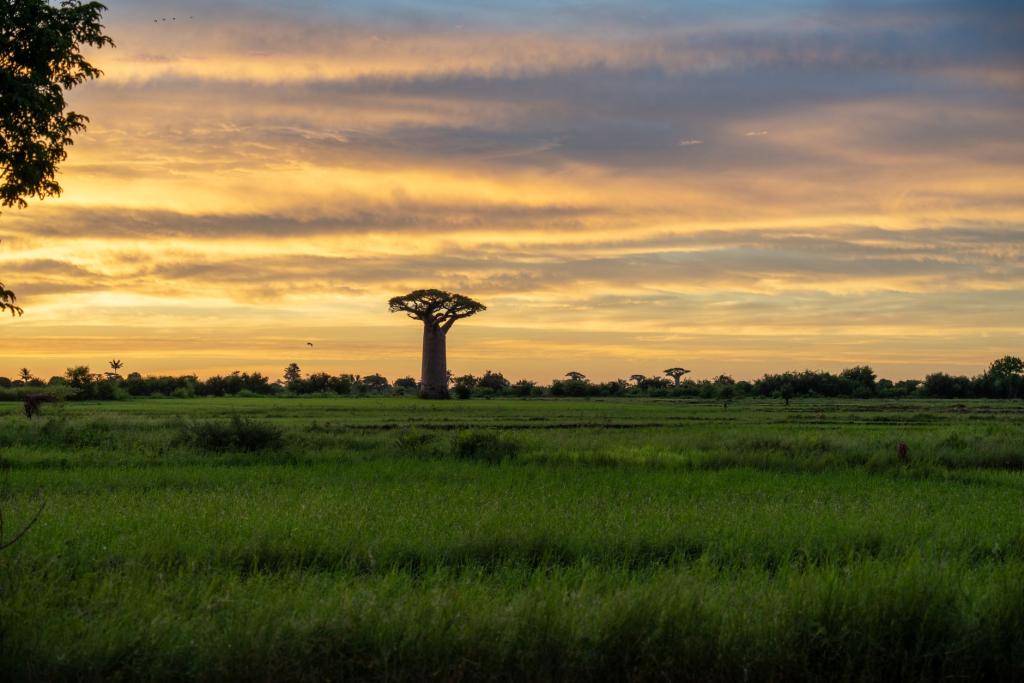
For decades, the official count of baobab species on Earth stood at eight: one in Australia, one in continental Africa, and six in Madagascar. That number is now nine. Researchers at the University of Wisconsin-Madison have recognized a ninth baobab species, Adansonia bozy, after genetic testing showed that baobabs in northern Madagascar long grouped with Adansonia za actually form their own distinct branch of the baobab family tree.
The findings appear in the journal Taxon, in a paper titled "Phylogenomic analysis of Madagascar's baobabs reveals admixed populations and supports resurrection of a previously described species." Lead author Nisa Karimi carried out the work as part of her PhD in the university's former botany department, working with co-author David Baum and collaborators from the Missouri Botanical Garden and Iowa State University. According to the study, DNA sequences from hundreds of genes showed the northern populations were more closely related to two other northern Madagascar groups than to the baobab species they had been filed under. The full paper is available at https://dx.doi.org/10.1002/tax.70176.
Baum has spent more than 40 years studying baobabs, and he said the genetic data in this case left little room for argument. "Any group that we choose to recognize in a taxonomy should be composed of organisms that are more closely related to each other than to anything outside the group," he said. Karimi added that it remains surprising how many basic questions about baobabs are still open: "It's surprising that we're still answering basic biological questions about baobabs, in terms of how many species actually exist on the landscape."
A new name for familiar trees
The trees themselves give almost nothing away, which is exactly why this baobab species went unrecognized for so long. Karimi said it is sometimes impossible to identify a baobab species from its leaves alone, and the reliable check is seeing the tree in flower. That makes fieldwork a race against a narrow window. Each species blooms for roughly one month, and the flowers open after dark, sometimes more than 100 feet up in the branches, so researchers have to time their trips and train on climbing rigs to scale the trunks and rappel back down.
Collecting the leaf samples was only the first hurdle. Baobab tissue is loaded with polysaccharides, so when Karimi ground the leaves in the lab back in Wisconsin, the result was a slimy mass that shredded the DNA into fragments. Getting the long, high-quality strands needed for analysis took extensive trial and error before she landed on an extraction method that worked. From there the team used targeted sequence capture, the standard method in phylogenetic analysis, to pull out and sequence hundreds of genes of interest from each sample, then used computational tools to compare the sequences across species.
Why the name change matters
The researchers believe Adansonia bozy is endangered, based on its known range across Madagascar. That assessment carries practical weight: conservation funding in Madagascar tends to flow toward recognized threatened and endangered species, and a tree that has no scientific name has no line in any budget. Giving the species a name is the first step toward protecting it.
The split also changes what scientists thought they knew about Adansonia za, the baobab species the bozy trees had been folded into. With those trees removed from its tally, that species is less widespread than previously assumed, which could prompt a review of its own conservation status. The paper flags a similar question around another widespread Malagasy baobab, which the data suggest may also be hiding more than one species. Karimi and Baum plan to continue the work, and they suspect additional unnamed species are still standing in remote parts of the island.
Baobabs are among the most recognizable trees on the planet, with swollen trunks that store water through dry seasons, and Madagascar is their stronghold. Before this paper, six of the world's eight known baobab species grew there and nowhere else. The island's count is now seven of nine, and the list may still be incomplete. More stories from the plant world are collected on our Plants and Trees page. As Karimi put it, "You can't conserve anything if you don't know how to describe and name them and understand how they're related to other things on the landscape."
Read the full report on the study at Phys.org for more detail on the fieldwork and the genetic analysis.
Comments 0
No comments yet. Be the first to share your thoughts!
Leave a comment
Share your thoughts. Your email will not be published.