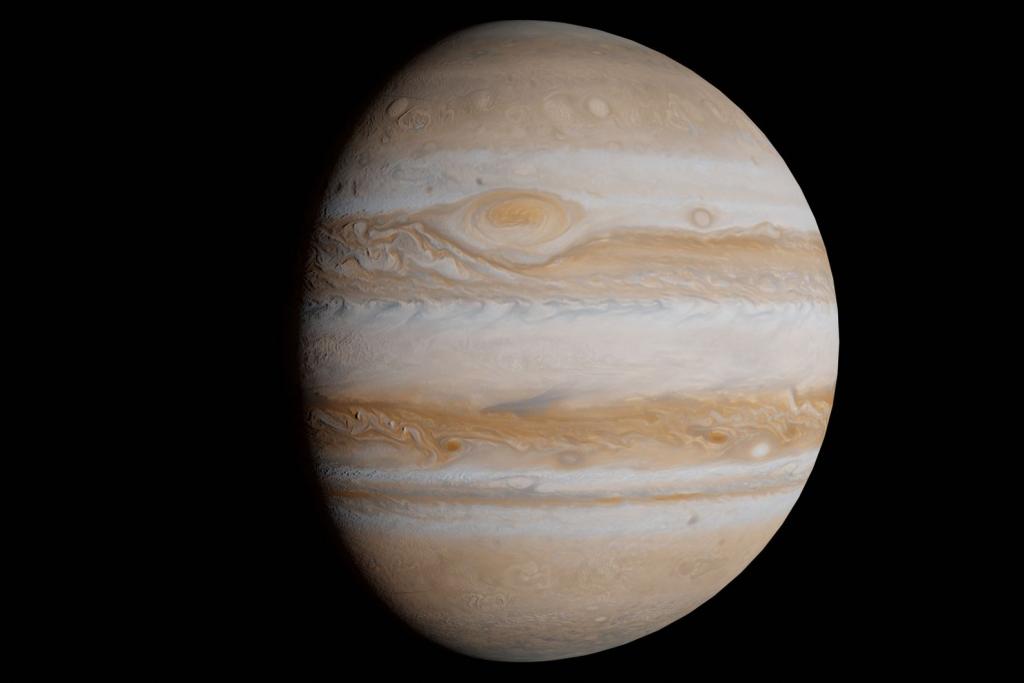
The Solar System has an expiration date, and scientists just moved it dramatically closer. A new study finds that the outer planets — Jupiter, Saturn, Uranus, Neptune — will likely tear themselves apart a billion times sooner than astronomers previously believed. The old forecast gave the Solar System's giant planets a calm, orderly retirement stretching a billion billion years past the Sun's death. The new one? About a single billion years. In cosmic terms, that's the difference between forever and an afternoon.
The twist is the villain. For decades, astronomers assumed that if the Solar System ever fell apart, the blame would land on passing stars or the planets jostling one another. Instead, as reported by Sky & Telescope, the new research says the real culprit is the Sun itself — dying, bloated, and shedding its outer layers in thousands of lopsided bursts, each one nudging the giant planets off their courses.
Here's how it works. In roughly five billion years, the Sun will balloon into a red giant and then collapse into a white dwarf, a dense ember of a star about the size of Earth. During that transformation, the Sun won't shed its mass smoothly. It will cough off its outer layers in thousands of uneven eruptions, and every lopsided burst gives the giant planets a tiny gravitational shove. One shove means nothing. Thousands of them add up to orbital doom.
How the Solar System Was Supposed to Die
The old consensus was reassuring. Once the Sun became a white dwarf, the reasoning went, the giant planets would settle into a stately, undisturbed waltz that could last a billion billion years — tens of millions of times longer than the universe has even existed. Mass loss from the dying Sun was expected to be smooth, and smooth mass loss lets planetary orbits widen gently without any drama. That picture held for years. It is now, officially, out of date.
The Solar System's New Death Clock
Konstantin Batygin and Jim Fuller of Caltech, together with Fred Adams of the University of Michigan, ran simulations that treated the Sun's mass loss the way it actually happens: in random, uneven bursts. Their paper, published in The Astrophysical Journal Letters, found that the bursts keep nudging the outer planets until their orbits destabilize, and that the disassembly typically arrives about a billion years after the white dwarf forms — a billion times sooner than the old estimate, according to AAS Nova.
The numbers are grim reading for Jupiter fans. In the simulations, about forty percent of runs saw the outer planets disrupted or violently scattered while the Sun was still in its red giant phase — before the white dwarf even existed. Roughly ninety percent broke down within three billion years. Bigger bursts mean a faster collapse, and the ejection models point to bursts carrying roughly a ten-thousandth of the Sun's mass each — heavy enough, repeated thousands of times, to wreck the outer Solar System.
Newton Gets the Last Laugh
The story of the Solar System's stability is really a three-century argument about whether the universe needs a maintenance crew. Isaac Newton, working over three hundred years ago, suspected the planets' orderly orbits couldn't last forever on their own. A century later, Pierre-Simon Laplace and Joseph-Louis Lagrange answered him with elegant mathematics showing the Solar System was essentially self-correcting. Modern computer simulations mostly backed the optimists, giving even Mercury — the twitchiest planet — only about a one-percent chance of flying off the rails.
Batygin isn't buying the happy ending. As one of the study's authors put it, the dying Sun "shakes it, and more often than not, spills it," according to 404 Media. The same piece quotes the researchers concluding that "Newton's envisioned instability is real after all. He was mistaken only about the perpetrator." Translation: Newton was right that the clockwork breaks. He just blamed the wrong suspect.
Should You Worry About the Solar System?
Honestly? No — at least not on any timescale that matters to you. The Sun has roughly five billion years before the red giant phase begins, and Earth has much bigger problems on the horizon: our planet gets swallowed by the expanding Sun long before the outer planets begin their slow-motion breakup. Your great-great-grand-everything will be stardust either way.
What makes the finding exciting is that it's testable — a rare gift in cosmic-doom forecasting. Astronomers can now examine planetary systems orbiting other white dwarfs and check whether they look as scrambled as the new model predicts. If they do, the Solar System's shortened life expectancy moves from theory to observation. If they don't, it's back to the simulations. Either way, science just did what science does: updated the forecast when the old math stopped matching reality.
There's something beautifully spooky-season about the whole thing. The Solar System doesn't get destroyed by some alien invader or a rogue star. It gets undone by its own star — the same Sun that made life on Earth possible, quietly shaking its planetary family apart on its way out. For more cosmic doom, read how a planet may have risen from a dead star, or browse more science stories.
Comments 0
No comments yet. Be the first to share your thoughts!
Leave a comment
Share your thoughts. Your email will not be published.