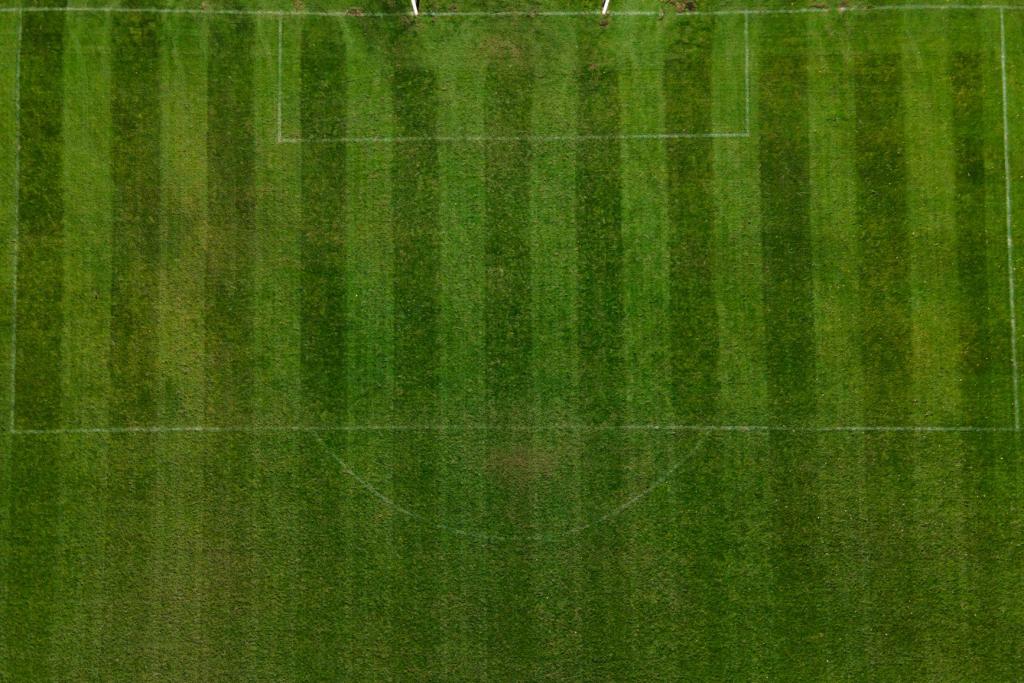
People in Roskilde, Denmark have been playing soccer on a field for decades without knowing what lay right beneath the turf. Earlier this year, a ground-penetrating radar survey of the field found the surprisingly intact remains of St. Clare's Convent, a 13th-century religious complex that historians thought had been lost centuries ago.
The scans of St. Clare's Convent revealed rooms, cloisters, pillars, a courtyard and a church buried about one meter below the surface, according to Smithsonian Magazine. ROMU, a state-recognized Danish museum organization, announced the results in August 2026 after running the survey with the National Museum of Denmark and the Norwegian Institute for Cultural Heritage Research. The scan was triggered by the Roskilde municipality's plans to build an underground parking facility beneath the soccer field, and the survey was meant to make sure nothing historic was disturbed by construction.
"The results are simply impressive. GPR data do not always provide such clear images," Arne Abel Stamnes, an archaeologist at the Norwegian Institute for Cultural Heritage Research, said in a statement. "In my assessment, these are among the clearest GPR results from a monastery complex in Scandinavia."
The work happened in January, when researchers drove an ATV across the snow-covered field with a radar scanner mounted on it. Ground-penetrating radar maps underground structures without excavation, and the team could read the results as they arrived on a laptop: walls, pillars and vaults that had survived for more than 700 years. The field sits in Byparken, a public park in Roskilde, where historical sources had long placed the convent but could not show what remained of it.
A convent thought lost after the Reformation
St. Clare's was one of five monastic sites in medieval Roskilde, a city west of Copenhagen that served as a religious and royal power center during the Middle Ages. In the 16th century, the Protestant Reformation led to the dissolution of Catholic institutions across the region, and St. Clare's was demolished. According to Popular Science, more than half a million of the convent's bricks were removed and reused in construction projects at the nearby Selsø Castle.
Because so little of the building seemed to remain, St. Clare's was the only one of Roskilde's five monastic sites that lacked protected ancient monument status. Historians assumed little, if any, of St. Clare's Convent had survived, leaving researchers with a gap in their understanding of the era's monastic architecture.
"We knew that St. Clare's Convent had been located here, but not how much of the complex from 1256 had been preserved," Jesper Langkilde, an archaeologist at ROMU, told the Norwegian Institute for Cultural Heritage Research. "The GPR survey has produced very clear results and a solid basis for planning further investigations," he said.
Langkilde, who is also a museum curator at ROMU, said excavations of monasteries and convents are "rare," and told Fox News Digital he was "quite surprised" by the find. "I almost didn't believe my own eyes that so much was still there, and that we got such a clear image of it," he said.
The scans suggest the lowest parts of the walls and foundations survived because they were built from large boulders, which were often left in place when medieval buildings were torn down. The whole complex measured roughly 230 feet by 230 feet, and the eastern wing of St. Clare's Convent looks exceptionally well preserved, with clearly defined rooms and vault pillars.
What comes next for the buried convent
Researchers are working with the Roskilde municipality on plans for trial excavations at the site of the proposed parking facility. Digging will let them confirm what the radar shows and learn more about the layout and daily use of St. Clare's Convent.
The survey already gives researchers a detailed look at St. Clare's Convent, which is useful because monastery excavations are rare in Denmark. The radar mapped the whole complex from a single pass over the frozen field. What happens next depends on the municipality's decision about the parking facility and what the trial digs turn up.
The find also joins a run of recent European discoveries, including a massive Gallic coin workshop unearthed in France and a 1,700-year-old Odyssey fragment that turned up in a Dutch library.
Comments 0
No comments yet. Be the first to share your thoughts!
Leave a comment
Share your thoughts. Your email will not be published.