An enormous tomb uncovered during an airport expansion in northwest China may be the final resting place of one of history's most consequential royal figures. Archaeologists say the 2,250-year-old burial complex near Xi'an Xianyang International Airport most likely belonged to Empress Dowager Huayang, the adoptive grandmother of Qin Shi Huang, the ruler who unified China more than two millennia ago.
The findings were announced on September 18 by the Shaanxi Provincial Institute of Archaeology, which identified the site as the Shangzhaoyao Qin Mausoleum, named for a former village where it stands. Researchers examined the tomb's design, radiocarbon-dated its remains, and compared it against historical records before concluding it was a royal-level burial from the late Warring States period. The lead archaeologist, Zhao Hanqing, wrote in a research paper that Huayang was the most likely owner.
A royal cemetery beside the runway
The site first drew attention in 2018, when surveyors were working ahead of a planned third-phase expansion of the airport. They uncovered a large ya-shaped tomb with its own independent funerary enclosure, and further excavation in 2022 mapped the full layout of the cemetery. According to archaeology.wiki's reporting of the announcement, the nearly square complex includes outer and inner boundary ditches, an inner enclosure wall, the main tomb, 45 accompanying graves, 15 subsidiary burials, and 62 sacrificial pits. Eight more pits ring the principal tomb, and five of the subsidiary burials contain chariot-and-horse pits of the kind reserved for Qin nobility.
The main tomb itself sits at the center of the inner enclosure beneath a truncated-pyramid burial mound, with four sloping passages leading down to an approximately square burial chamber. Despite centuries of looting, archaeologists recovered hundreds of artifacts from the site, including pottery and objects made from bronze, iron, jade, agate, and glass, Heritage Daily reported.
Dating the site proved decisive. Radiocarbon analysis of bones recovered from the tomb produced a range of 389 to 208 BC, placing the burial squarely in the period when Huayang lived. She died in 230 BC. At first, researchers suspected the tomb belonged to an emperor of the Northern Zhou dynasty, which ruled more than 700 years later, between AD 557 and 581. A closer look at the architecture showed it was instead a Qin state royal burial from the Warring States period, and comparisons with Qin burial traditions narrowed the occupant to a woman of imperial rank. The result has not been declared certain: no inscription or identifiable remains have been found that name the tomb's owner.
The grandmother who put an empire in motion
The case for Empress Dowager Huayang rests on the family she built. She married the Qin prince who would become King Xiaowen, and when the couple had no sons of their own, she adopted Ying Yiren, an impoverished Qin prince who had been sent to a rival state as a political hostage. After King Xiaowen's brief reign, Ying Yiren took the throne, and his own son eventually became Qin Shi Huang, the ruler who defeated the remaining rival states and founded the Qin dynasty in 221 BC, becoming the first emperor of a politically unified China.
One mystery remains: why was Huayang buried in her own cemetery? Historical accounts describe her as buried alongside King Xiaowen at Shouling on the Xianyang Plain, and the king's burial site lies about 2.3 kilometers from the newly studied tomb. Researchers now argue that the records' description of a combined burial may not have meant a shared cemetery at all, but rather separate, neighboring mausoleum complexes. Earlier Qin tradition called for a king to be buried with his queen, but King Xiaowen had two wives, and the practice was abandoned during his time. The new system of separate mausoleums for kings and queens became a defining feature of Qin royal burial architecture, and according to the researchers it helped lay the foundations for the burial system used for Qin Shi Huang himself.
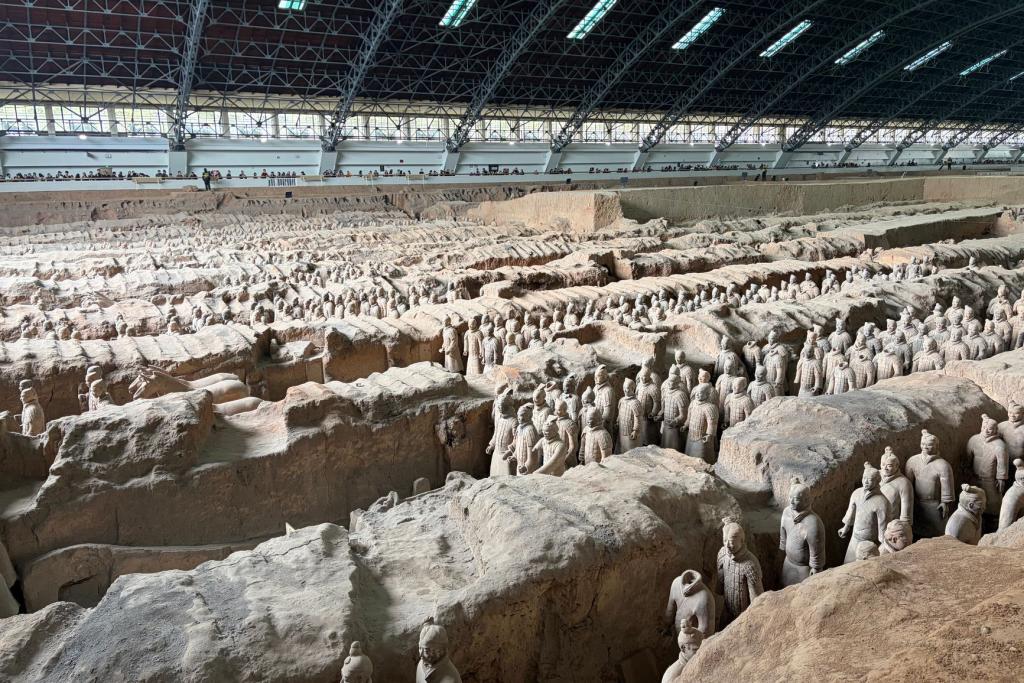
That connection is what gives the discovery its weight. Qin Shi Huang's enormous mausoleum near Xi'an, built after he took the throne, would become world-famous as the home of the Terracotta Army. If the airport tomb is indeed Empress Dowager Huayang's, it would be a rare archaeological link to the royal family whose political maneuvering made the unification of China possible. As the researchers put it, the tomb's date, scale, location, and layout all point to the empress dowager, even while the identification stops short of certainty. More work on the cemetery, including the study of its grave goods and sacrificial pits, is expected to sharpen the picture further. Sources: Heritage Daily and archaeology.wiki, with reporting from the South China Morning Post. Related GenZNewz coverage: the 600-year-old Chimú tomb discovered in Peru and the Odyssey fragment that surfaced in a Dutch library.
Comments 0
No comments yet. Be the first to share your thoughts!
Leave a comment
Share your thoughts. Your email will not be published.