For 2,000 years, a field of rough stones in central France hid one of the most sophisticated factories of the ancient world. This summer, after 25 years of digging at the Corent oppidum in the Puy-de-Dôme department, archaeologist Matthieu Poux and his team uncovered what may be the largest Gallic coin workshop ever found, not just in Celtic Europe but in the entire ancient world.
Poux, a specialist in the Gallo-Roman world at Lumière University Lyon 2, did not arrive at that conclusion lightly. “Don't count your chickens before they hatch,” he cautioned in an interview with Le Monde. But the evidence kept pointing the same way. Across a 500-square-meter excavation, his team traced a thick stone wall, between one and two meters wide and at least 40 meters long, cut by a narrow passage and lined with small rooms fitted with hearths or kilns and supplied with water. The facility operated in the decades before the Gallic Wars of 58 to 51 BCE, and it did far more than turn out local bronze coinage. It also minted silver and gold Arverni staters, the currency of the Gallic people of the region, which circulated widely across Gaul.
On Tuesday, September 15, the site was covered over to protect it from looters until the next excavation campaign. The roughly one hundred students and volunteers who had worked there all summer had braved alternating heatwaves and torrential rains, sometimes forcing the team to limit digging to the mornings. For Clémentine Frecon, an insurance agent who took unpaid leave to join the dig, the season was made worthwhile by a single find: a lead coin blank that changed the picture. French coverage of the announcement echoed the scale of the claim, describing what could be the biggest known minting workshop of antiquity. Breizh-Info reported on the dig the day after Le Monde broke the story.
A mint run like a modern factory
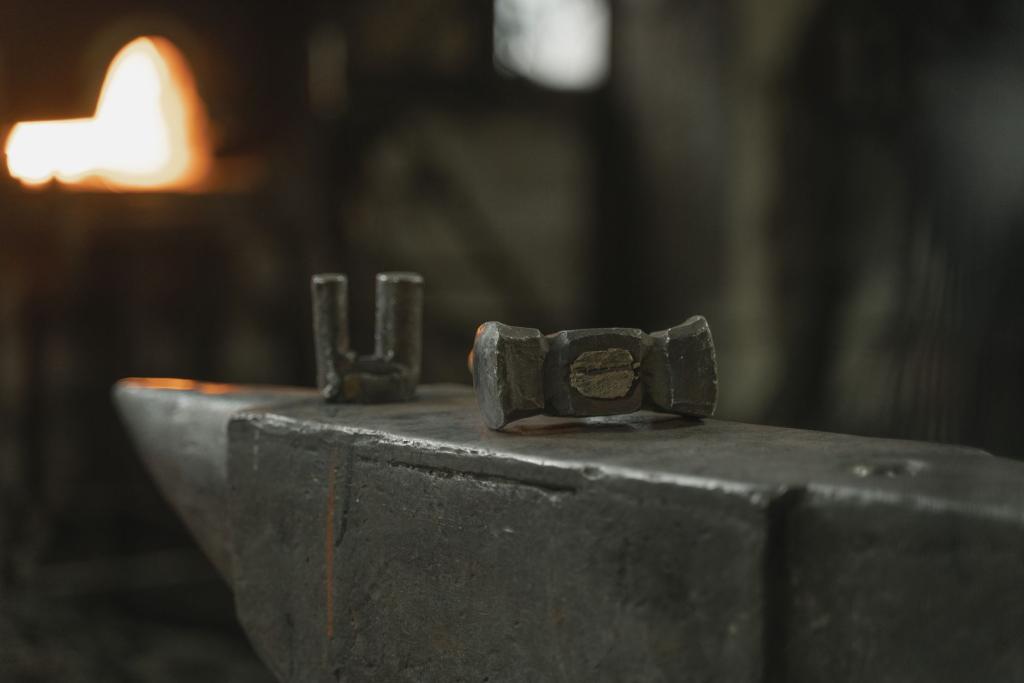
The most striking thing about this year's dig is what was missing. Two years ago, the same team excavated a workshop specializing in bronze coins and found casting failures everywhere, along with strings of unfinished blanks. This time there was not a single piece of metal waste. Only a few tiny flecks of gold and silver clung to the stone, ceramic, and iron tools left behind: small anvils, a chisel, a hammer. It was as if the place had been swept clean, because not a speck of precious metal could be allowed to go missing. “One can imagine the workers' pockets were checked every evening,” Poux suggested.
Everything else speaks of a production line under tight control. A lead blank bore the imprint of two dies matching a known variant of Arverni stater, with a charioteer and four-part wheels. Under magnification, researchers could make out a horse's back, a rider, the curve of a chariot wheel, and on the obverse a stylized curly-haired head standing for the issuing authority. The blank had been deliberately defaced with a chisel, according to numismatist Katherine Gruel of the French National Center for Scientific Research, who took part in the dig, so that its imprints could never be reused to make molds or counterfeit coins. This kind of blank, Gruel explained, served as a proof: a way to test the dies and show the design to a client before striking began.
Only once the client approved the design did full production start, placing a blank between two dies and striking it to print the design.
The finishing stage was just as exacting. Polished stones, worn smooth with use, show that each coin was carefully trimmed to the correct weight before it left the workshop. Another rare find was a small bronze die, a cylinder roughly 12 millimeters across, also engraved with a stylized face. Taken together, the finds trace the whole production line of this Gallic coin workshop, from proofing and striking to trimming and inspection.
An old capital reclaims its title
The find reaches beyond craftsmanship into a long-running historical argument. Corent is an oppidum, a fortified Gallic town, and Poux believes the mint tips the scales in the debate over whether Corent rather than Gergovie was the Arverni capital before the Gallic Wars. Gergovie, about seven kilometers to the north, is famous as the site of Vercingétorix's victory over Caesar's troops in 52 BCE, a few months before the Gauls were crushed at Alésia. According to Poux, the Gallic leader likely emptied Corent deliberately, concentrating his forces at Gergovie and denying Caesar its wealth, just as the Roman general had already seized the riches of Bourges.
The stone building itself adds weight to that reading. The 2024 bronze workshop was built of wood, typical of Gallic construction. The new mint, by contrast, is stone and “recalls Mediterranean architecture,” Poux noted, a sign of outside influence reaching the Arverni capital. A scattering of flints on the site has raised a further question: the mineral, mixed with salt, could separate gold and silver from electrum, a natural alloy. If the mint handled that process too, the whole chain from raw ore to finished coin ran under one roof, a hypothesis Poux plans to test by consulting specialists, according to Le Monde.
After the Roman victory, both Corent and Gergovie faded in favor of Augustonemetum, the city that would become present-day Clermont-Ferrand. But the quarter-century of work at Corent has already revealed a large sanctuary, an amphitheater, and religious and political buildings. The Puy-de-Dôme department, which owns the archaeological park, keeps the site open to the public free of charge.
Poux is now seeking additional funding, on top of state and department support, to keep the campaigns going. The debate between Corent and Gergovie is far from settled, in part because it is difficult to date occupations to within less than ten or twenty years. But as Poux put it, if the hypothesis of a monumental minting center holds, the discovery could carry decisive weight. Le Monde's full report on the Corent excavation carries the details of the team's summer campaign. More from this beat: how AI is revealing lost ancient settlements and how daily life changed from boomers to Gen Z.
Comments 0
No comments yet. Be the first to share your thoughts!
Leave a comment
Share your thoughts. Your email will not be published.