Egypt's Ministry of Tourism and Antiquities has announced the discovery of a Roman pyramid tomb at Bir al-Shaghala in the Dakhla Oasis, a small mudbrick structure built in the shape of a pyramid for a man and his wife. The tomb dates to the Roman era, roughly seventeen centuries ago, and was uncovered by an Egyptian archaeological mission from the Supreme Council of Antiquities. According to the council, its architecture has no exact parallel elsewhere in the cemetery where it was found.
What sets the burial apart is the collision of traditions packed into this Roman pyramid tomb, built for a private family rather than royalty. Egyptian funerary conventions sit alongside a Greek inscription and recognizably Roman objects, all inside one building. It was reported by Heritage Daily as an unusual combination of ancient Egyptian religious imagery and a Greek funerary poem.
A doorway carved with the underworld
Visitors reached the entrance down a staircase of 14 steps, arriving at a doorway cut from sandstone in classic Egyptian style. The door carries recessed hieroglyphic texts with protective funerary spells and prayers. Above it, a cornice bears a winged sun disk flanked by a pair of cobras, with an architectural element shaped like a bundle of papyrus reeds below, according to the ministry's announcement.
The upper lintel holds the tomb's rarest image: a funerary scene showing the seventh hour of the Amduat, the ancient Egyptian book that follows the sun god's journey through the night. The Supreme Council of Antiquities says it is the first example of this hour documented anywhere in the Bir al-Shaghala cemetery, and more inscriptions and scenes relating to the couple run down both sides of the doorway. The stone that blocked the entrance carries an Osirian figure ringed by protective spells.
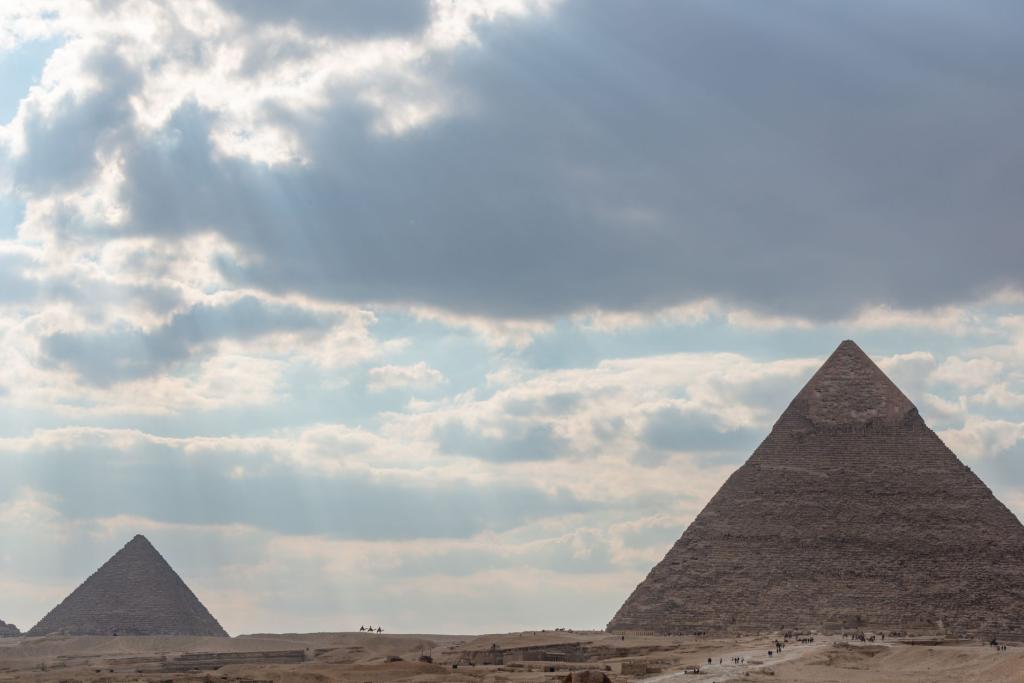
Beyond the entrance lies a mudbrick transverse hall with a vaulted roof, part of which had collapsed on the western side. Two mudbrick burial chambers, covered in plaster, open to the right, and the pyramid-shaped upper structure rises directly above them. The scale is modest beside the stone pyramids of Giza, but the Roman pyramid tomb shows how deeply the older Egyptian funerary traditions stayed embedded in oasis life.
The judge remembered in Greek
Fixed into the southern wall of the pyramid structure, excavators found a rectangular stone stele carrying a nineteen-line funerary poem written in ancient Greek. The poem was dedicated to a man named Psychtis, and preliminary research suggests he may have worked as a judge. Archaeologists have dated the inscription to around the late third or early fourth century AD, placing it firmly in the Roman period, reported Arkeonews. Sami Dardiri, head of the Central Administration for Middle Egypt Antiquities, described the stele as the find's standout text, while Mohamed Abdel-Badie, head of the Egyptian Antiquities Sector, called the sandstone doorway unique at Bir al-Shaghala.
The tomb also produced objects that tie it directly to imperial Rome. Excavators recovered a bronze coin bearing a raised image of Emperor Constantine, whose reign transformed the Roman world. A sandstone offering table set above a purification basin of the same stone, along with several pottery vessels, suggests that ritual activity continued around the tomb long after the burial itself.
Why the find matters
Tourism and Antiquities Minister Sherif Fathy said in a statement that the discovery highlights the archaeological and cultural richness of Egypt's oases and the evidence they preserve of the civilizations that flourished there across the centuries. The significance of the find, said Hisham El-Leithy, secretary-general of the Supreme Council of Antiquities, lies in what its architecture, inscriptions, and funerary texts reveal about funerary practices and the cultural and religious life of the Dakhla Oasis during the Roman period.
The setting sharpens that claim. Dakhla sits about 750 kilometers southwest of Cairo, one of Egypt's seven major oases and continuously inhabited for over two millennia. The Amduat, painted on the tomb's lintel, originated in the New Kingdom, more than a thousand years before Psychtis was buried, yet its imagery still mattered enough to carve onto a Roman-era doorway. In this Roman pyramid tomb, Egyptian spells for the dead, a Greek poem of mourning, and a Roman emperor's coin share the same mudbrick walls.
Comments 0
No comments yet. Be the first to share your thoughts!
Leave a comment
Share your thoughts. Your email will not be published.