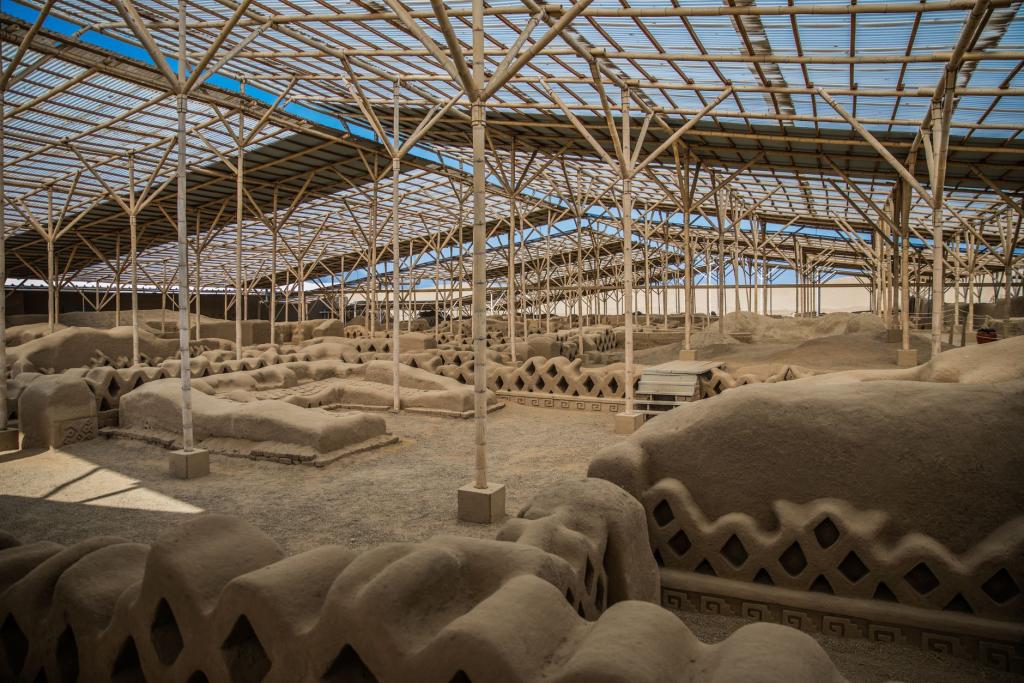
Archaeologists working at Chan Chan, the ancient Chimú capital near Trujillo on Peru's northern coast, have unsealed an elite mausoleum that remained closed for nearly 600 years. Inside the funerary platform, researchers found the remains of at least 38 people along with metal weapons, copper and gold artifacts, ornate jewelry, and colorful textiles. The discovery was announced by Peru's Ministry of Culture, and Smithsonian Magazine reported that the sealed state of the tomb sets it apart from every other Chimú tomb studied so far.
The Chimú civilization thrived in northern Peru between roughly 900 and 1470, building Chan Chan into the largest urban center in the Americas at the time. The tomb dates to the final years of that civilization, during or just before the Inca conquest of the region in the mid-15th century. That the mausoleum survived untouched by both colonial-era and modern looters is what makes the find so unusual. Before this, almost everything known about elite Chimú burials came from looted platforms, private collections, and museum holdings. National Geographic, which also covered the discovery, described the unlooted tomb as a rare window into the elusive Chimú elite.
What the excavation uncovered
The mausoleum sits inside Chan Chan's Utzh An complex, a UNESCO World Heritage Site, and its entrance was buried beneath layers of sand, soil, and stone until excavations earlier this year. A staircase descends into a central chamber that measures roughly 4 feet wide and 16 feet deep, according to the Peruvian state news agency Andina.
Inside the main room, archaeologists identified a single individual whose skull carried traces of red pigment, possibly cinnabar, a crystalline form of mercury sulfide. Several of that person's bones were missing, which led researchers to conclude the remains had been moved or reburied at some point. Reburial was a common practice among Andean societies of the period, whose communities continued to handle and honor the bodies of relatives and leaders after death.
Two rooms flank the central chamber. One was nearly empty. The other held about 20 sets of human remains along with additional artifacts, and 17 more skeletons turned up as the team excavated the funerary platform itself. Altogether, the count stands at no fewer than 38 individuals.
Why archaeologists call it exceptional
The Chimú tomb's greatest value is what it preserves in place. Jorge Meneses, the lead archaeologist, told BBC News that this was the first time Peruvian researchers had come across an almost intact elite funerary platform with unaltered contents. Everything known about elite Chimú burial before this came from disturbed sites. "There was no scientific data on the individuals and their corresponding artifacts and associations," he told El País.
Henry Luis Gayoso, an official with Peru's Ministry of Culture, told the New York Times that what is clear so far is that the buried people belonged to the elite or were closely connected to it. Gabriel Prieto, an anthropologist at the University of Florida who was not involved in the excavation, told the Times it was "the discovery of the decade," noting that it is the first time archaeologists have been able to study an elite Chimú burial in its original state.
The grave goods support that reading. The weapons, metal emblems, jewelry, and textiles suggest the individuals were people of high status, possibly royalty. Researchers say the undisturbed tomb offers a first real chance to reconstruct Chimú funerary practices and social hierarchies during a period of upheaval, as Inca power was closing in.
A mystery remains in the central chamber
For all the tomb's clarity, several questions are unresolved. Archaeologists do not yet know the ages or genders of the buried individuals, or the circumstances of their deaths. One person in a side room was laid in a position rarely seen in Chimú graves, and the principal burial in the central chamber appears incomplete, its bones perhaps removed during later rituals.
Those details hint at a more complicated story than a single moment of burial. Andean societies of the era treated the dead as ongoing participants in community life, so a tomb sealed for six centuries may contain several episodes of ritual activity rather than one. Meneses and his team now face the slow work of documenting every bone and object before exposure to the modern environment can damage them.
Most of Chan Chan is still underground
The find also shows how little of the ancient capital has been explored. Meneses told El País that archaeologists have excavated no more than 7 percent of Chan Chan's total area. "Evidently, the citadel has much more to tell," he said.
At its height, the city covered miles of desert coast and housed tens of thousands of residents, sustained by a network of irrigation canals that made it the first large-scale engineered society in the Americas. With more than 93 percent of Chan Chan still unexcavated, the tomb is one small part of what remains buried beneath the desert.
The Peruvian find is one of several recent ancient discoveries making news. GenZ NewZ also reported on a 2,300-year-old Zoroastrian fire altar unearthed in Uzbekistan and an Ice Age mastodon tooth found in a California creek.
Comments 0
No comments yet. Be the first to share your thoughts!
Leave a comment
Share your thoughts. Your email will not be published.