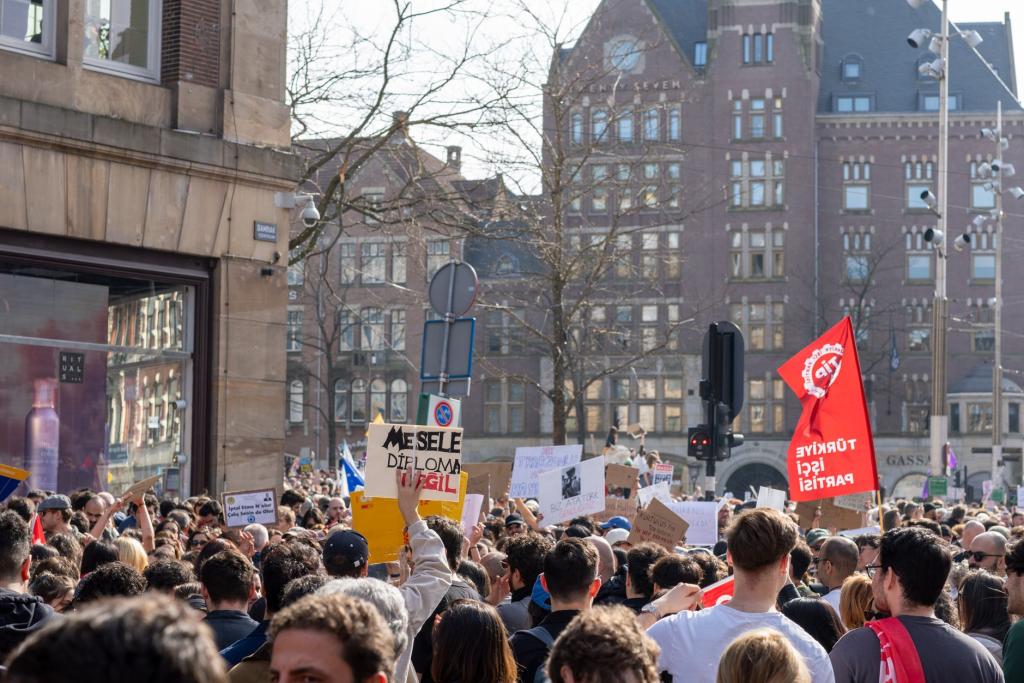
Rally at Gould Plaza
On Friday, September 18, a small but loud group of NYU students took over a corner of Gould Plaza for the latest NYU divestment protest. Roughly ten members of the university's Students for a Democratic Society chapter chanted "Disclose, divest right away" and handed out flyers explaining a federal bill that could strip funding from universities that boycott Israel, according to a September 21 report by Washington Square News.
The rally was part of SDS's national week of action. Gallatin senior Patrick Reddy and CAS sophomore Zaara Ahmed spoke, demanding that NYU cut ties with Israeli companies and shut down its study-away site in Tel Aviv. Protesters carried signs reading "MONEY FOR JOBS & EDUCATION, NOT FOR BOMBS & OCCUPATION" and "DIVESTMENT IS NOT A CRIME! STUDENTS STAND WITH PALESTINE." SDS treasurer and Tandon senior Ebtesham Ahmed said the group, along with the campus chapters of Law Students for Justice in Palestine and Young Democratic Socialists of America, has raised these demands with administrators several times without getting a response.
What the bill would do
The bill at the center of the NYU divestment protest is the Protect Economic and Academic Freedom Act of 2026, also known as H.R. 4795. The House passed it on September 3 by a 237-169 vote, with thirty-three Democrats joining the majority and two Republicans voting no, according to Reuters. Co-sponsored by Rep. Virginia Foxx of North Carolina and Rep. Josh Gottheimer of New Jersey, the bill amends the Higher Education Act of 1965 to cut off federal student aid to schools that engage in what it calls a "nonexpressive commercial boycott" of Israel. Colleges would also have to certify that students and faculty face no unreasonable obstacles to joining academic programs based in Israel. The bill now awaits action in the Senate. If it passes there and President Donald Trump signs it, it becomes law.
Supporters frame the bill as a defense against antisemitism on campus. Opponents call it an attack on free expression. Rep. Jerrold Nadler, a New York Democrat, said he opposes the BDS movement but voted no anyway, arguing that protecting the right to boycott is the only way to keep speech he does agree with equally protected, according to Reuters. Civil rights advocates made the same point louder: Jenin Younes of the American-Arab Anti-Discrimination Committee called the vote "an outrageous attack on freedom of speech," noting that boycotts helped drive consequential movements for justice in American history, including the civil rights movement. Students put it more simply. "We don't want our tuition dollars going toward the state of Israel, toward the Tel Aviv site, toward weapons companies," Ebtesham Ahmed said, according to Washington Square News. "It's an attempt to pressure universities to not divest from the state of Israel."
Gould Plaza has seen this before
For the students who organized Friday's action, the location was the point. Zaara Ahmed tied the rally to the pro-Palestinian encampment that occupied Gould Plaza in April 2024, which lasted fifteen hours before administrators sent in police and more than 130 protesters were arrested. NYU kept the plaza barricaded outside the Stern School of Business for over two years, only reopening it at the end of last semester with new ID checks and entry lines. "Students stood here before us," Zaara Ahmed said during her speech, according to Washington Square News. "Students were arrested here before us. And now, we're standing here too." Organizers said reminding newer students of that history mattered, since many current students enrolled after the encampment.
Why the money matters to NYU
The bill's threat matters because the university's finances are shaky. NYU ran a 71 million dollar deficit last year after the Trump administration cut federal funding, while the year before it had pulled in more than 732 million for research and 700 million for financial aid, according to Washington Square News. Administrators have said they want to diversify funding as federal streams wobble and international and graduate enrollment slips. The students' argument is straightforward: a school this dependent on Washington has every incentive to avoid anything Congress might label a boycott.
The rally was small, and the organizers treated that as a feature. Tandon first-year Daniel Liu, who stumbled on the demonstration while walking across campus, told Washington Square News he had known nothing about the bill or the protest beforehand. "NYU should definitely be more considerate toward what is going on between Israel and Palestine," he told Washington Square News in an interview. "Protests like these are really important."
The Senate has not scheduled a vote on the bill, and the White House has not said whether the president would sign it. For now, the NYU chapter's demands sit unanswered, and its organizers say the week of action is only the start. Like the young African climate activists pushing governments across the continent, these students are betting that a small crowd with a clear demand can outlast a much bigger machine. And as the debate over campus speech keeps escalating, their fight sits next to the broader battle over who gets to control the press itself.
Comments 0
No comments yet. Be the first to share your thoughts!
Leave a comment
Share your thoughts. Your email will not be published.