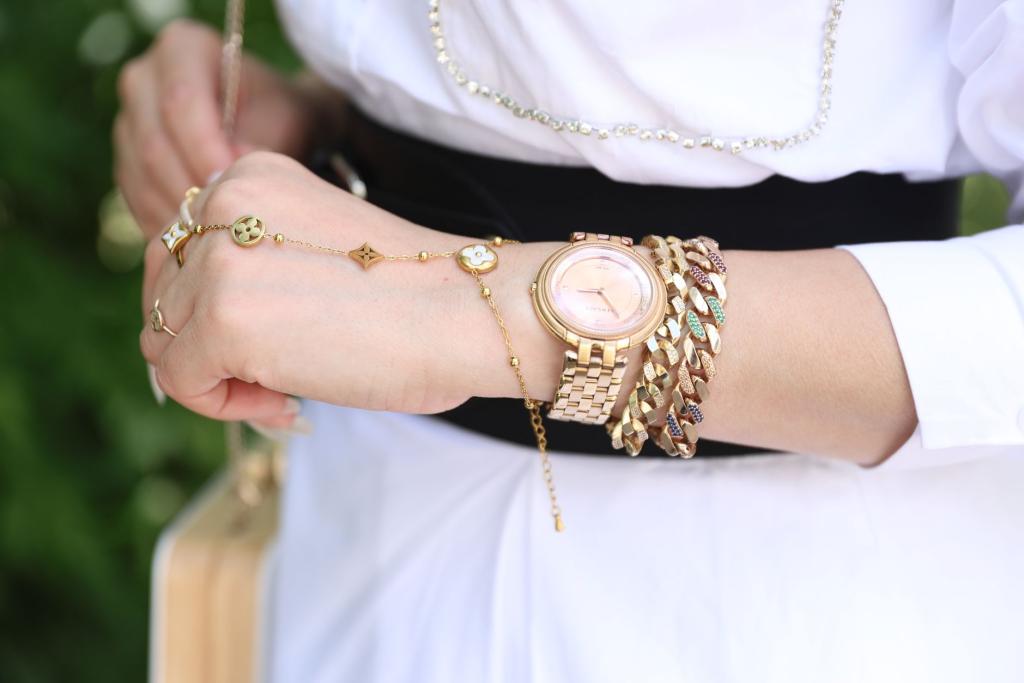
The most coveted watch of the season is one you can barely see. Gen Z has fallen hard for ultra-tiny vintage-style timepieces — pieces so dainty they read more like bracelets than watches — and given them an affectionate nickname: grandma watches. The trend marks a sharp break from the oversized statement watches that ruled the 2000s and early 2010s, and from the chunky plastic sports watches that defined the mid-2000s.
The measurements explain the nickname. The watch industry classifies anything under 30 millimeters as a mini, but the styles everyone wants right now measure between 18 and 26 millimeters across — small enough to get lost in a stack of bangles or nestle beside a tennis bracelet, according to Grazia’s reporting on the trend. Luxury houses have noticed: Cartier’s Mini Baignoire and Bulova’s Goddess of Time are the high-end faces of the movement, and Gen Z style stars including Olivia Rodrigo and Lily-Rose Depp have been spotted wearing petite vintage-inspired pieces.
The sales data behind the grandma watches boom
This is more than a vibe shift — the receipts exist. A joint report from resale platform Chrono24 and watch publication Fratello found that Gen Z dress-watch purchases were up 44 percent since 2018, with dress watches making up 12 percent of the generation’s watch buying. Cartier has been the clearest winner: its share of Gen Z purchases climbed from 1.7 percent to 6.8 percent over seven years. According to Forbes, cited in Lifestyle Asia’s coverage of the trend, the mini watch-as-jewellery category opens up revenue streams from buyers who are not traditional collectors at all — smaller pieces feel less intimidating to first-time buyers than their oversized predecessors.
The industry has responded at full speed. At this year’s Watches and Wonders trade show, downsized pieces were among the biggest stories, with houses reviving compact proportions across their icons — Van Cleef & Arpels showed a 23-millimeter Perlée, Chanel a 19-millimeter J12, Omega a 26-millimeter De Ville Mini Trésor and Hermès a scaled-down Cape Cod, as NUVO magazine reported. The message from the maisons is consistent: after decades of watches growing ever larger, the pendulum has swung back toward elegance at a smaller scale.
A century of small, then decades of big
The tiny watch is not actually new — it is a homecoming. Cartier introduced the Baignoire, with its distinctive bathtub-oval case, back in 1912, and for most of the twentieth century a lady’s watch was simply expected to be small. The supersize era arrived later: through the 2000s and early 2010s, bigger read as bolder, and even women’s pieces bulked up. What changed is function. With a phone in every pocket handling actual timekeeping, the wristwatch has been freed from its job — which is why today’s mini watch is styled, stacked and worn first and foremost as jewelry.
That jewelry-first logic explains the trend’s stranger edges. Ring watches are making a comeback, and pocket watches clipped to belt loops have found an audience among dressers who enjoy the eccentric-collector look, Grazia reports. None of these are about reading the time at a glance — a dial that small is not winning any legibility awards. They are about what the object says on the wrist: restraint, vintage literacy, a wink at inherited style.
How to wear the trend without the trust fund
Here is the practical part: you do not need a luxury budget to play. The whole point of the grandma watches aesthetic is that the best examples look inherited, not purchased — which makes vintage shops, estate sales and resale platforms the natural hunting ground. Style-wise, the move is to treat the watch as a bracelet: stack it with bangles, let it hide half-behind a cuff, pair it with pieces that look collected over time rather than bought in one haul.
The honest counterpoint is that the trend’s poster pieces remain luxury goods. The most coveted mini watches sell for thousands of dollars, and there is a real irony in an aesthetic named for grandmothers being driven by fashion houses charging heirloom prices for brand-new pieces. There is also the consumption question: a trend that celebrates delicate, jewelry-like objects can quietly encourage collecting more of them. The thrifting route sidesteps both problems — a genuine vintage piece costs less, wastes nothing and, fittingly, might once have belonged to an actual grandmother. For more on the aesthetics shaping right now, visit our Aesthetics topic page — and see the other end of this week’s fashion spectrum, where Apple Martin’s runway debut stole the show at Paris Fashion Week.
Comments 0
No comments yet. Be the first to share your thoughts!
Leave a comment
Share your thoughts. Your email will not be published.