The planet is now heating up roughly twice as fast as it did a generation ago, according to the most authoritative annual checkup on Earth's climate. The 2026 State of the Climate Report, published this week in the peer-reviewed journal BioScience, tracks sixteen planetary vital signs and found seven of them at record extremes. Its sharpest finding: the warming rate doubled over the past decade, compressing every timeline for adaptation, policy, and the approach of climate tipping points. At the current pace, the world could breach two degrees of warming above pre-industrial levels before 2050 — within the working lifetimes of most adults alive today.
A warming rate doubled in size matters because the rate, not just the total temperature, decides how much time there is to act. Warming of this speed compresses every adaptation timeline at once. A temperature level is a snapshot; the rate tells you how fast the line is moving. From 1970 to 2010, the global average temperature rose by roughly 0.19 degrees Celsius per decade. From 2010 to 2024, that figure rose to about 0.36 degrees per decade — a step-change in the pace of planetary warming. As the report states: "We are witnessing the rapid destabilization of the Earth's climate system. This is no longer a warning for the future; it is a diagnosis of the present."
The Records That Broke This Year
The vital signs that set new extremes span greenhouse gases, ice, and oceans. Atmospheric carbon dioxide reached 428 parts per million in May — roughly fifty percent above pre-industrial levels and, according to the Intergovernmental Panel on Climate Change, higher than at any point in the last two million years. Methane and nitrous oxide also broke prior records. Ocean heat content and sea level kept climbing toward new highs, with the thermal expansion of warming seawater accounting for about fifty-six percent of recent sea-level rise, the report finds.
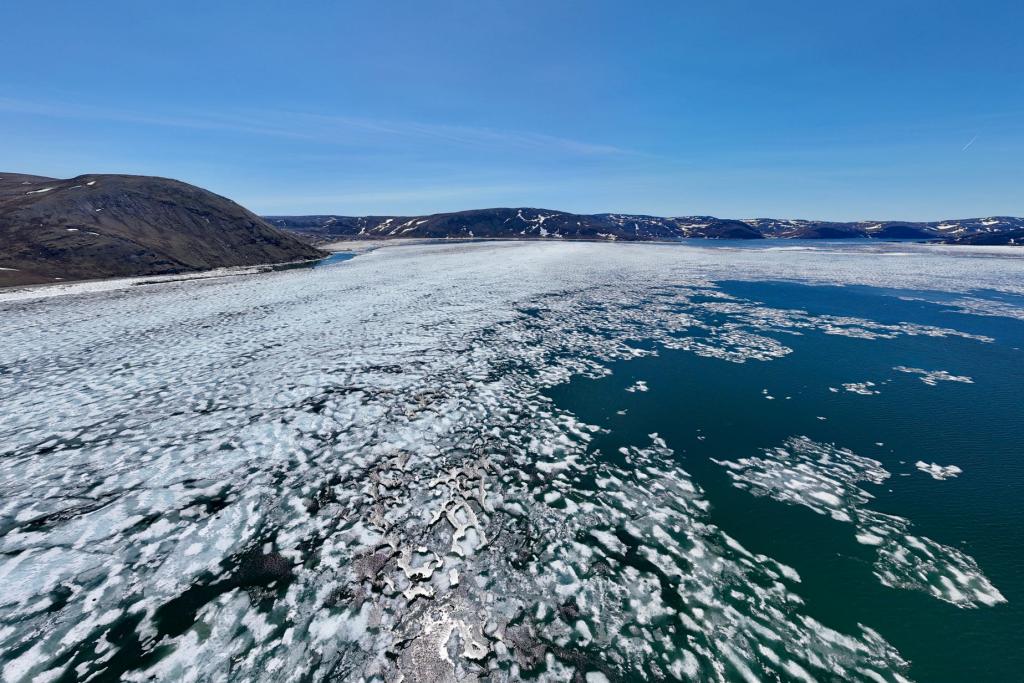
The ice numbers are especially stark. Worldwide glacier thickness and the mass of the Greenland ice sheet both sit at record lows. Research published this year in Nature Communications by scientists at the University of Barcelona quantified Greenland's melt in detail: extreme meltwater volume there has risen sixfold since 1990, from 12.7 gigatons per decade to 82.4 gigatons per decade, with northern Greenland emerging as a new hotspot. In July 2026, the contiguous United States recorded its hottest month in 132 years of NOAA data, averaging 76.89 degrees Fahrenheit across the Lower 48 and beating the Dust Bowl record of July 1936 by an eighth of a degree — one more sign that warming keeps rewriting the record books. Every one of the Lower 48 states ran at least one degree warmer than its twentieth-century average.
Why the Speed Changed
Part of the acceleration may be a side effect of cleaner air. Sulfate aerosols from industry and shipping historically masked a portion of greenhouse-gas warming, and as air-quality rules have cut those emissions, some suppressed warming has re-emerged. The report's co-authors, led by William J. Ripple of Oregon State University's College of Forestry and Christopher Wolf of Terrestrial Ecosystems Research Associates, also note a counterpoint: co-author Michael Mann of the University of Pennsylvania and colleagues argue that the 2023-2024 temperature surge sits within the range of what state-of-the-art climate models projected. The pace is alarming, in other words, but not entirely unanticipated. More than sixty international co-authors contributed, including Johan Rockstrom of the Potsdam Institute for Climate Impact Research, and the American Institute of Biological Sciences issued the report's press release.
The same acceleration is what makes the report's tipping-point warnings feel urgent rather than abstract. Warming faster rather than slower changes which systems break first and how little warning they give. The Atlantic overturning circulation, the ocean system that carries warm water northward and regulates weather across three continents, is already weakening. Research published in April 2026 found it could weaken by between forty-two and fifty-eight percent by the end of the century even under moderate emissions scenarios — a decline roughly sixty percent stronger than the average of standard climate models projected. The Amazon faces a similar squeeze: warming alone might leave the forest resilient up to five degrees of heating, but combined with ongoing deforestation, the report cites research showing dieback could become irreversible at just 1.5 to 1.9 degrees. Natural feedbacks from permafrost, wetlands, and wildfires could add twenty to thirty percent to post-2020 human-caused warming by 2100. New research on ice cliffs shows how uneven and hard to predict that kind of collapse can be.
What the Numbers Cost This Year
The human toll of the past year, documented with attribution analyses from the ClimaMeter hazard database, shows what the warming curve means at ground level. A severe European heatwave in June 2026 caused approximately fourteen thousand excess deaths in a preliminary estimate. A North American heatwave the same month affected roughly fifty million people across the eastern United States and southern Canada. Hurricane Melissa, a Category 5 Atlantic storm, struck Jamaica and Haiti in October 2025, killing ninety-five people and causing more than twelve billion dollars in damages. In Indonesia, a November 2025 tropical storm combined with monsoon rains killed 708 people. These are the kinds of events that are reshaping how younger generations think about the environmental cost of modern life.
Fossil fuel use sits underneath all of it. Consumption grew 0.9 percent in 2025, with oil, coal, and gas all reaching record highs and annual energy-related carbon dioxide emissions surpassing 41 gigatons for the first time. There is one genuine bright spot in the report: in 2025, renewable energy surpassed coal in global electricity output for the first time in more than a century of coal-dominated power. Solar and wind consumption grew by about eighteen percent, and more than ninety percent of new utility-scale renewable projects now produce electricity more cheaply than the least expensive new fossil fuel alternatives. The catch, which the report is direct about, is that rising total energy demand absorbed most of that growth — fossil fuel consumption did not shrink in absolute terms. None of that changes the underlying warming trajectory, but it shows the tools available to bend it are getting cheaper. Growing renewables faster than demand grows is the real challenge, not growing renewables at all. Tropical primary forest loss also fell by thirty-six percent in 2025 compared with 2024.
The report also quantifies a widening gap between what adaptation requires and what it gets. Global adaptation finance reached about sixty-four billion dollars in 2024, while the estimated need for developing countries alone is between 310 and 365 billion dollars a year by 2035 — a nearly fivefold shortfall, according to the UN Environment Programme's Adaptation Gap Report. The communities facing the sharpest consequences are often the least responsible for cumulative emissions, and funding tends to flow to large infrastructure over community-led approaches. Climate policy downgrades suggest even wealthy countries are not closing that gap. Fifty-seven countries attended the world's first intergovernmental conference on transitioning away from fossil fuels in Santa Marta, Colombia, in April 2026; twenty-four signed the resulting Belem Declaration, though every major emitter stayed away.
This is the seventh report in an annual series that began in 2020, and the accompanying scientists' warning of a climate emergency has now drawn nearly sixteen thousand signatories from 167 countries. The authors close with a line meant to be read as a challenge rather than an epitaph: the future trajectory of the climate system, they write, "has not yet been fully determined," and the decisions of the coming years will decide whether future generations inherit an unstable planet or a resilient one. The diagnosis is in. What happens next is still, technically, a choice.
Comments 0
No comments yet. Be the first to share your thoughts!
Leave a comment
Share your thoughts. Your email will not be published.