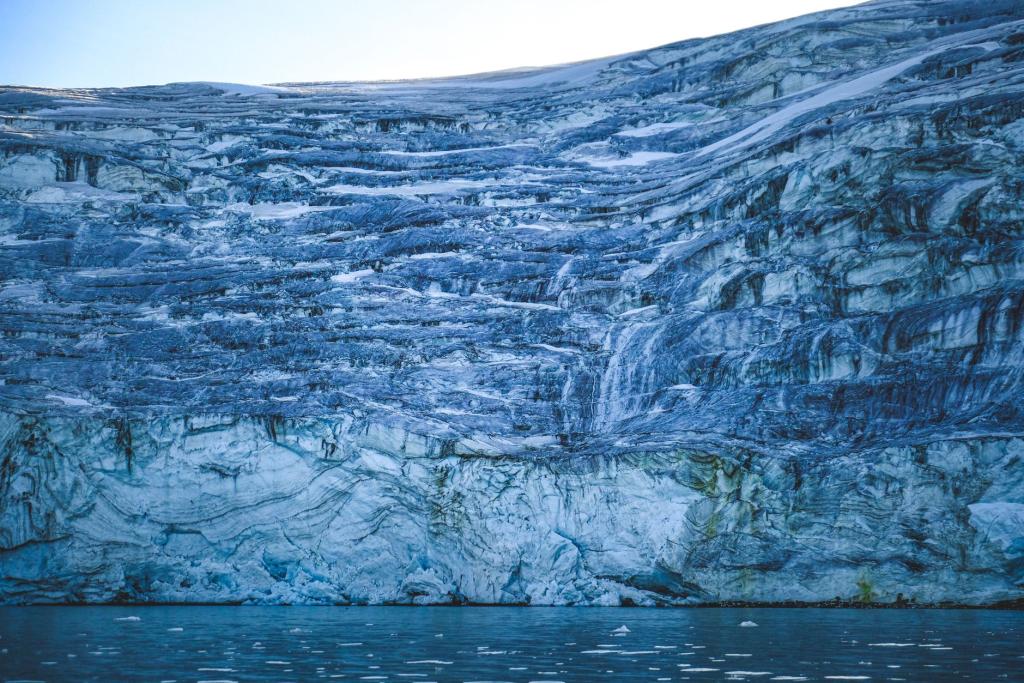
A sprawling new look at Antarctica's tallest ice walls suggests the most alarming version of how glaciers could fall apart is not playing out, at least for now. Researchers who analyzed thousands of ice cliffs by satellite found that ice cliff collapse proceeds more quickly than existing models expect, yet the rapid retreat usually stalls instead of snowballing into a self-sustaining chain reaction. The study, published October 15 in the journal Science, gives the first large-scale observational check on a disputed theory known as marine ice-cliff instability, which some sea level projections have treated as a wildcard.
Marine ice-cliff instability starts from a simple physics claim: an ice cliff standing more than roughly 100 meters above the waterline should topple under its own weight, exposing an even taller cliff behind it, which then fails in turn. That cascade could chew rapidly through an ice sheet. Because the process had not yet been observed directly in nature, modelers have argued for years about whether the mechanics of ice cliff collapse belong in forecasts of future sea level rise.
What the satellite record shows
To settle the question with data instead of simulations, the team turned to NASA's Ice, Cloud, and land Elevation Satellite-2, or ICESat-2, which measures the height of ice surfaces with a laser altimeter. They assembled 15,330 individual observations taken every three months from 2019 through 2023, covering cliffs all around the margins of the ice sheets. It is the first satellite survey built specifically to test ice cliff collapse. The analysis was led by Caroline Needell, a doctoral student in the joint program between MIT and the Woods Hole Oceanographic Institution, with WHOI glaciologist Catherine Walker and University of Michigan geophysicist Jeremy Bassis as co-authors.
What they found is a split verdict for the theory. The average cliff in the survey stood only about 30 meters tall, far below the instability threshold, and only a rare few climbed past that critical height. Where tall cliffs did break apart, they retreated faster than current models predict. But the fast retreat did not keep going: in every case the researchers documented, the glaciers stabilized afterward. Needell said the team saw no unstable retreat anywhere in the sample, even though the retreat ran faster than the ice cliff collapse rates that models predict, according to the study announcement.
What decides whether a cliff fails
The risk, the researchers report, comes down to two factors: how steeply the seabed drops off beneath the ice, and how quickly the ice streams toward the sea. Fast-flowing ice spreads and thins at the glacier's edge, much like a thick liquid leveling out on a plate, and that thinning lowers the cliff before it can grow tall enough to fail. Idealized mathematical models had suggested such a balancing act was possible, but the new study of ice cliff collapse provides the first systematic measurements from real glaciers.
The result lands with special force on Thwaites Glacier in West Antarctica, the Florida-sized glacier whose potential collapse has dominated sea level headlines. Underwater ridges still pin Thwaites in place from below, but Douglas Benn of the University of St Andrews told New Scientist the glacier is likely to jump from one ridge to the next over the coming decades, almost tripping downhill, until the ridges run out later this century. At that point, Benn said, runaway collapse becomes a real possibility, though the new data raise the chance that faster ice flow could thin the looming cliffs first. Whether thinning can outpace the rapid ice loss remains an open question, Needell told the magazine.
The takeaway for coastal planners is not that the danger has vanished. Global sea level has already risen by more than 8 inches since 1880, and it is expected to keep climbing through this century as the ice sheets shed mass, the researchers note. The survey instead sharpens the models: it flags the conditions that drive rapid ice loss and the conditions that shut it down, giving forecasters firmer ground for the century-scale projections that cities will rely on. "Understanding how ice sheets lose mass is key to improving projections of future sea level rise," Walker said, according to the announcement.
Marine ice-cliff instability, the mechanism behind the worst-case ice cliff collapse scenarios, remains one of the biggest open questions in sea level science. As Bassis put it, the glaciers studied so far have restabilized after fast retreats; whether that holds as climate change pushes ice sheets into unfamiliar territory is something nobody knows yet.
Comments 0
No comments yet. Be the first to share your thoughts!
Leave a comment
Share your thoughts. Your email will not be published.