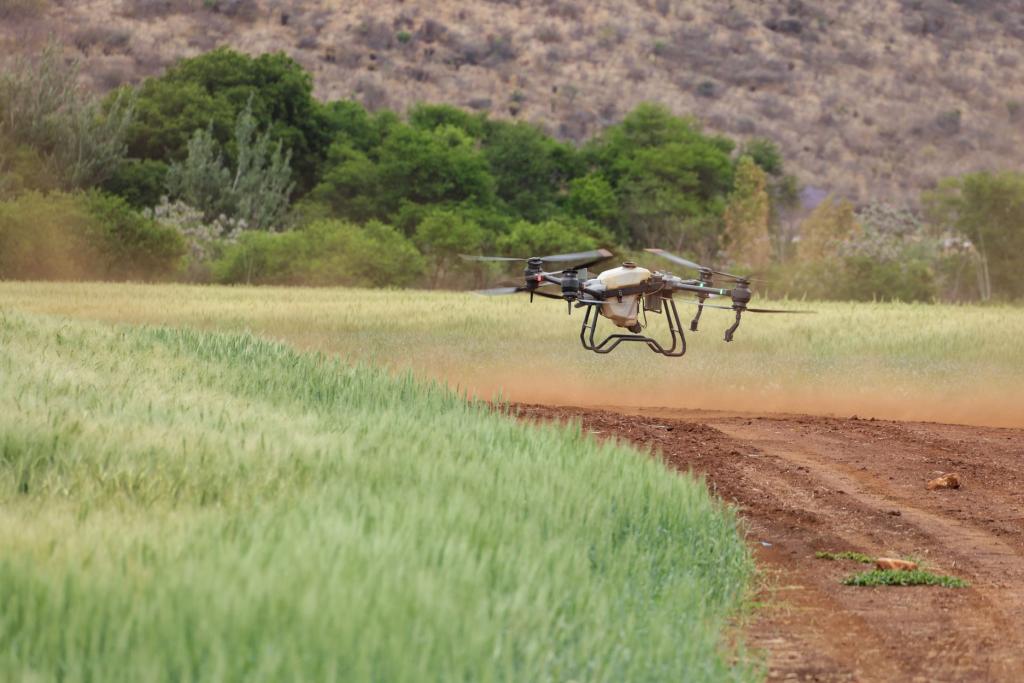
Drones can now drop medicine into some of the hardest-to-reach villages on Earth — but a landmark new trial shows that speed means little when the shelves they are racing to are already empty. In the first cluster-randomized controlled trial of medical drone delivery in a Global South health system, researchers assigned 109 remote public-sector health facilities in eastern Madagascar to either drone-supported deliveries or standard land-based resupply. Two drones then completed 1,551 successful flights, ferrying medicines, vaccines, malaria rapid diagnostic tests and contraceptives to extraordinarily remote clinics. Yet stockouts of most vaccines, antimalarial medicines and contraceptive commodities barely budged, and modern contraceptive use among nearby women did not rise, according to the study team. The findings were published in the journal BMJ Global Health and announced by the UNC Gillings School of Global Public Health.
The trial, nicknamed "Wings of Access," is the strongest evidence yet on a technology that has attracted enormous enthusiasm — and donor money — as a fix for last-mile health logistics. Earlier evaluations of medical drone delivery leaned on observational designs and self-reported or routinely collected data. This one did something rarer: it randomized 55 facilities to drone delivery and 54 to business-as-usual land resupply, ran the drone service from September 2023 through October 2024, and then sent auditors to visually verify what was actually on the shelves. A representative survey of 1,199 reproductive-age women in the surrounding communities measured whether any of it translated into real contraceptive use. The trial's abstract lays out the design in full.
The drones worked — the health system didn't
Operationally, the drone program was a success. More than fifteen hundred sorties moved real medical cargo across terrain where roads are often little more than footpaths. But faster transportation could not compensate for everything broken upstream. The facilities in the study faced procurement delays, incomplete or inaccurate inventory records, irregular ordering and limited forecasting capacity — plus shortages further up the supply chain, where products were sometimes simply unavailable at the district level. In other words, drones delivered on time, but the system frequently had not ordered enough, had not noticed it was running out, or had nowhere to reorder from.
The conditions on the ground underline the point. More than two-thirds of the facilities had no electricity, and more than nine in ten had no running water. Supplies were often checked only once or twice a month, and orders were commonly placed every two to three months — so shortages were frequently discovered only after a facility had already run out. More than a third of facilities described emergency reordering as challenging. Katherine Tumlinson, an associate professor at UNC Gillings who led the research, put it plainly: the problem "was not that the technology failed" — rather, she said, "faster transportation alone is not enough" when a health system cannot reliably track what is on the shelf or anticipate what will run out.
What this drone delivery trial means for the global-health bet
Until now, the drone-delivery story in global health has mostly been told through pilot projects and vendor case studies — impressive flight counts and distance totals without a control group to compare against. That is where the science changes the story. By comparing matched facilities that did and did not get drone service, the Madagascar trial isolated the effect of the drones themselves, and the primary analyses found no measurable impact on current modern contraceptive use, stockouts of most commodities, malaria test stockouts or most patient-reported quality measures. Secondary analyses hinted at possible reductions in malaria-test stockouts and modest contraceptive improvements, but those signals did not hold up consistently across the statistical models.
The researchers are careful to say this does not make drones useless. They see a real role for drone delivery in emergencies, for time-sensitive products such as vaccines, and for facilities that become physically inaccessible during certain seasons. The argument is about sequencing, not scrapping: drones are far more likely to improve what patients find on the shelf when paired with stronger inventory management, better forecasting, reliable procurement and systems that redistribute stock before shortages hit. Buy the software and the stockroom discipline first, then buy the aircraft.
What comes next for last-mile supply chains
The bigger lesson extends beyond one country. Governments and donors are weighing large investments in drone-based logistics across the Global South, and according to the researchers this trial is a case study in why rigorous evaluation should come before scale-up. The next generation of last-mile interventions, the authors argue, should focus less on how quickly products can move and more on whether health systems can detect shortages, forecast need and trigger the right response before a clinic runs dry.
There is a human cost to getting the order wrong. When a remote clinic stocks out of antimalarials or contraceptives, patients do not simply wait for the next delivery — they go without, travel hours to the next facility, or turn to informal sellers. A drone that arrives faster with the wrong cargo, or arrives to find the district warehouse empty, does not change that math. The technology proved it can fly. The harder, less photogenic work — counting pills, placing orders on time, keeping the cold chain honest — is what determines whether anyone gets treated. For the next wave of health-tech bets, Madagascar's experiment offers a humbling rule of thumb: fix the supply chain, then upgrade the delivery.
For another look at how rigorous studies are reshaping medicine, see our story on the flatworm brain-regeneration discovery.
Comments 0
No comments yet. Be the first to share your thoughts!
Leave a comment
Share your thoughts. Your email will not be published.