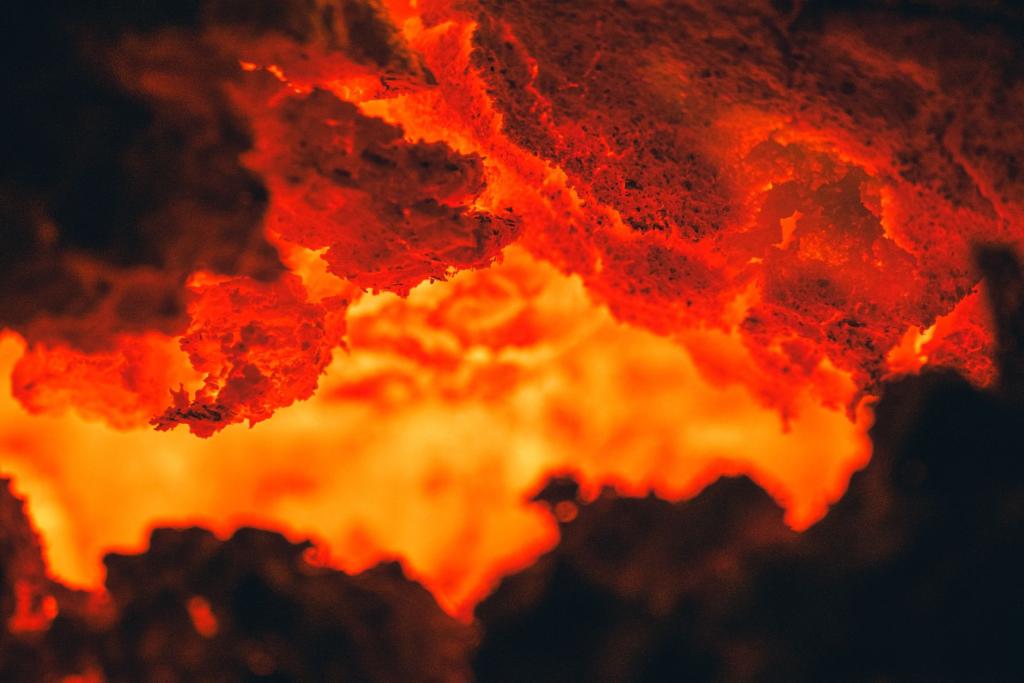
Some planets refuse to follow the rules. A rocky super-Earth called HD 3167 b orbits its star so closely that a year there lasts just one Earth day, and its dayside is likely a sea of molten rock. By every model astronomers had, a world this close to its star should have been stripped bare — its atmosphere blasted away by stellar wind and high-energy radiation. Yet new observations from the James Webb Space Telescope show this lava planet defying those expectations, making it the coolest lava planet ever found with signs of a gaseous envelope.
The discovery was reported in The Astrophysical Journal Letters in a study led by University of Chicago graduate student Brandon Park Coy, with UChicago associate professor Edwin Kite as a co-author. According to a University of Chicago release republished by Phys.org, the team used Webb's mid-infrared instruments to measure the planet's dayside temperature — and found it noticeably cooler than the maximum possible for bare rock.
A Dayside Cooler Than It Should Be
The technique is called a secondary eclipse. Webb measures the total mid-infrared light from the planet and its star together, then watches as the planet slips behind its star and the light dips. That tiny drop reveals how much heat is coming from the planet itself. For HD 3167 b, the eclipse depth measured 38 plus-or-minus 11 parts per million — more than five standard deviations below what a dark, maximally hot bare rock would produce. That dip in the lava planet's dayside glow is the heart of the case.
A world with no atmosphere should be as hot as theoretically possible on its star-facing side, given how reflective its surface is and how close it orbits. An atmosphere changes the picture: it can ferry heat from the dayside to the nightside, and clouds can reflect incoming starlight. The team argues the cooler-than-expected dayside is best explained by an atmosphere doing one or both of those things.
There is a familiar local example. On Venus, reported by the University of Chicago researchers, there is almost no difference in surface temperature between the day and night sides, or between the poles and the equator — an atmosphere can be that efficient at redistributing heat. Something similar may be happening on a world roughly one and a half times Earth's radius, with an equilibrium temperature near eighteen hundred Kelvin, orbiting a K-type star in the constellation Pisces.
Why This Breaks the Cosmic Shoreline
The result challenges an idea astronomers call the cosmic shoreline: a boundary between planets that can hold onto atmospheres and those that get stripped by extreme irradiation and stellar winds. As Kite put it, the closer a rocky planet orbits its star, the harder it should be to have an atmosphere, "because it's bombarded by stellar wind and gets more high-energy photons from the star."
What makes this find stand out is temperature. Four other lava planets were already known to show evidence of atmospheres, but all of them sit in a much hotter regime. With this discovery, scientists now count five lava planets with atmospheres — and HD 3167 b is the least irradiated ultra-short-period super-Earth with atmosphere evidence, bridging a gap where models were uncertain about where the transition occurs.
The study is also the first result from a ten-planet survey program designed to find that critical temperature threshold where atmospheres start appearing on lava worlds. The program is led by Megan Weiner Mansfield, a UChicago PhD graduate now at the University of Maryland. Each new planet in the survey will narrow the range where the cosmic shoreline actually sits.
A Window Into Earth's First Days
Why should anyone care about a lava planet circling a distant star every 24 hours? Because it may be a time machine. "We're interested in studying these kinds of planets because we think early Earth might have looked a lot like a lava world," Coy said in the release. In its first couple of million years, Earth was kept molten by planetesimal collisions — a magma-ocean stage that set the conditions for everything that followed.
These worlds are, in Kite's words, "too hot for life," and nobody is mistaking this lava planet for a second Earth. But by studying how lava worlds keep — or lose — their atmospheres, scientists can test the processes that matter for other rocky worlds, including the ones future telescopes might one day call habitable. Of the more than six thousand exoplanets catalogued so far, only a small fraction are rocky worlds showing signs of atmospheric gases.
There is an honest caveat, and the researchers state it plainly: the atmosphere's composition is still unknown. The emission spectrum is not yet precise enough to say whether it is vaporized silicate rock, or heavier gases such as carbon dioxide, carbon monoxide, or water vapor. Follow-up spectroscopy with Webb's near-infrared instruments is the obvious next step — and that ambiguity is exactly why the survey continues.
The counterpoint from skeptics of single-measurement claims is fair: one eclipse depth, however precise, is not a composition, and reflective bare rock with unusual surface properties is the competing explanation the team had to rule out. Their answer is the statistics — the dip sits well beyond what bare-rock models predict — plus the planet's slight underdensity compared with an Earth-like composition, which independently favors an atmosphere. Still, the community will want confirmation before the textbooks change.
For now, the scoreboard reads: five lava planets with atmospheres, one cosmic shoreline in need of redrawing, and a distant magma ocean offering clues about the violent infancy of Earth. You can read more about the survey program in the University of Chicago's full release, and follow the broader exoplanet beat on the Science topic page. For another story about life's origins in extreme places, see Asgard Archaea Can Crawl: New Clue to the Origin of Complex Life.
Comments 0
No comments yet. Be the first to share your thoughts!
Leave a comment
Share your thoughts. Your email will not be published.