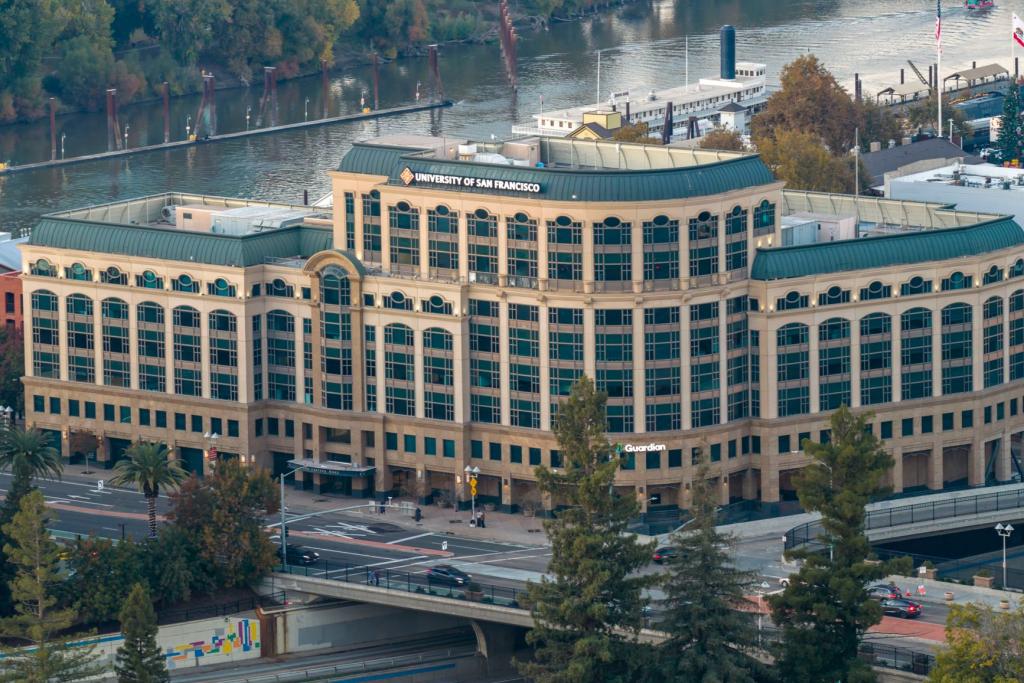
The Justice Department announced Tuesday that its Civil Rights Division found the University of California, San Francisco School of Medicine discriminated by race in admissions for its 2023 to 2025 incoming classes. The department concluded that the school's UCSF admissions discrimination violated Title VI of the Civil Rights Act of 1964 and the Supreme Court's 2023 decision in Students for Fair Admissions v. Harvard, which banned race-conscious admissions in higher education.
Assistant Attorney General Harmeet K. Dhillon, who leads the Civil Rights Division, said the school let racial preferences decide who got in. "Unfortunately, at UCSF Medical School, MCAT scores and undergraduate GPAs have taken a backseat to race," Dhillon said. She added that aspiring doctors should be admitted on their qualifications and that federally funded medical schools may not use what she called misguided and illegal notions of diversity.
Investigators said race influenced each of the school's three admissions stages: the primary application, the secondary application, and the interview. The applications ask candidates to identify and discuss their race, and the department found that race was used to decide which students advanced from one stage to the next. Fewer than 10% of secondary applications move on to interviews, yet Black and Hispanic applicants were invited to interview at far higher rates than white and Asian applicants, despite having lower MCAT scores and undergraduate grades, according to the Justice Department.
The numbers in the findings are stark. The department said that from 2023 to 2025, UCSF admitted Black and Hispanic applicants whose academic records fell below the average for the white and Asian applicants the school rejected. When MCAT scores, undergraduate GPAs, and socioeconomic background were held equal, the school was 4.6 times more likely to admit a Hispanic applicant than a white applicant and 12.6 times more likely to admit a Black applicant than a white applicant, with similar disparities against Asian applicants. Federal officials also told the New York Post that in 2025, the school admitted 7% of Black applicants and 4.8% of Hispanic applicants, compared with 1.7% of white applicants and 2% of Asian applicants.
UCSF pushes back
UCSF rejected the department's conclusions. "UC San Francisco disagrees with the Department of Justice's finding regarding the School of Medicine's admissions process," the university said in a statement late Tuesday, according to Reuters. The university said every applicant is evaluated through a rigorous, individualized review process that prioritizes academic excellence, and that it would engage constructively with the department to resolve the matter. The university did not directly address the department's statistical claims in its public response.
The Justice Department sent a nine-page findings letter to UCSF Chancellor Sam Hawgood on Tuesday, giving the school until October 2 to engage on a voluntary compliance agreement. If the two sides cannot reach terms, the department said it will file suit to bring the school's admissions practices into compliance.
The latest front in the admissions fight
The case is the latest move in the Trump administration's campaign against diversity initiatives at universities. The president has signed executive orders aimed at dismantling such programs, which he has cast as anti-merit and discriminatory against white people and men, while civil rights advocates argue the practices address historic inequities facing ethnic minorities, women, and other marginalized groups, according to Reuters. The finding arrives the same week that CNN, MS NOW and Politico sued the Trump administration over revoked White House press credentials, another court fight over the limits of executive power. The department described the UCSF admissions discrimination finding as part of an ongoing review of medical school admissions across the country.
The Justice Department said medical schools receive substantial federal funding and remain subject to federal nondiscrimination law. The department said it will keep investigating Title VI compliance across medical schools, pursuing settlement talks where it finds violations and filing lawsuits when talks fail. The full findings are laid out in the department's September 22 announcement.
UCSF's medical school admits only about 2.5% of more than 10,000 applicants each year, making it one of the most selective programs in the country. With the October 2 deadline approaching, both sides now face a choice between a negotiated overhaul of how UCSF picks its future doctors and a courtroom fight that could reach far beyond one campus. College campuses remain a flashpoint for civil-rights disputes, from admissions battles in the United States to student activists facing charges over a campus protest in Manila.
Comments 0
No comments yet. Be the first to share your thoughts!
Leave a comment
Share your thoughts. Your email will not be published.