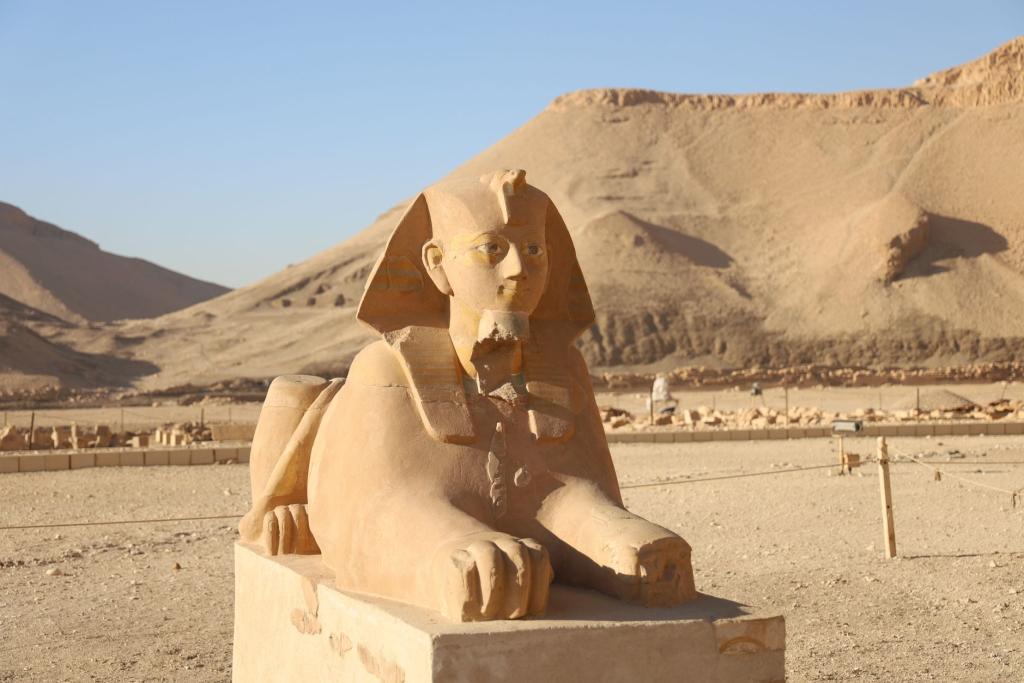
Egypt's Ministry of Tourism and Antiquities announced on October 13, 2026 that rescue excavations in the Nile Delta had uncovered the remains of two colossal royal statues. The dig, in the village of Behbeit el-Hagar in Gharbia Governorate, produced a carved head wearing the double crown of a united Egypt, and part of a back pillar bearing a royal Horus name that names the subject: Ramesses the Great, the 19th-Dynasty king who ruled for more than six decades over three thousand years ago.
The first statue survives as a limestone head measuring about one point six metres tall, according to Heritage Daily, reporting on the Supreme Council of Antiquities announcement. The king wears the pschent, the double crown combining the White Crown of Upper Egypt and the Red Crown of Lower Egypt. Behind the head, archaeologists recovered the upper section of the statue's back pillar, the support carved behind royal figures. That pillar carries the Horus name "Hor Ka Nakht Mery Ma'at," conventionally rendered as "Horus, Strong Bull, Beloved of Ma'at." From the scale of the head, the team estimates the complete monument, base included, once stood roughly eight and a half metres high.
A second royal figure came out of the same ground in more fragmentary form. It survives to a length of about two point four metres, missing its legs and base, but the face is described as remarkably well preserved beneath a striped nemes headdress. Its features closely resemble the first statue, which is why excavators believe it may also portray the same king. That second attribution stays provisional: unlike the first statue, no surviving inscription directly names its subject. A separate block of pink granite, about one point three metres long, carries hieroglyphic titles including "King of Upper and Lower Egypt" and "Son of Ra."
How a farmer's field turned into an excavation
The discovery began without a research plan. A local resident working a plot of land in front of his home struck a stone block covered in carvings and reported it to the Behbeit el-Hagar Antiquities Inspectorate, according to archaeologymag.com. Inspectors confirmed the block was ancient, completed the required legal procedures, and filed an archaeological report. The Supreme Council of Antiquities then formed a committee and dispatched a specialist team to run rescue excavations, which brought both statues and the granite block to light.
That chain, from a chance find to a formal dig, is how a large share of Egypt's archaeology still happens. Farmland in the Delta sits on top of buried settlements, and a single turned-up block can be the first sign of something far larger below. Dr. Hisham El-Leithy, secretary-general of the Supreme Council of Antiquities, said work and archaeological study at the site were continuing, and that the team still needed to establish the statues' original setting and what it meant.
Reading a king's name off the stone
Egyptian kings carried five royal names, and the Horus name was the oldest of the set. Finding it carved on the back pillar gave the team a firm identification rather than a guess: the inscription belongs to the titulary of the pharaoh who reigned from about 1279 to 1213 BC. He is the ruler behind Abu Simbel's rock-cut temples and the Ramesseum, the king whose building programme stretched from Nubia to the Levant across a reign of sixty-six years.
The unanswered questions are the interesting ones. Where did these two statues originally stand, and what building did they guard? Behbeit el-Hagar is best known for its much later Temple of Isis, built centuries after this king's death, so the monuments' relationship to that site is unclear. The second statue's missing inscription means its identity rests on style and resemblance alone, the kind of attribution that can shift as excavation continues.
Why Egypt built its kings this big
Colossal royal sculpture was political technology. A statue nearly nine metres tall did not decorate a temple; it announced who controlled the land, the harvest, and the gods' favour. Ramesses the Great understood that better than almost any ruler of his age. The seated figures at Abu Simbel reach about twenty metres, and the great standing colossus once in Cairo's Ramses Square now greets visitors at the Grand Egyptian Museum. Against that lineage, the Behbeit el-Hagar pair fits a familiar pattern: monuments meant to be seen from far away and remembered for generations.
What makes this find land differently is how ordinary its beginning was. No satellite survey or grant-funded campaign located these statues. A landowner noticed carved stone in his field and called the authorities, and within weeks Egypt had two more royal monuments to study. More than three millennia after the 19th-Dynasty king's death, his image keeps surfacing from the Delta soil, and the excavators say the ground there has not finished speaking. For readers following the story, the next chapter is the dig itself: the team's ongoing work should reveal whether the statues stood together, what structure they belonged to, and how much more of Behbeit el-Hagar's ancient landscape is still buried. More ancient-world finds are collected on our The Old World page.
Comments 0
No comments yet. Be the first to share your thoughts!
Leave a comment
Share your thoughts. Your email will not be published.