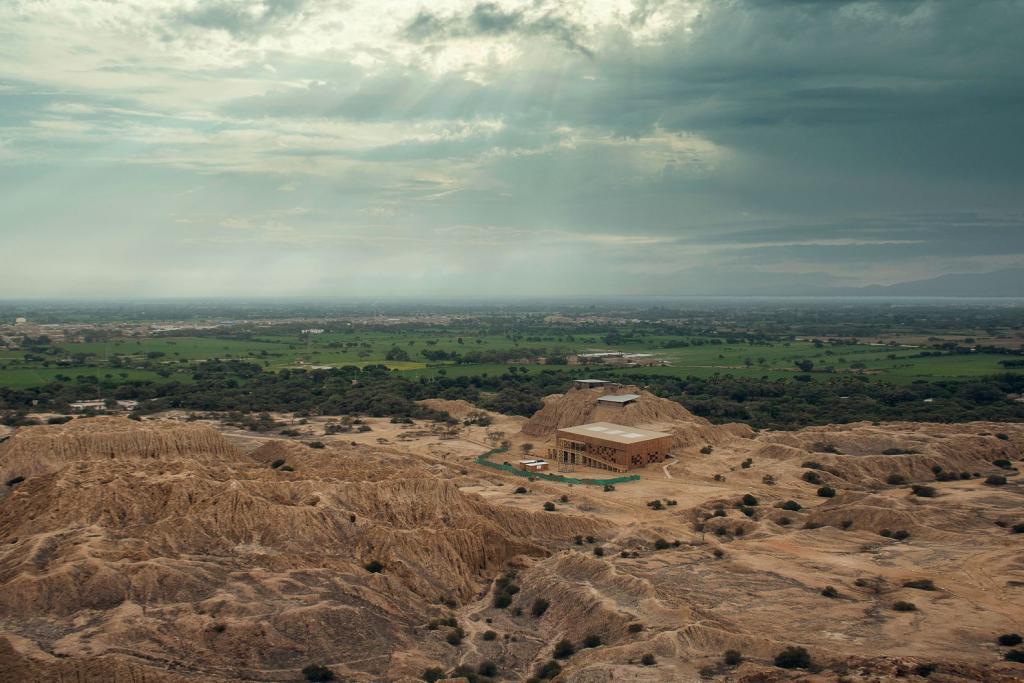
Archaeologists in Mexico have confirmed a remarkable find in the Sierra Norte mountains of Puebla: an ancient solar observatory built as a monumental complex for watching the Sun and tracking important dates in the Mesoamerican calendar. The discovery was announced on October 13 by Mexico's National Institute of Anthropology and History (INAH), which dates the structure to more than two thousand five hundred years ago.
The complex sits at Teteles de Ávila Castillo, also known as Tetelihtic. Researchers reached their conclusion through detailed architectural studies, comparisons with other Mesoamerican ceremonial centers, and careful observations of the Sun's movement across the horizon. The evidence showed that the settlement's inhabitants planned their ceremonial buildings around astronomical events and the prominent features of the surrounding mountain landscape, as Heritage Daily reported.
The timing of the Sun mattered enormously to the people who built the ancient solar observatory. In Mesoamerica, the calendar organized both ritual life and the farming year, and solar observations anchored it. A complex that could pin down key dates gave its community a reliable schedule for planting, harvest festivals, and ceremonies, which made astronomy a practical science long before anyone wrote the word.
A calendar written in stone
The ancient solar observatory dates to the Middle Preclassic period, between approximately 1000 and 600 BC, placing it among the earliest known examples of astronomical architecture in Mesoamerica. The complex belongs to a category known as Group E structures, which archaeologists had previously associated only with the ancient Maya civilization.
According to INAH, the Teteles de Ávila Castillo complex is the first confirmed example of its kind found outside the Maya region. That makes it rare evidence of sophisticated astronomical knowledge among ancient Mesoamerican civilizations beyond the Maya, and it shows the tradition of building sky-aligned ceremonial centers reached further across the region than researchers had documented.
The Maya connection is what gives the find its edge. For years, Group E complexes were treated as a Maya signature, so discovering one in Puebla raises an obvious question: did the idea travel through contact between distant peoples, or did two traditions arrive at the same solution on their own? The ancient solar observatory does not answer that yet, but it forces the question onto the table, and either answer reshapes the map of early American science.
INAH presented the findings as part of its ongoing work documenting Mexico's archaeological heritage. The announcement puts Teteles de Ávila Castillo on a short list of places where the built environment itself served as a scientific instrument, and the ancient solar observatory gives Puebla a new claim in the deep history of astronomy.
Skywatchers without telescopes
Ancient observatories worked without lenses or instruments. Skywatchers marked where the Sun rose against fixed points on the horizon, and aligned buildings gave them reliable reference lines for following its annual cycle. Because those dates organized planting and ritual life, the architecture doubled as a timekeeping tool. The ancient solar observatory at Tetelihtic shows its builders treated the sky as something worth engineering around.
There is a quiet thrill in how ordinary the method was. No advanced technology was required, only patience, clear sightlines, and generations of record-keeping. The builders chose their site with the mountains in mind, folding the landscape itself into the instrument. That kind of planning suggests the observatory was a communal project, maintained across lifetimes rather than built in a single burst of effort.
The announcement continues a busy season for archaeology. French researchers recently catalogued a remarkable hoard of Roman dice from an ancient settlement (see the Roman dice discovery), Moroccan teams traced what may be North Africa's oldest defensive wall (the Oued Beht wall), and divers in Germany recovered Mesolithic timbers preserved beneath a lake (the Mesolithic lake timbers).
For now, the ancient solar observatory at Teteles de Ávila Castillo stands as the earliest known astronomical structure of its type outside the Maya world. Its stones tracked the Sun long before telescopes existed, and they still mark the dates that mattered to the people who raised them.
Comments 0
No comments yet. Be the first to share your thoughts!
Leave a comment
Share your thoughts. Your email will not be published.